
1. Making Life Meaningful with Vows
Taking the eight Mahayana precepts is another way to make life meaningful, to take its essence all day and night, by taking vows. It is so simple. It is just for one day. It makes it so easy. It’s not for a lifetime. We have an unbelievable fortune to take the eight Mahayana precepts, which are just for one day; it has skies of merit and is an unbelievable purification. (Lama Zopa Rinpoche)
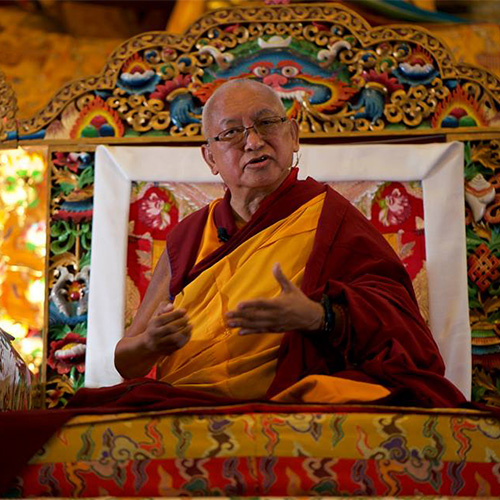
Photo: Bill Kane, Kopan Monastery, Nepal, 2016
Taking the Eight Mahayana Precepts at Kopan
Whether you can become enlightened in this life or be liberated from samsara in this life depends on the root, or foundation, of the higher training in morality. That is the basic thing. Special insight, lhagtong, depends on the higher training in concentration, and that depends on the higher training in morality. That is the very base, the foundation. [That is taken] from sutra. Morality is the basis; it is like the earth. For living beings and nonliving things – that which is moving and immovable – the earth is the foundation. Morality is like that, so one should hold and keep it. This is the foundation for all the qualities, the basis on which you achieve all the qualities up to enlightenment. So hold it, keep it firmly, because it is what makes life most meaningful.
The eight Mahayana precepts[1] have unbelievable benefits, so we have been very fortunate in the organization (FPMT). [The practice of taking them] started from the early times at Kopan. I don’t remember if the eight Mahayana precepts were taken during the first Kopan course, but maybe the second course. At that time, I was taking the eight Mahayana precepts often, so it started then that, during the one-month course, we would take the eight Mahayana precepts for two weeks.
That was fantastic. It is fantastic to be able to offer that chance to sentient beings, to the people who come to the course. It is not only about sitting cross-legged in meditation, not only that. Sitting happens in many parts of the world. Many people do that external [behavior]. But over one month for two weeks, to do this and keep them very strictly, having only one meal, I think is fantastic. There is so much to enjoy in this life and the next lives up to enlightenment. Can you imagine hundreds and thousands of lifetimes of enjoyment in the deva and human realms, in a pure land, up to enlightenment? Also, since the vow is taken with bodhichitta, it becomes the cause to achieve enlightenment.
That we give this opportunity to sentient beings, to people, began from Kopan in the early times. That is really yum-yum. I think that is a really wonderful thing. It is the best gift to sentient beings that we do that, wow. It is most fantastic. It makes life meaningful. It is unbelievable. It’s an unbelievable cause to achieve the realizations of the path, nirvana and enlightenment, to achieve all the buddha’s qualities, the limitless skies of qualities of a buddha’s body, speech, and mind. This is due to Lama’s kindness; Lama Yeshe was kinder than all the three time buddhas.
I think Kyabje Serkong Rinpoche is the one who inspired us to do Nyung Nä and the eight Mahayana precepts. Rinpoche did like that. Rinpoche tried to explain the Chenrezig mandala to us and inspired us to do Nyung Nä, so we began doing Nyung Nä in Lawudo. Rinpoche gave [teachings on] the whole entire text, the kriya tantric text, Cha Gyu Pädma Karpo (Kriya Tantra White Lotus), a huge text of extensive teachings on kriya tantra, and an elaborate commentary on Nyung Nä, which I thought to translate. Now, I have received all of the lineage. With the oral transmission from Kyongla Rato Rinpoche, the lineage has now been received.
So, we’re able to make life unbelievably meaningful by creating the cause to achieve all the happiness up to enlightenment, to achieve buddhahood, sooner or later.
Each person who takes vows brings so much benefit to the world. Remember the story of the four harmonious brothers. In India, in Kashyaka, there was great success: the rains came at the right time and the crops grew. There was plenty. The king thought, “I did it.” The ministers thought, “I did it.” The leaders thought, “I did it.” One day they gathered together and a minister suggested that they go to ask a sage with clairvoyance. They went to see the sage and asked, “Who caused this development of the country, the king or the ministers? Then the sage said, “None of you. It was four animals living harmoniously in the forest.”
There was an elephant who spread the five vows to other elephants; a monkey who spread the five vows to other monkeys; a rabbit to other rabbits; and a bird to other birds. Then, there was respect for others. The vows spread in the forest and because of that the place developed economically. Actually, they were all embodiments, for example, the bird was Guru Shakyamuni Buddha. I’m not sure about the other three, but one was Ananda, the Buddha’s relative and attendant. That is one story about how [taking and keeping vows] helps the world to have peace and to grow economically. Incredible peace and happiness in the world is received. Besides human beings, the devas and nagas also receive much happiness from that.
Making Life Meaningful With Vows
(duration: 6 minutes)
Transcript of Video 1: “The Merit of Keeping Just One Vow”
(You can read the transcript of the video below. Alternatively, you can read the same transcript alongside the video by clicking here to download it or view it in a separate window.)
(Rinpoche cites a quotation in Tibetan) This quotation is very important to keep in your prayer book, in your diarrhea.
Student: Diary.
Rinpoche (joking): Not diarrhea?
Recite this verse of the Buddha's words from the Sutra of the King of Concentration a few times, while kneeling down, in order to inspire you to be able to live in the ordination and to continue to purify:
For ten billion eons equaling the number of sand grains in the Pacific Ocean, if one offers umbrellas, flags, garlands of light offerings, food, and drink with a calm mind, or offers service to one hundred billion times ten million buddhas; when the holy Dharma has become extremely perished and the teachings of the One Gone to Bliss have stopped, somebody who is enjoying [living in] one vow for one day or night, this merit is particularly more exalted than having made all those offerings.[2]
For eons, how many eons? “Ten million eons.” Then, “equaling the number of the sand grains of the Ganga.” This “Ganga” could be the River Ganga in India, but not always. When we talk about the benefits of bodhichitta, they use the example of the Ganga, but it is not the River Ganga, they are talking about the Pacific Ocean, the number of sand grains of that. I haven’t seen in a commentary, specifically, whether [here] it is talking about the Pacific Ocean or the River Ganga, but even if it is just the River Ganga, the number of sand grains is immeasurable. When I talk about even one handful of sand, the number is immeasurable; so remember that. Ten million eons, “For ten million eons, the number of sand grains of the Ganga,” so that is amazing. It is infinite. This gives an idea of the [amount of] time.
(Rinpoche cites a quotation in Tibetan) “With a calm mind, one offers food and drink, umbrellas, banners, lines of light offerings.” This is to give some idea of the offerings. So, “you offer them to the buddhas.” How many buddhas? “Ten million buddhas.” Sanggye chewa. But to how many [times] ten million buddhas? One tragtrig [1011], one hundred billion, I think. Ten times one hundred million is a terbum [109], ten terbum are a ‘great terbum’ [1010], ten great terbum are one tragtrig [1011]. So how much is it? Ten great terbum are one tragtrig. Ten million buddhas by how many? Ten great terbum; that is one tragtrig [1011] – to that many buddhas. Can you imagine the number? It is amazing. For that much time, that many offerings, to that many buddhas; that is what it says.
Then, compared to that, there is no comparison to somebody who, when the Dharma is degenerating or stopping, lives in one vow, one precept, day and night – the merits are far more greater. These merits are far more greater than those others. Can you imagine for that many eons making that many offerings to that many buddhas? Now that becomes very small compared to living in one vow for one day. These merits are far more greater than all those others. That is the essence of why it is important to take the eight Mahayana precepts. And there are eight; there is not just one.
[End of Video 1: “The Merit of Keeping Just One Vow”]
Taking the eight Mahayana precepts is another way to make life meaningful, to take its essence all day and night, by taking vows. It is so simple. It is just for one day. Just for one day. It makes it so easy. It’s not for a lifetime. Of course, you can take the eight Mahayana precepts for a lifetime, if someone wishes to. As a lay person, you can live in the five lay vows until the time of death; if not five vows, then four, if not four, then three. Then, you can take the eight Mahayana precepts . We have an unbelievable fortune to take the eight Mahayana precepts , which are just for one day; it has skies of merit and is an unbelievable purification.
I mentioned the quotation from Sutra of the King of Concentration about keeping even one vow for one day, about how much merit, good karma, you collect. Don’t disregard that. The Buddha said this and I said to write this down in your notebook, in your “diarrhea book,” to remind you. Otherwise, you heard what the lama said but you didn’t understand it completely, so you did not make what the lama said useful. You didn’t even get the whole idea. That quotation is so precious.
Kyabje Ribur Rinpoche kept that quotation in his notebook. One time, we did Vajrayogini self-initiation in his house, and when it finished, at the end, he showed us this quotation. There were a few of us there and he showed us this quotation. Of course, he himself did not need this; he was beyond this. A buddha does not need vows; since there is no delusion, no hallucinated mind, not even subtle defilements, there is no harm to sentient beings. A buddha doesn’t need them.
It is very important to keep that quotation in your house, on your altar, in the dining room, or in your office. Write it down with nice handwriting and put it on the altar, or in your prayer book, wherever. It is very good to have Dharma messages or instructions posted around the house as a reminder.
The eight Mahayana precepts are for both lay and ordained persons. An ordained person, a monk or nun, normally takes the pratimoksha vows for a lifetime until death, whereas the bodhisattva vows are taken until enlightenment. However, even if one is able to keep the major pratimoksha vows, the basic vows, one is unable to keep the branch vows pure for a whole lifetime. But as the eight Mahayana precepts are taken just for one day, that day you must keep them very purely, as much as possible, not half and half or taking the vows and then not being sure that every single one is practiced. Don’t make it like soup or salad. Make sure everything is kept pure. Taking the eight Mahayana precepts , by which you fast and so forth, also helps you keep pure the usual daily vows that you have taken.
When you think about making your life meaningful, one extremely important way is that [of taking vows]. You must write down that key thing and make sure you get it done. Don’t miss it. Otherwise, life is distracted by this and that. It goes on like that. It depends on how many distractions one has. It depends on how much worldly concern one has. It depends on how much you become a friend of worldly concern. It depends on that, how much distraction there is in life, not allowing you to practice Dharma, making you unable to practice Dharma. Sooner or later one day, death comes. Everyday there is distraction and then, suddenly, one day death comes. Life totally changes – there is a total change at the house. Life is something else; it totally changes. When you’re about to die, there is no time. No matter how much you regret, “I shouldn’t have done this or that,” all the sadness, “I should have done many retreats,” “I should have abandoned this and lived in the pure Dharma.” This [thought] comes, but then there is no time. One is filled with unbelievable sadness and worried about the lower realms, about what will happen after this. The karma expresses that feeling.
This is true even for a non-believer, one who doesn’t believe in reincarnation and karma. Intellectually you don’t believe in them, but near the time of death there is the feeling that “something very terrible is going to happen to me,” even though intellectually you don’t believe in reincarnation or karma. I have seen people like that. That happens not only when death comes to you, but also when you see a family member, a relative or parent, die. That makes you discover. It makes you think of life, of your life. This is what happens. The person is suddenly changed; that makes you see your life. It makes you think, “Now I should not engage in negative karma and distraction. I should live in pure Dharma.” When you see a family member die in the house, it reminds you of pure Dharma.