Chapters 1-4 of Lama Zopa Rinpoche's Teachings
| Site: | FPMT Online Learning Center |
| Curso: | The Eight Mahayana Precepts |
| Livro: | Chapters 1-4 of Lama Zopa Rinpoche's Teachings |
| Impresso por: | Invitado |
| Data: | domingo, 11 out. 2026, 20:16 |
1. Making Life Meaningful with Vows
Taking the eight Mahayana precepts is another way to make life meaningful, to take its essence all day and night, by taking vows. It is so simple. It is just for one day. It makes it so easy. It’s not for a lifetime. We have an unbelievable fortune to take the eight Mahayana precepts, which are just for one day; it has skies of merit and is an unbelievable purification. (Lama Zopa Rinpoche)
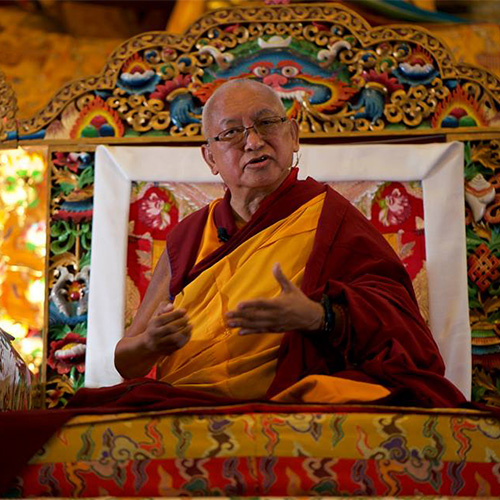
Photo: Bill Kane, Kopan Monastery, Nepal, 2016
Taking the Eight Mahayana Precepts at Kopan
Whether you can become enlightened in this life or be liberated from samsara in this life depends on the root, or foundation, of the higher training in morality. That is the basic thing. Special insight, lhagtong, depends on the higher training in concentration, and that depends on the higher training in morality. That is the very base, the foundation. [That is taken] from sutra. Morality is the basis; it is like the earth. For living beings and nonliving things – that which is moving and immovable – the earth is the foundation. Morality is like that, so one should hold and keep it. This is the foundation for all the qualities, the basis on which you achieve all the qualities up to enlightenment. So hold it, keep it firmly, because it is what makes life most meaningful.
The eight Mahayana precepts[1] have unbelievable benefits, so we have been very fortunate in the organization (FPMT). [The practice of taking them] started from the early times at Kopan. I don’t remember if the eight Mahayana precepts were taken during the first Kopan course, but maybe the second course. At that time, I was taking the eight Mahayana precepts often, so it started then that, during the one-month course, we would take the eight Mahayana precepts for two weeks.
That was fantastic. It is fantastic to be able to offer that chance to sentient beings, to the people who come to the course. It is not only about sitting cross-legged in meditation, not only that. Sitting happens in many parts of the world. Many people do that external [behavior]. But over one month for two weeks, to do this and keep them very strictly, having only one meal, I think is fantastic. There is so much to enjoy in this life and the next lives up to enlightenment. Can you imagine hundreds and thousands of lifetimes of enjoyment in the deva and human realms, in a pure land, up to enlightenment? Also, since the vow is taken with bodhichitta, it becomes the cause to achieve enlightenment.
That we give this opportunity to sentient beings, to people, began from Kopan in the early times. That is really yum-yum. I think that is a really wonderful thing. It is the best gift to sentient beings that we do that, wow. It is most fantastic. It makes life meaningful. It is unbelievable. It’s an unbelievable cause to achieve the realizations of the path, nirvana and enlightenment, to achieve all the buddha’s qualities, the limitless skies of qualities of a buddha’s body, speech, and mind. This is due to Lama’s kindness; Lama Yeshe was kinder than all the three time buddhas.
I think Kyabje Serkong Rinpoche is the one who inspired us to do Nyung Nä and the eight Mahayana precepts. Rinpoche did like that. Rinpoche tried to explain the Chenrezig mandala to us and inspired us to do Nyung Nä, so we began doing Nyung Nä in Lawudo. Rinpoche gave [teachings on] the whole entire text, the kriya tantric text, Cha Gyu Pädma Karpo (Kriya Tantra White Lotus), a huge text of extensive teachings on kriya tantra, and an elaborate commentary on Nyung Nä, which I thought to translate. Now, I have received all of the lineage. With the oral transmission from Kyongla Rato Rinpoche, the lineage has now been received.
So, we’re able to make life unbelievably meaningful by creating the cause to achieve all the happiness up to enlightenment, to achieve buddhahood, sooner or later.
Each person who takes vows brings so much benefit to the world. Remember the story of the four harmonious brothers. In India, in Kashyaka, there was great success: the rains came at the right time and the crops grew. There was plenty. The king thought, “I did it.” The ministers thought, “I did it.” The leaders thought, “I did it.” One day they gathered together and a minister suggested that they go to ask a sage with clairvoyance. They went to see the sage and asked, “Who caused this development of the country, the king or the ministers? Then the sage said, “None of you. It was four animals living harmoniously in the forest.”
There was an elephant who spread the five vows to other elephants; a monkey who spread the five vows to other monkeys; a rabbit to other rabbits; and a bird to other birds. Then, there was respect for others. The vows spread in the forest and because of that the place developed economically. Actually, they were all embodiments, for example, the bird was Guru Shakyamuni Buddha. I’m not sure about the other three, but one was Ananda, the Buddha’s relative and attendant. That is one story about how [taking and keeping vows] helps the world to have peace and to grow economically. Incredible peace and happiness in the world is received. Besides human beings, the devas and nagas also receive much happiness from that.
Making Life Meaningful With Vows
(duration: 6 minutes)
Transcript of Video 1: “The Merit of Keeping Just One Vow”
(You can read the transcript of the video below. Alternatively, you can read the same transcript alongside the video by clicking here to download it or view it in a separate window.)
(Rinpoche cites a quotation in Tibetan) This quotation is very important to keep in your prayer book, in your diarrhea.
Student: Diary.
Rinpoche (joking): Not diarrhea?
Recite this verse of the Buddha's words from the Sutra of the King of Concentration a few times, while kneeling down, in order to inspire you to be able to live in the ordination and to continue to purify:
For ten billion eons equaling the number of sand grains in the Pacific Ocean, if one offers umbrellas, flags, garlands of light offerings, food, and drink with a calm mind, or offers service to one hundred billion times ten million buddhas; when the holy Dharma has become extremely perished and the teachings of the One Gone to Bliss have stopped, somebody who is enjoying [living in] one vow for one day or night, this merit is particularly more exalted than having made all those offerings.[2]
For eons, how many eons? “Ten million eons.” Then, “equaling the number of the sand grains of the Ganga.” This “Ganga” could be the River Ganga in India, but not always. When we talk about the benefits of bodhichitta, they use the example of the Ganga, but it is not the River Ganga, they are talking about the Pacific Ocean, the number of sand grains of that. I haven’t seen in a commentary, specifically, whether [here] it is talking about the Pacific Ocean or the River Ganga, but even if it is just the River Ganga, the number of sand grains is immeasurable. When I talk about even one handful of sand, the number is immeasurable; so remember that. Ten million eons, “For ten million eons, the number of sand grains of the Ganga,” so that is amazing. It is infinite. This gives an idea of the [amount of] time.
(Rinpoche cites a quotation in Tibetan) “With a calm mind, one offers food and drink, umbrellas, banners, lines of light offerings.” This is to give some idea of the offerings. So, “you offer them to the buddhas.” How many buddhas? “Ten million buddhas.” Sanggye chewa. But to how many [times] ten million buddhas? One tragtrig [1011], one hundred billion, I think. Ten times one hundred million is a terbum [109], ten terbum are a ‘great terbum’ [1010], ten great terbum are one tragtrig [1011]. So how much is it? Ten great terbum are one tragtrig. Ten million buddhas by how many? Ten great terbum; that is one tragtrig [1011] – to that many buddhas. Can you imagine the number? It is amazing. For that much time, that many offerings, to that many buddhas; that is what it says.
Then, compared to that, there is no comparison to somebody who, when the Dharma is degenerating or stopping, lives in one vow, one precept, day and night – the merits are far more greater. These merits are far more greater than those others. Can you imagine for that many eons making that many offerings to that many buddhas? Now that becomes very small compared to living in one vow for one day. These merits are far more greater than all those others. That is the essence of why it is important to take the eight Mahayana precepts. And there are eight; there is not just one.
[End of Video 1: “The Merit of Keeping Just One Vow”]
Taking the eight Mahayana precepts is another way to make life meaningful, to take its essence all day and night, by taking vows. It is so simple. It is just for one day. Just for one day. It makes it so easy. It’s not for a lifetime. Of course, you can take the eight Mahayana precepts for a lifetime, if someone wishes to. As a lay person, you can live in the five lay vows until the time of death; if not five vows, then four, if not four, then three. Then, you can take the eight Mahayana precepts . We have an unbelievable fortune to take the eight Mahayana precepts , which are just for one day; it has skies of merit and is an unbelievable purification.
I mentioned the quotation from Sutra of the King of Concentration about keeping even one vow for one day, about how much merit, good karma, you collect. Don’t disregard that. The Buddha said this and I said to write this down in your notebook, in your “diarrhea book,” to remind you. Otherwise, you heard what the lama said but you didn’t understand it completely, so you did not make what the lama said useful. You didn’t even get the whole idea. That quotation is so precious.
Kyabje Ribur Rinpoche kept that quotation in his notebook. One time, we did Vajrayogini self-initiation in his house, and when it finished, at the end, he showed us this quotation. There were a few of us there and he showed us this quotation. Of course, he himself did not need this; he was beyond this. A buddha does not need vows; since there is no delusion, no hallucinated mind, not even subtle defilements, there is no harm to sentient beings. A buddha doesn’t need them.
It is very important to keep that quotation in your house, on your altar, in the dining room, or in your office. Write it down with nice handwriting and put it on the altar, or in your prayer book, wherever. It is very good to have Dharma messages or instructions posted around the house as a reminder.
The eight Mahayana precepts are for both lay and ordained persons. An ordained person, a monk or nun, normally takes the pratimoksha vows for a lifetime until death, whereas the bodhisattva vows are taken until enlightenment. However, even if one is able to keep the major pratimoksha vows, the basic vows, one is unable to keep the branch vows pure for a whole lifetime. But as the eight Mahayana precepts are taken just for one day, that day you must keep them very purely, as much as possible, not half and half or taking the vows and then not being sure that every single one is practiced. Don’t make it like soup or salad. Make sure everything is kept pure. Taking the eight Mahayana precepts , by which you fast and so forth, also helps you keep pure the usual daily vows that you have taken.
When you think about making your life meaningful, one extremely important way is that [of taking vows]. You must write down that key thing and make sure you get it done. Don’t miss it. Otherwise, life is distracted by this and that. It goes on like that. It depends on how many distractions one has. It depends on how much worldly concern one has. It depends on how much you become a friend of worldly concern. It depends on that, how much distraction there is in life, not allowing you to practice Dharma, making you unable to practice Dharma. Sooner or later one day, death comes. Everyday there is distraction and then, suddenly, one day death comes. Life totally changes – there is a total change at the house. Life is something else; it totally changes. When you’re about to die, there is no time. No matter how much you regret, “I shouldn’t have done this or that,” all the sadness, “I should have done many retreats,” “I should have abandoned this and lived in the pure Dharma.” This [thought] comes, but then there is no time. One is filled with unbelievable sadness and worried about the lower realms, about what will happen after this. The karma expresses that feeling.
This is true even for a non-believer, one who doesn’t believe in reincarnation and karma. Intellectually you don’t believe in them, but near the time of death there is the feeling that “something very terrible is going to happen to me,” even though intellectually you don’t believe in reincarnation or karma. I have seen people like that. That happens not only when death comes to you, but also when you see a family member, a relative or parent, die. That makes you discover. It makes you think of life, of your life. This is what happens. The person is suddenly changed; that makes you see your life. It makes you think, “Now I should not engage in negative karma and distraction. I should live in pure Dharma.” When you see a family member die in the house, it reminds you of pure Dharma.
[1] The eight Mahayana precepts are eight vows that are taken for the period of a single day. The eight vows are to: (1) abandon killing, (2) abandon stealing, (3) abandon sexual activity, (4) abandon lying, (5) abandon intoxicating substances, (6) abandon sitting on large or high seat or beds, (7) abandon eating at the wrong time (after noon), and (8) abandon perfumes, wearing garlands and ornaments, and singing, dancing, and playing music.
[2] From The FPMT Retreat Prayer Book, 2016:
Though you offer service with a calm mind to
One hundred billion times ten million buddhas,
With food and drink, umbrellas, flags, and garlands of light offerings,
For ten million eons equaling the number of sand grains in the Pacific Ocean,
The merit of someone enjoying living in one vow for one day and night,
When the holy Dharma is degenerating
And the teachings of the One Gone to Bliss are ceasing,
Is particularly more exalted than that.
2. Specific Benefits of the Individual Precepts
These benefits will not only come in future lives. When the karma is powerful, changes can happen even in this life, so don’t think that karma begins only after this life and there is nothing you can experience in this life. (Lama Zopa Rinpoche)
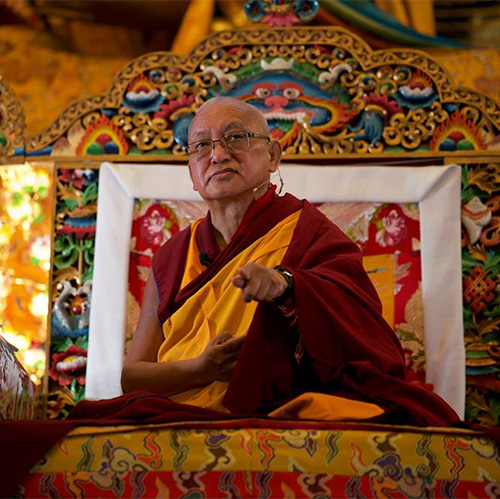
Photo: Bill Kane, Kopan Monastery, Nepal, 2016
Living in these eight precepts means abstaining from eight negative karmas that harm you and other sentient beings, directly or indirectly. You can understand that abstaining from these eight negative karmas naturally becomes a source of happiness. It is a root of happiness for you and for other sentient beings.
Explanations are given of the general benefits of the eight precepts and of the specific benefits of the individual precepts. From those two, today we will concentrate on the specific benefits of the individual vows.
The benefits of avoiding taking the lives of others, that is, killing: This is the basic cause of long life; you will live long and not have sicknesses in all your future lives. No matter how many hospitals you visit and how many treatments you get, if you haven’t created good karma from your side, for example, by living in the morality of abstaining from killing or harming others, you cannot have a long life no matter how many hospitals and health organizations and medicines exist. No matter how many hospitals, doctors, and medicines there are in the world, having a long life is based on first having good karma. It is all based on morality. There has to be good karma from the side of the person. Without this, no matter what is set up externally, nothing can help give someone a long life. External factors can help only on the basis of the person having good karma, such as that from practicing the morality of abstaining from killing.
Many diseases are based on this negative karma of killing, including even the inability to digest food. Many people have problems with their digestion throughout their whole life. This sickness is not the only one caused by the negative karma of killing; it is one of many. This is mentioned in the Tenth Bhumi Sutra.
Another benefit of abstaining from killing is that you become glorious, or magnificent, now and in the future. These good results are not related only to future lives; when the karma is powerful, it can also affect this life. You become glorious, or radiant, similar to the way we see His Holiness the Dalai Lama or we saw His Holiness Ling Rinpoche.
The benefits of avoiding taking what has not been given, or stealing. In all lifetimes, you will have perfect enjoyments and will receive them effortlessly. You will receive things just by wishing for them. Also, no one will interfere with your enjoyments by confiscating or stealing them.
These benefits will not only come in future lives. When the karma is powerful, changes can happen even in this life, so don’t think that karma begins only after this life and there is nothing you can experience in this life. For example, at the beginning you might be able to make very few or very poor quality offerings, but as you continue the practice of making offerings to holy objects or of making charity to other sentient beings, you are gradually able to make more extensive and better quality offerings and more extensive charity. As a result of your good karma, you can have perfect enjoyments, so your offerings to the merit field and your charity to others can become better and better and more and more extensive. Because you created the cause through your previous small offerings and small acts of charity, sooner or later in this life, you can make better and more extensive offerings.
Kadampa Geshe Potowa, I think it was, explained this in relation to the offering of incense. At the beginning, he offered incense using a plant that grows on high mountains; it looks like hair and has a very nice scent. Because he offered this incense to holy objects, later he gained many advantages and was able to make better and more extensive offerings of incense. This is an example of how karma works, of how your life can become better even in the immediate future.
The benefits of living in the morality of abstaining from the sexual act. The eight precepts of the Lesser Vehicle path refer to abstaining from any sexual misconduct, but here in the eight Mahayana precepts it is any sexual act. The benefits of living in this vow are that in all lifetimes you will have a beautiful body and a beautiful complexion. I guess this will save a lot of expense on cosmetics and plastic surgery. You won’t need to have a big operation on your face to straighten this bit and stretch that bit back and forth. I heard that it’s very expensive! Keeping this precept will also incidentally save you a lot of money. The only problem is perhaps that it will cause other people to lose their jobs. There won’t be any need for shops full of cosmetics, for all those billions of different cosmetics in different colors. Anyway, I’m joking.
Another benefit is that you will have perfect sense organs. When we know the benefits, we can automatically understand that if someone has some physical disability, it is a result of not having practiced this or that morality. When you hear about the shortcomings of the complete ten non-virtuous actions, you naturally understand the good results that you will achieve through living in the morality of the ten virtues. By hearing about the positive results, the benefits, of living in the precepts, you come to know the causes of various problems such as being born with an imperfect or ugly body, with missing limbs or imperfect senses.
Physical disabilities cannot be explained simply by an imperfect egg or sperm, as scientists tend to do. That is just a condition for the problem, not its main cause. There might be an imperfect egg, with some cells missing or something, but you need to explain why the imperfect egg happens. The answer is incomplete. Even though the cause is traced back to a defective egg or sperm, this is not the final answer because it is talking only about the physical condition. We are still left with the question, “But what causes the defective egg?” Here, by understanding the benefits of abstaining from the sexual act, you come to know its opposite, the result of sexual misconduct or the sexual act that becomes negative karma.
The benefits of abstaining from telling lies. In all lifetimes you will not be cheated by others. In our daily lives, whenever we find that somebody has cheated us, we should immediately remember that we are experiencing the result of having told lies in the past. Rather than just becoming upset and angry and making ourselves unhappy, and rather than putting all the blame on someone else, we should think, “This is the result of my past negative karma of telling lies.”
In this way, our delusions – the three poisonous minds of ignorance, anger, and attachment – and our negative karmas become only inspirations; they remind us that from now on we should be careful in our practice of morality, that we should practice the morality of abstaining from telling lies. When we encounter problems in our life, remembering the cause that we created in the past only encourages us; it gives us the strong determination to abandon creating the cause of the problems. We resolve, “From now on I will not create the cause of this problem. Instead I will create its opposite, the cause of happiness.”
Another benefit of abstaining from lying is that everyone values our speech, everyone believes what we say. In our daily lives, when we say something and other people don’t listen to or don’t believe us, when our speech is powerless, we should realize that this is the result of our past negative karma of telling lies. This sometimes happens in our daily lives. The other way around is that someone who normally doesn’t listen to others, somehow has to accept a particular person’s request, even though it is a difficult one. This is because that particular person has power in his speech. He comes in, asks for something, and somehow the other person naturally has to accept. There is a reason for this; it comes from the past good karma that person created by living in the morality of abstaining from telling lies.
The benefits of abstaining from drinking alcohol. In all lifetimes you will have a great memory. This can be to do with past lives, but I also think you can tell that much of it is the result of this life. The memory of a person who lives in pure vows is very clear. Take Geshe Sopa Rinpoche as an example. There are eight prayers, including The King of Prayers, Praise to Maitreya Buddha, and a prayer to be born in Maitreya’s pure land, that are normally recited for others. Geshe-la said that he had not recited those eight prayers since leaving Tibet, which was about forty years ago, [but still he remembered them]. In Tibet, those prayers are recited every day when all the monks do puja in an assembly. When I was in Madison for the commentary on great insight, it happened a few times that a Tibetan or Western person passed away and Geshe Sopa Rinpoche was asked to pray for them. I respected very much the way that Geshe-la took care of each request very precisely. I thought it was fantastic. He paid very special attention when he was requested to pray for someone who had died. He called the monks who were around and had everyone pray together in his room. This is fantastic, because there is a lot of benefit for the people who have passed away. Because those praying, principally Geshe-la himself but also the other geshes, were all living in pure vows, their prayers had a lot of power.
One of the people Geshe-la did prayers for was a Tibetan man who used to take tourists to the very high mountains in Nepal. I think he died when his airplane crashed. He was a very good man with a big family; it seems that everyone loved him very much because he was so kindhearted. I think that his daughter has some association with the Hyatt Hotel in Chicago. After he finished reciting the eight prayers, Geshe-la said, “I haven’t recited these prayers since I left Tibet, but I can remember all of them!” I mean, forty years is a long time.
The point I am trying to make is that it seems that a good memory is the result [of abandoning alcohol] not only in past lives but in this life. The way you live your life has an immediate effect on your mind. There can be a positive result even in this life, if you live in morality in the earlier part of your life. Other benefits of living in the morality of abstaining from alcohol, of abandoning alcohol, are that all your senses become clear and that you have perfect wisdom.
Many people become like vegetables later in life; they are not dead but they are unable to function. It could be the result of past karma, but I think much of it has to do with the karma of this life, with how they lived earlier on in this life. If you study how these people lived, if you analyze their attitudes and their behavior, you might be able to see how this particular problem happened. Otherwise, there is no way to explain it without knowing karma. There is no way to explain it.
The benefits of avoiding sitting on high or expensive thrones and beds. This means sitting on such a throne or bed without a Dharma reason, without the thought to benefit others or to show respect for the teachings. Sitting on high or expensive thrones and beds with a motivation of attachment clinging to this life, out of pride and so forth, becomes negative karma. Here, “high” means higher than a cubit.
By living in this vow, you will always be praised and respected by others. In this way, you will be able to benefit others. When others praise and respect you, you can bring them into Dharma, into the path to enlightenment. Also, especially if you are a bodhisattva or an ordained person, praising and respecting you helps others create good karma. Another benefit is that you will have many enjoyments, such as comfortable bedding and animals to ride when you travel. The text says specifically that you receive many things to ride on, which means animals, but I think you can include other vehicles such as cars and airplanes.
The benefits of avoiding eating at the wrong time. In all lifetimes you will have perfect crops and you will receive food and drink without any effort. Difficulty in obtaining the means of living comes from not having practiced the morality of abstaining from eating at the wrong time in the past and from eating with attachment. [When one takes the eight Mahayana precepts for a single day, the vow is to eat one meal only, in one sitting, and to finish it before midday.]
The benefits of avoiding perfumes and wearing garlands and ornaments. In all lifetimes your body will have a scented smell; not a scented smell from a shop, but one that comes naturally from the body. I remember in Solu Khumbu when I was very young, there was a small incarnate lama with a naturally scented smell. It made a strong impression on my mind. You also notice this smell when you meet some lamas. It is not like the smell of perfume; it is a holy kind of smell.
Different scents, such as manufactured perfumes, have different effects on the mind. Some perfumes make you feel serene and peaceful; others have the opposite effect, causing you to generate attachment.
Other benefits are that your body will have a good color, a beautiful shape, and many special signs similar to those of the bodies of holy beings.
The benefits of living in the vow of avoiding singing, dancing, and playing music. In all lifetimes you will have subdued conduct, with a very subdued mind and body. The sound of Dharma will also come continuously from you. We can meet people like this in our daily life; when they talk, the Dharma always comes out in their conversation. However, this could also refer to reciting prayers and mantras.
3. His Holiness’ Motivation for Taking the Precepts
Now, every sentient being in your heart is the dearest, most kind, precious one. Therefore, any service you can offer, even a little service you can offer to anybody, even to an insect drowning in water or to a person, whatever small service you can offer is the happiest thing in life. Then, not only to cause them the happiness of this life, but more importantly to cause them the happiness of future lives, then more importantly to cause them liberation from samsara. Then the most beneficial is to bring them to enlightenment. To do that one must attain enlightenment, therefore I am going to take the eight Mahayana precepts. (Lama Zopa Rinpoche)
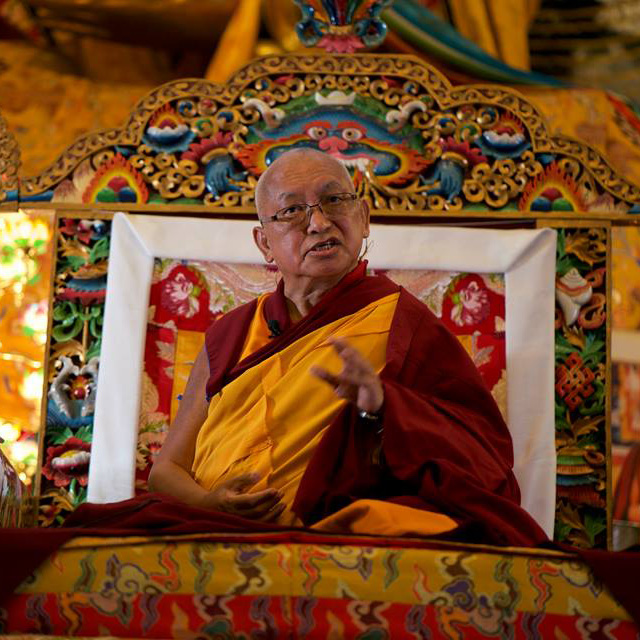
Photo: Bill Kane, Kopan Monastery, Nepal, 2016
I thought to read the motivation that His Holiness taught one time in Dharamsala, when He gave the eight Mahayana precepts outside the temple. It was a very effective motivation, so I got the tape and wrote it down. After listening to that, now I’ve forgotten it, but at that time, after the motivation, my mind very much thought of others; it had changed. Of course, it was not an actual realization, but a blessing. Then I didn’t put any more effort into it, but still I am thinking to do that motivation.
The Real I Taking the Precepts is Not There
Oneself and all sentient beings have been suffering in samsara from beginningless rebirths because of a wrong concept. While there is no self inside this body, while this body is not the self, nor is the mind the self… Or it can be done by way of elaborating with the five aggregates, the aggregate of form and so on: the aggregate of form is not the I; the aggregate of feeling is not the self; the aggregate of cognition,[1] dushe kyi pungpo, is not the I, it is not the self; duche kyi pungpo, the compounding aggregate, [is not the I]. “Compounding” is the translation of the word duche. From the fifty-one mental factors you take out the two of feeling and cognition, so there are forty-nine left and these mental factors are called “compounding aggregates” because they compound the result. We must make it clear, that duche is compounding phenomena. The other duche is causative phenomena, but this one is compounding phenomena as it is compounding or producing its result. We need to make the translation more precise.
Then consider the aggregate of consciousness is not the I. None of them individually is the self and all of them together are not the self. The aggregates individually are not the I; nor on the aggregates can you find the I, the self. From the tips of the hair down to the toes there is nowhere that you can find the I, the self. That is the same; you can’t find both. What you can’t find is the two things.
(duration: 13 minutes)
Transcript of Video 2: “The Real I”
(You can read the transcript of the video below. Alternatively, you can read the same transcript alongside the video by clicking here to download it or view it in a separate window.)
What we believe now is “I am taking the eight Mahayana precepts in this hall in North Carolina.” There is a real I taking the eight Mahayana precepts while sitting on this cushion on this floor. That real I you can’t find. “Real I” means that which is not merely labeled by the mind; that means it is existing from its own side. When we say a “real” something, when most common people in the world in everyday life say “real,” that means the gagcha, the object to be refuted – existence from its own side. We use the common word “real” for the object to be refuted. What ordinary people use is the word “real,” but it is talking about the gagcha, the object to be refuted. The object to be refuted is what has appeared to the hallucinated mind, and it is what is believed and what is held to be one hundred percent true by ignorance.
That real I which you are believing, for instance, myself giving the eight Mahayana precepts and you believe you are taking the Precepts – I cannot say everyone is thinking this – but, it’s not there. In reality, it is not there. There is no such real I that is giving the eight Mahayana precepts and no real I that is taking them. You can’t find that. You cannot find it from the tip of the hair down to the tip of your toes. Nowhere can you find that. Not only can you not find that one, but you can’t find even the merely imputed I that exists. Even the I that exists, the merely imputed one, even that you can’t find. You can find it in the United States, now. You can find it in this hall, but you can’t find it on these aggregates. If you look for it, you can’t find it, even the merely labeled one.
So, there is a question: when you look for it and can’t find it, then is that realizing emptiness? From my point of view, you need to check that definition: if you look for it and can’t find it, then you are seeing emptiness. You need to check more about that topic. Because the I is three: the merely labeled I, the mere I, and the real I (the I not merely labeled by the mind, but existing from its own side).[2] Then the just I is not “merely labeled” or “truly existent.” I saw that in a text, these three. When you look for it, you can’t find it. Which I? That needs to be checked. Because when you look for both the merely labeled I and the not merely labeled I, both the truly existent I and the merely labeled I, you can’t find them. If, for instance, you look for the merely labeled I and can’t find it, and then you also look for it on these aggregates and can’t find it, then that becomes falling into nihilism.
In the lamrim, it explains that if you look for the vase, just the vase, not the truly existent vase, you leave out the object to be refuted. You don’t touch the object to be refuted. In the four-part analysis, which analyzes the four vital points, the first point is understanding the object to be refuted. Why does that come first? It doesn’t make sense that when you look for the merely-labeled general I, you can’t find it. If you look for the vase, just the general vase, you don’t touch the truly existent real vase. If you cannot find it anywhere, then nothing becomes clear; the vase is not clear at the end. Then there is the danger of falling down into the nihilism that destroys dependent arising. I have checked in a few different places that mention the mistaken way of analyzing by missing the object to be refuted. So it becomes unclear what the vase is and you cannot point it out. So you cannot come to the conclusion that the vase exists, the conventional truth, which is the truth for the obscured mind, kundzob denpa, or truth for the all-obscured mind. The existence of that vase, the dependent arising, is destroyed by that way of analyzing. It cannot come back to dependent arising. It does not support it, it doesn’t help it, so you are lost. This is just a drop, to express some idea. That kind of analysis doesn’t become meditation on emptiness. It is not meditation on emptiness. Meditation on emptiness should harm ignorance, however, this does not harm ignorance. Ignorance is still left there. If it is meditation on emptiness, it should harm that. “When you look for the object and can’t find it, that is seeing emptiness,” I think that needs to be made very specific.
This I is taking the eight Mahayana precepts . The real I taking the eight Mahayana precepts is not there. You cannot find it in this body, nor on these aggregates. It is just totally empty, just totally empty. That one is totally non-existent from its own side. From where it is appearing to the hallucinated mind, it is totally non-existent right there.
[End of Video 2: “The Real I”]
Normally, I say this is my mudra of “appearing from there” [Rinpoche demonstrates the gesture]. This is the mudra expressing the gagcha, the object to be refuted, appearing from there, from its own side. Then, when seeing emptiness, it is totally non-existent right there, from where it is appearing while it is totally empty, totally non-existent, not only now, not only from last night, not only from birth, but it never happened from beginningless time. It has been empty and non-existent from the beginning. It never came into existence. It has been empty and non-existent from the beginning. While it is like this, then you have a hallucination that it is existing from its own side. That which is merely imputed appears back to you as not merely labeled by the mind. Just this second it is merely imputed, but in the next second it appears to the hallucinated mind as not being merely labeled by the mind. It is a mental fabrication. Then, one lets one’s mind hold on to it, thinking this is one hundred percent totally existent or true. It is in that moment that we create the root of samsara: ignorance.
We are following ignorance. We are under the control of ignorance. Ignorance has been our guru. We listen to everything ignorance says. We totally trust in ignorance. It has been like this from beginningless rebirths. Because of that, then other negative emotions and concepts such as attachment and anger arise. Then many secondary branches of anger and attachment happen. There are many different types; eighty-four thousand teachings were given because there are eighty-four thousand delusions.
Due to Ignorance We Have Experienced the Suffering of the Lower Realms Numberless Times
This then motivates karma. According to the Prasangika school, the karma plants a karmic seed on the mere I. But without the continuum of mind, how does it leave an imprint? That imprint produces rebirth. This ignorance, the self-grasping of the person and the self-grasping of the aggregates, has created suffering in samsara from beginningless rebirths. We have been suffering in samsara up to now.
We have experienced rebirth numberless times in the hell realms: the eight cold hells, eight hot hells, and sixteen neighboring hells. We have had numberless times there from beginningless rebirths. Then we have had numberless rebirths in the hungry ghost realm, where one experiences the heaviest suffering of hunger and thirst for hundreds and thousands and tens of thousands of years. It is such heavy suffering. In essence, we could not find even one drop of water for hundreds of thousands of years. In this suffering, we could not find even the wetness of water on the ground or even one spoonful of food for hundreds of thousands of years. We have been born there numberless times from beginningless rebirths and suffered. It is the same for the animal realm. The first main mistake, which causes rebirth in the animal realm, is being extremely foolish and ignorant. Then, there is the unbelievably heavy suffering of being eaten by one another. Wherever you are, wherever the animal is, its enemies are also there. It’s like that in the ocean or in the forest; the enemy is nearby due to karma. Anytime they can get eaten.
I was recently telling someone that some time ago while I was flying in an airplane, I had the thought, when you look at the ocean it looks so peaceful, like there is nothing wrong. Outside it appears to be so calm and peaceful. However, once you think inside the water, you go inside the water, and watch the animals, what suffering. There is immeasurable suffering – animals the size of mountains eating an unbelievable number of small ones. Whatever they get next to their mouth they eat. Then, there are many small ones eating big ones by living on their body and eating them. In the animal realm you are constantly escaping in fear of being eaten at anytime. At the same time that you experience fear and want to escape, you also need to look for food. At the same time you are eating some animal alive; you are afraid of being eaten by another animal. It’s just aaaamaaaazing. It is an unbelievable state of fear.
Look at the birds. When birds land on a plant looking for food they are always looking this way and that way. You have to understand why. At the same time they are looking this way and that, in all ten directions. There is always fear.
However, since I am talking about this, we are not, at the moment, in this situation of living in constant fear of being eaten. There are many people in the world who eat that which is alive, but we do not do that because of having met the Buddha-Dharma and generated compassion. It is just amazing that we are not born as one of those animals. Wow. This is an unbelievable opportunity. We have the comfort and freedom to practice Dharma today, for example, by taking the eight Mahayana precepts . This time of retreat on the lamrim: doing meditation, then tantric practice, the quickest path to enlightenment, Lama Chöpa or Guru Puja, all sits on the foundation of the lamrim. Lamrim means to purify obstacles and collect extensive merits. Lamrim is a condition for this. It is just amazing. What is the English word? We are not aware enough of our life situation. All of this suffering and fear we do not have that we are continuously not aware of. Then, there is so much comfort, unbelievable comfort. It’s so unbelievable that we can’t imagine what comfort we have. We are kind of spoiled and so unable to practice Dharma. We are totally spoiled. There is an English word that I have forgotten. [We take it for granted.]
We have been born as those animals living in the ocean. We have been like that numberless times. We have been all of those animals, big like mountains, whales. We have been born numberless times like that. Then we have been small ones numberless times. We have been born as jellyfish numberless times and then been eaten by other animals numberless times. Even those animals that are with human beings experience unbelievable suffering. They experience heat and cold, are tortured, carry heavy loads, pull carriages. Can you imagine? In India, I saw an animal carrying a heavy load and breathing heavily because of this. Even animals living with human beings are tortured. As long as they function, are of use, it’s okay, but when they are no longer of use, they are killed – like horses and cows. As long as they have a function like giving milk, they are used. [Horses] are used for riding, then when they get old and no longer function, they are killed for their meat. Horsemeat is not eaten here, but in Mongolia and other countries, they eat horsemeat and drink horse milk. Can you imagine?
They cannot express anything. They have no freedom and cannot express their feelings. They cannot express how much they suffer. As long as they can walk, they are used. We have been born like that numberless times, not only in the water and in the forest, but on the earth. Wherever you are, the enemy is there. There are those living in the ground, like the moles that makes tunnels and then snakes eat them. Sometimes they come out and make a lot of noise and the snake goes back. Wherever they are, the enemy comes. Imagine the difference between us human beings and them? We don’t have that problem for even one day. So, if we don’t practice Dharma and use this incredible life with so much comfort while we have it, it is just wasted. There is no greater loss than this. In Engaging in the Bodhisattva Deeds, Master Shantideva says:
If, even when I have the good fortune of virtuous conduct,
I do not create virtue,
Then what shall I do when all confused
By the suffering of the unfortunate rebirths? [4.18]
If I do not create virtues
But readily amass negativities,
Then for hundreds of millions of eons
I shall not even hear the term “good migration.” [4.19]
“When we have the fortune to collect and enjoy virtue, if we do not collect merits, then when we are born in the lower realms, totally ignorant and experiencing the suffering of lower realms, at that time what can we do?” Nothing. You can do nothing. While we have this incredible opportunity, then we don’t practice Dharma, don’t do the practice of purification, don’t collect merits, and don’t attain the paths. Then when we are reborn in the lower realms, due to the karma we have collected from beginningless rebirths to be born in the lower realms and which we haven’t finished purifying and which we haven’t finished experiencing, what can we do? You can do nothing. You have to suffer until that karma finishes, for eons and eons and eons.
Due to Ignorance We Have Experienced the Suffering of the Higher Realms Numberless Times
Human beings experience eight types of sufferings: suffering of rebirth (as explained in the five outlines of the Lamrim Chenmo), old age, sickness, death, suffering of meeting undesirable objects, suffering of parting from desirable objects… There is so much worry and fear that you can’t find the object of desire. Even when you look for it, you can’t find it. Even if you find it, you don’t get satisfaction. As Mick Jagger of the Rolling Stones expressed with his guitar, it is exactly like that. He expressed his experience, his life. He is someone who became very famous in the world and achieved a reputation, wealth, friends, but still didn’t get satisfaction. He expressed that. There are all of these sufferings. Then, there is the suffering of the contaminated aggregates. The conclusion is like that.
The suras’ and asuras’ mental suffering of the five signs that they are nearing death is much heavier than the hell beings’ physical sufferings. I think sometimes the beggar on the street who begs everyday for some food does not have much worry: just to get some food and live on that. There is not much worry about becoming better than others, richer than others, having a company, like wealthy people and business people. They have all this wealth and are millionaires or zillionaires, but they have so many worries. They have an unbelievable house. It is just unbelievable. I recently saw on TV in the Unites States a program about someone who was very wealthy. They showed the house built near a lake, on the water. They showed everything: the house, its many, many rooms, beds, boats. The good thing was that the person had a sincere heart focused on helping others. They did not know Dharma, but they had a sincere heart and compassion directed toward helping others. Otherwise, there is nothing other than much worry and fear.
You think of business, reputation, somebody else getting richer than you, and yourself becoming weaker. There is worry and fear about losing your reputation or wealth. Even if you have enough money for many, many lifetimes, there is unbelievable worry. Then, there are also relationship problems, not just externally, but so much stress and pressure. Then, there is the worry or fear of losing the relationship. There is much worry and problems. The beggar doesn’t have that much painstaking worry, painstaking!
There was one lama, Gelek Rinpoche, when he was living in Delhi he mentioned, during his teachings, about the poor people who work on the road outside under the hot sun. They are putting bricks, working on the road. They look at the large buildings and can see air-conditioning and fans going around and think, “Oh, those people with so much comfort and pleasure, it is like heaven. How wonderful their life is, no problems, only happiness.” Then, those people who are living in the houses think, “Oh, those people working on the road have no heavy responsibility. How simple, how good, their lives are, with no responsibility, no problems.” Those wealthy people living in the houses are attracted to the life of those poor people outside, because they have so many relationship problems, business problems, so many problems, so much worry and fear. So, the devas’ mental suffering is heavier than the animals’ physical suffering, as Kyabje Trijang Rinpoche explained.
The Four Wrong Concepts of a Self, Samsaric Happiness, a Clean Body, and Permanence
We have gone through these sufferings numberless times. Not only that, but the wrong concepts… The original one is this: while there is no I, holding that there is an I, that wrong concept.
The other one is, as I already talked about yesterday, samsaric pleasures, which are only suffering. We look at them and label them as real happiness and then become attached to them. We have been continuously suffering in samsara since beginningless rebirths like that.
This body is like a garbage can or a septic tank that holds all the waste from the toilets, all of the essence that goes out of us, and is collected in a septic tank. It would be unimaginable to be inside that, but the body is like that, like a septic tank or a garbage can. Nagarjuna said the body is a container of thirty-six dirty things. Food before being eaten is clean, then after it goes inside the body, it comes out dirty. Like Kunu Lama Rinpoche says, “Whether it comes out of the mouth, ears, or holes in the lower part of the body, it is dirty.” It is dirty because inside the body it is dirty, so this shows that the nature of the body is dirty. By looking at it as clean and then being attached to that, due to that, we have continuously taken rebirth and suffered in samsara from beginningless rebirths up to now.
One’s own life, the I, is impermanent, the aggregates are impermanent, possessions are impermanent, and the family is impermanent. They are compounded by causes and conditions. Since they are under the control of causes and conditions, they change. They do not last, but always change. Not only day-by-day, hour-by-hour, minute-by-minute, or even second-by-second, but they change even within a second. Perhaps due to subtle impermanence, they change even within a second and don’t stay the same even within a second. Geshe Lamrimpa, in Tibet, mentioned in his text that everything changes. But, by holding to permanence, that this is going to last long, and then being attached to that, we have been suffering and reborn in samsara numberless times and we have suffered from beginningless rebirths.
Due to the concept of permanence, we have been suffering. We have died and beein reborn in samsara numberless times and suffered from beginningless rebirths. Due to the concept of permanence of impermanent phenomena, not realizing they are in the nature of impermanence, of not meditating and not having realized the nature of impermanence, not being aware of impermanence and leading life with the concept of permanence, it is an unbelievable shock when you see change, when death happens to oneself or one’s family. With decay and change, when this happens and you see it, then there is an unbelievable shock, a nervous breakdown, you become crazy. This happens.
The first time I went to Malaysia, I stayed with one family there. At that time, there was no center there so I stayed with this wealthy family. Many lamas had stayed there. One day the son suddenly died. Then the father threw all the statues they had been given on the floor and they broke. Normally you don’t think of impermanence, only the permanence of yourself, your family, etc. So when suddenly a change happens, you can’t stand it. It becomes an unbelievable shock. But it is part of life; it is the nature of life. The mind thought that the nature of life was permanence. This man thought that the Buddha didn’t look after his family, so he threw all the statues given by His Holiness on the floor. That is just an example.
Every Sentient Being is Most Precious, Kind, and Dear
(duration: minutes)
Transcript of Video 3: “Abbreviated Motivation for Taking the Precepts”
(You can read the transcript of the video below. Alternatively, you can read the same transcript alongside the video by clicking here to download it or view it in a separate window.)
If you follow these wrong concepts, you will have to experience the suffering of samsara without end. However, just being free from the oceans of samsaric sufferings and its causes is not enough. All the sufferings, all obstacles and misfortunes and all undesirable things, come from the self-cherishing thought, cherishing the I. It all comes from the I; so the I is what needs to be let go of. All happiness – the happiness from beginningless rebirths, present happiness, future happiness, liberation, and enlightenment – comes from bodhichitta, from cherishing others, from a good heart cherishing others, the thought to benefit others.
That means all your past numberless happinesses from beginningless rebirths, your present happiness, and your future happiness up to enlightenment, you receive from others, from the numberless hell beings, hungry ghosts, animals, human beings, asuras, and suras, and intermediate state beings. The happiness from beginningless rebirths, you cannot imagine all that you have received from the numberless hell beings. You can’t imagine just that result, without thinking of other happiness, just that. There is so much to feel, to think, so much debt. How kind. To make this short: from the hell beings, hungry ghosts, animals, human beings, suras, and asuras – numberless sentient beings – we have received so much. So they are unbelievably precious, kind, dear ones. On top of that, we received our present happiness from all of them, so they are so precious, kind, dear. Then, all the future life happiness is received from each sentient being, the numberless sentient beings from each realm. Therefore, they are much more kind, precious, and dear. Then, liberation from samsara we receive from the numberless hell beings, hungry ghosts, animals, human beings, asuras, and suras. You can’t imagine that ultimate happiness, so they are unbelievably dear, precious, kind. On top of that, you receive enlightenment from every hell being, hungry ghost, animal, human being, sura, and asura, from every sentient being.
So now, every sentient being in your heart is the dearest, most kind, precious one. They are kinder than Buddha, Dharma, and Sangha, because Buddha, Dharma, and Sangha came from the kindness of sentient beings. You survive by eating the food that came from the field, but to have food, you need the field; so the field becomes precious. Therefore, any service you can offer, even a little service you can offer to anybody, even to an insect drowning in water or to a person, whatever small service you can offer is the happiest thing in life. It is the most enjoyable thing in life, the most meaningful thing in life. Even a small help, even if you can only give a small help, that is the happiest thing in life, the most beneficial and enjoyable. You have the happiest life. By seeing this dearest, most precious, kindest one, you are unbelievably happy if there is anything you can do to help them. Then, not only to cause them the happiness of this life, but more importantly to cause them the happiness of future lives, then more importantly to cause them liberation from samsara. Then the most beneficial is to bring them to enlightenment. To do that one must attain enlightenment, therefore I am going to take the eight Mahayana precepts .
[End of Video 3: “Abbreviated Motivation for Taking the Precepts”]
4. Actual Ceremony for Taking the Precepts
Think that you have received the eight Mahayana precepts from the lama that you visualized as Guru Shakyamuni Buddha and then all the buddhas and bodhisattvas. You must make a strong determination, “I have received the eight Mahayana precepts, the reviving and purifying ordination, the eight Mahayana precepts.” Okay? (Lama Zopa Rinpoche)
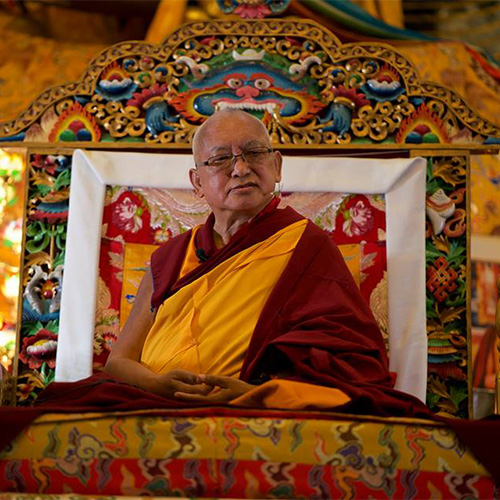
Photo: Bill Kane, Kopan Monastery, Nepal, 2016
[Note: The full practice for taking the eight Mahayana precepts can be found in the booklet supplied with this module of Living in the Path. If you are taking these precepts for the first time and wish to receive the lineage of the precepts from Lama Zopa Rinpoche, first recite the “Preliminary Prayers” on pp. 27–33 of the booklet, and then complete the remainder of the practice by watching Video 4: “Actual Ceremony for Taking the Precepts” and repeating the words of the ceremony after Lama Zopa Rinpoche, as indicated below.]
(duration: 38 minutes)
Transcript of Video 4: “Actual Ceremony for Taking the Precepts”
(You can read the transcript of the video below. Alternatively, you can read the same transcript alongside the video by clicking here to download it or view it in a separate window.)
Do three prostrations. (Stand up and do three prostrations to Lama Zopa Rinpoche visualized as Guru Shakyamuni Buddha.)
Here, it involves visualizing the lama [as Guru Shakyamuni Buddha]. This is because the eight Mahayana precepts come not from sutra, but come from Kriya Tantra. That is why they involve avoiding black food,[1] because in Kriya Tantra the emphasis is on keeping the body clean, so that the mind becomes without obstacles, clear for meditation. So that is why avoiding black food. Kriya Tantra is outer yoga. Why the eight Mahayana precepts…. The pratimoksha vows don’t involve that, but that is why the eight Mahayana precepts involve avoiding eating black food, because from where they come is Kriya Tantra.
Visualize the lama as Shakyamuni Buddha, then think you are taking the precepts from him, also the buddhas and bodhisattvas surrounding him.
[Repeat after Lama Zopa Rinpoche:]
Prayer for Taking the Precepts
CHHOG CHU NA / ZHUG PÄI SANG GYÄ DANG / JANG CHHUB SEM PA / THAM CHÄ / DAG LA GONG SU SÖL /
Maybe we will do the English first.
[Repeat after Lama Zopa Rinpoche:]
All buddhas and bodhisattvas / dwelling in the ten directions, / please pay attention to me.
Then also if there is a lama there:
LOB PÖN GONG SU SÖL
Master, please pay attention to me.
That is not in English there. It is here in the Tibetan, but not in the English. It is not written in the English.[2] If there is a lama then you have to say LOBPÖN GONG SU SOL. LOBPÖN is the guide of the disciple, the preceptor or guide of the disciple leading in the path to liberation. You are asking him to pay attention.
[Repeat after Lama Zopa Rinpoche:]
LOB PÖN GONG SU SÖL
Master, please pay attention to me.
So that one. We will read the English.
[Repeat after Lama Zopa Rinpoche:]
Just as / the previous tathagatas, / foe destroyers, / perfectly completed buddhas, /
who, like the divine wise horse / and the great elephant, / did what had to be done, / performed actions, /
laid down the burden, / subsequently attained their own welfare, /
completely exhausted the fetters to existence, /
and had perfect speech, / well-liberated minds, /and well-liberated wisdom, /
for the welfare of all sentient beings, / in order to benefit,/ in order to liberate, /
in order to eliminate famine, / [in order to eliminate war, / in order to stop the harm of the four elements,]
War is not in the original prayer, but I thought it was very good to mention. I added it because there is so much war happening, so taking the eight Mahayana precepts is the antidote to that.
[Repeat after Lama Zopa Rinpoche:]
in order to stop / the harm of the four elements, /
So that is another one that is added. In particular in California, sorry, in the United States there are so many fires. In one year it happens so many times, fire, then in particular California, that is one place. And also it happens in Australia, but I think a little bit less than in the United States. It is to help that. So we extend the purpose of taking the eight Mahayana precepts, so it becomes very, very good. The government doesn’t have to ask you, “Please do this”; you just do it with a good heart. It doesn’t depend on the government asking you and paying you money for that.
[Repeat after Lama Zopa Rinpoche:]
in order to eliminate sickness, /
in order to fully complete / the thirty-seven practices harmonious with enlightenment, /
and in order to definitely / actualize / the unsurpassed result of perfect, / complete enlightenment /
perfectly performed / the restoring and purifying ordination; /
similarly, also / I, who am called /
Please mention your name.
from this time / until sunrise tomorrow, / for the welfare of all sentient beings, /
in order to benefit, / in order to liberate, /
in order to eliminate famine, / [in order to eliminate war, / in order to stop the harm of the four elements,] / in order to eliminate sickness, /
in order to fully complete the thirty-seven practices harmonious with enlightenment, /
and in order to definitely actualize the unsurpassed result / of perfect, / complete enlightenment, /
shall perfectly undertake / the restoring and purifying ordination. /
[Repeat a second time after Lama Zopa Rinpoche:]
All buddhas and bodhisattvas dwelling in the ten directions, / please pay attention to me. /
Please, Guru, pay attention to me. /
Just as the previous tathagatas, / foe destroyers, / perfectly completed buddhas, /
who, like the divine wise horse / and the great elephant, / did what had to be done, / performed actions, /
laid down the burden, / subsequently attained their own welfare, / completely exhausted / the fetters to existence, /
and had perfect speech, / well-liberated minds, / and well-liberated wisdom, /
for the welfare of all sentient beings, /
in order to benefit, / in order to liberate, /
in order to eliminate famine, / [in order to eliminate war, / in order to stop the harm of the four elements,] / in order to eliminate sickness, /
in order to fully complete the thirty-seven practices / harmonious with enlightenment, /
and in order to definitely actualize the unsurpassed / result of perfect, complete enlightenment /
perfectly performed the restoring and purifying ordination; /
similarly, also I, who am called / [say your name],
from this time until sunrise tomorrow, / for the welfare of all sentient beings, /
in order to benefit, / in order to liberate, /
in order to eliminate famine, / [in order to eliminate war, / in order to stop the harm of the four elements,] / in order to eliminate sickness, /
in order to fully complete the thirty-seven practices harmonious with enlightenment, /
and in order to definitely actualize the unsurpassed result / of perfect, complete enlightenment, /
shall perfectly undertake / the restoring and purifying ordination. /
So, the third time you become Tibetan!
[Repeat the third time after Lama Zopa Rinpoche this time in Tibetan:]
CHHOG CHU NA ZHUG PÄI / SANG GYÄ DANG / JANG CHHUB SEM PA / THAM CHÄ / DAG LA GONG SU SÖL /
All buddhas and bodhisattvas dwelling in the ten directions, please pay attention to me.
LOB PÖN GONG SU SÖL
Master, please pay attention to me.
JI TAR NGÖN GYI / DE ZHIN SHEG PA / DRA CHOM PA / YANG DAG PAR / DZOG PÄI SANG GYÄ /
Just as the previous tathagata, arhat, perfectly completed buddhas,
TA CHANG SHE TA BU / LANG PO CHHEN PO / JA WA JÄ SHING / JE PA JÄ PA /
who, like the divine wise horse and the great elephant, did what had to be done, performed actions,
KHUR BOR WA / RANG GI DÖN / JE SU THOB PA / SI PAR KÜN TU JOR WA / YONG SU ZÄ PA /
laid down the burden, subsequently attained their own welfare, completely exhausted the fetters to existence,
YANG DAG PÄI KA / LEG PAR NAM PAR DRÖL WÄI THUG / LEG PAR NAM PAR DRÖL WÄI SHE RAB CHÄN /
and had perfect speech, well-liberated minds, and well-liberated wisdom,
DE DAG GI / SEM CHÄN THAM CHÄ KYI / DÖN GYI CHHIR DANG /
for the welfare of all sentient beings,
PHÄN PAR JA WÄI CHHIR DANG / DRÖL WAR JA WÄI CHHIR DANG /
in order to benefit, in order to liberate,
MU GE ME PAR JA WÄI CHHIR DANG / NÄ ME PAR JA WÄI CHHIR DANG /
in order to eliminate famine, [in order to eliminate war, in order to stop the harm of the four elements,] in order to eliminate sickness,
JANG CHHUB KYI CHHOG KYI CHHÖ NAM YONG SU DZOG PAR JA WÄI CHHIR DANG /
in order to fully complete the thirty-seven practices harmonious with enlightenment,
LA NA ME PA / YANG DAG PAR / DZOG PÄI JANG CHHUB / NGE PAR TOG PAR JA WÄI CHHIR /
and in order to definitely actualize the unsurpassed result of perfect, complete enlightenment
SO JONG / YANG DAG PAR / DZÄ PA /
perfectly performed the restoring and purifying ordination;
DE ZHIN DU / DAG [ming]
similarly, also I,
Please mention your name.
ZHE GYI WÄ / KYANG /
who am called [say your name],
DÜ DI NÄ ZUNG TE / JI SI SANG NYI MA MA SHAR GYI BAR DU /
from this time until sunrise tomorrow,
So generally it depends on… It says “until sunrise,” so it depends on how you think, [whether] sunrise means light, until light comes at your place, until light comes at your place, or sun rises, there is no light at your place, not complete light, but the sun rising in the world, in the world, maybe in the country. Even if there is no light at your place, but the morning already started from east, all the stars, the brightness of the stars is gone, that is the very beginning of the morning. The very beginning of the morning. From the eastern side, if you look to that side, there is a little bit of white started, that is the very beginning of the morning.
So if you think, like Nyung Nä, when you do Chenrezig retreat, Nyung Nä, if you think that is sunrise, if you define it like that, the very beginning of day, if it is already the next day, so if you think in that way then you can have food and drink. It depends on how you think, having light at your place. If for Nyung Nä, if you think in that way, then you can have drink and food earlier, drink and food earlier, rather than many hours later. This helps people to not get too tired so much. If it is easier, then they get inspired to again do Nyung Nä in the future. If it is in a group do like that, but if it is yourself... But if you are leading a group, it is just to help the people for it not to become too difficult so that they will do Nyung Nä again. Khari Rinpoche, the great bodhisattva or yogi, the lama who founded the monastery down below Lawudo, when he does Nyung Nä, three o’clock, everyone had to get up at three o’clock in the morning. He stood outside, even though old aspect, but he stood outside the gompa and when the monks and nuns came in, he gave them brown sugar, a big brown sugar cut in pieces, with water then he gave in the hand of each person, then they had to eat that while their stomachs, they didn’t have water or food since yesterday, no water, no food. Rinpoche gave like that then they had to… They said sometimes they would vomit after that. Then they served tea and thugpa at three o’clock. Rinpoche said that it was so that it made people find Nyung Nä easier so they would be able to do many Nyung Näs. This is according to Khari Rinpoche, but of course at three o’clock it doesn’t start. I think, I noticed that around four o’clock, starts the white from the east. The brightness comes and the stars are gone around four, or after four. But that was according to Rinpoche’s own technique.
Now I forgot where I stopped. (Ven. Steve tells Rinpoche where he stopped: NYI MA MA SHAR GYI BAR DU.)
[Repeat after Lama Zopa Rinpoche:]
DÜ DI NÄ ZUNG TE / JI SI SANG NYI MA / MA SHAR GYI BAR DU /
from this time until sunrise tomorrow,
SEM CHÄN THAM CHÄ / KYI DÖN GYI CHHIR DANG /
for the welfare of all sentient beings,
PHÄN PAR JA WÄI CHHIR DANG / DRÖL WAR JA WÄI CHHIR DANG /
in order to benefit, in order to liberate,
MU GE ME PAR JA WÄI CHHIR DANG / NÄ ME PAR JA WÄI CHHIR DANG /
in order to eliminate famine, [in order to eliminate war, in order to stop the harm of the four elements,] in order to eliminate sickness,
JANG CHHUB KYI CHHOG KYI CHHÖ NAM / YONG SU DZOG PAR JA WÄI CHHIR DANG /
in order to fully complete the thirty-seven practices harmonious with enlightenment,
LA NA ME PA / YANG DAG PAR DZOG PÄI JANG CHHUB / NGE PAR TOG PAR JA WÄI CHHIR /
and in order to definitely actualize the unsurpassed result of perfect, complete enlightenment,
SO JONG / YANG DAG PAR LANG WAR GYI O
shall perfectly undertake the restoring and purifying ordination.
Then I say TAB YIN NO, then you say LEG SO. “This is the method” and you respond, LEG SO, yes.
TAB YIN NO
This is the method.
You say:
LEG SO
Excellent.
Think that you have received the eight Mahayana precepts from the lama that you visualized as Guru Shakyamuni Buddha and then all the buddhas and bodhisattvas. You must make a strong determination, “I have received the eight Mahayana precepts, the reviving and purifying ordination, the eight Mahayana precepts.” Okay?
Just as the foe destroyers / of the past have abandoned all misconduct / of body, speech, and mind, / such as taking the lives of others, / so shall I / for the sake of all beings, / abandon for one day / these wrong actions / and devote myself / to the pure practice of the training.
“Just as the foe destroyers of the past have abandoned all misconduct,” I think “abandoned all misconduct” it says, it means from now on I won’t do, for this one day, from now I won’t do killing, SOG CHÖ is killing. In English it says, “Just as the foe destroyers of the past have abandoned all misconduct,” so it doesn’t follow the Tibetan.[3]
[Repeat after Lama Zopa Rinpoche:]
Commitment Prayer to Keep the Precepts
DENG NÄ SOG CHÖ MI JA ZHING
From now on I shall not kill.
“From now on I won’t do killing.”
[Repeat after Lama Zopa Rinpoche:]
ZHÄN GYI NOR YANG LANG MI JA
I shall not steal others’ possessions.
means “I won’t take also the possessions of others.”
[Repeat after Lama Zopa Rinpoche:]
THRIG PÄI CHHÖ KYANG MI CHÖ CHING
I shall not engage in sexual activity.
“I won’t also do the sexual act.” Here in the eight Mahayana precepts, it means any sexual act.
[Repeat after Lama Zopa Rinpoche:]
DZÜN GYI TSHIG KYANG MI MA O
I shall not speak false words.
“I won’t tell also lies.” It seems the English here becomes very different.
[Repeat after Lama Zopa Rinpoche:]
KYÖN NI MANG PO NYER TEN PÄI
I shall avoid intoxicants,
So then after that, KYÖN NI MANG PO NYER TEN PÄI. Aleh. The translation of the Tibetan comes only now here: “From now on I shall not kill. I shall not steal others’ possessions.” It’s kind of… I don’t know where the other part comes from in English.[4]
[Repeat after Lama Zopa Rinpoche:]
KYÖN NI MANG PO NYER TEN PÄI
I shall avoid intoxicants,
CHHANG NI YONG SU PANG WAR JA
From which many mistakes arise.
“I will abandon chang, alcohol, completely, from where many mistakes arise.”
[Repeat after Lama Zopa Rinpoche:]
THRI TÄN CHHE THO MI JA ZHING
I shall not sit on large and high seats and beds.
THRI TÄN CHHE THO MI JA ZHING,“I won’t sit on thrones, large, high,” all that. Like that, to not get pride or those things, expensive, like tiger skin, leopard skin, or yeti skin. I am joking “yeti skin.”
[Repeat after Lama Zopa Rinpoche:]
DE ZHIN DÜ MA YIN PÄI ZÄ
I shall not eat food at the wrong times.
To not eat food at the wrong time, so the sun, what? Clockwise, it is after twelve o’clock, right? After twelve, but by the sun is what time?
Ven. Steve: Midday.
Rinpoche: One o’clock?
Ven. Steve: Yah, here it is 1:15.
Rinpoche: By the sun? 1:15? Okay. So that is noontime by counting the sun. So it depends whether you follow the clock or whether you follow the sun. By following the sun, if we follow the sun, so we are going to follow the sun, right? We are going to follow the sun, so noon is that. Not eating after noon, the point is that. Before that, you can eat at anytime.
DE ZHIN DÜ MA YIN PÄI ZÄ, DRI DANG THRENG WA GYÄN DANG NI.
[Repeat after Lama Zopa Rinpoche:]
DRI DANG THRENG WA GYÄN DANG NI
I shall avoid perfumes, garlands, and ornaments,
GAR DANG LU SOG PANG WAR JA
As well as dancing, singing, and so forth.
DRI is “scented smells,” THRENG WA is “malas” or “ornaments.” It is not something that you usually wear for practice, but something not for Dharma, something to do with attachment, you can’t wear that.
GAR DANG LU SOG PANG WAR JA, dance, singing songs, but when we do practice, when we do chanting for Dharma, the motivation is different from singing songs. Generally speaking, by the motivation, it is different.
[Repeat after Lama Zopa Rinpoche:]
JI TAR DRA CHOM TAG TU NI
Just as the arhats
SOG CHÖ LA SOG MI JE TAR
Never kill and so forth,
DE ZHIN SOG CHÖ LA SOG PANG
So too shall I abandon killing and so forth.
LA ME JANG CHHUB NYUR THOB SHOG
May I quickly attain supreme enlightenment.
“The arhats always do not engage in killing and so forth, I also will abandon killing and so forth. May I quickly attain enlightenment.
[Repeat after Lama Zopa Rinpoche:]
DUG NGÄL MANG THRUG JIG TEN DI
May I free this world, disturbed by much suffering,
SI PÄI TSHO LÄ DRÖL WAR SHOG
From the ocean of existence.
“May the living beings be liberated from SI PÄI TSHO, the oceans of samsara.” “This world” can be a place or it can be, JIG TEN, “depending on JIG, change,” “depending on change.” “Change” refers to the aggregates. Depending on change; “change” refers to the aggregates. The aggregates are in the nature of change, JIG TEN.
DUG NGÄL MANG THRUG, so many sufferings, like a cyclone, so much suffering.
Mantra of Pure Morality
Now, the mantra for reviving and purifying, making the precepts pure. This is one of the methods to be able, if you are living a lay life but lay life living in five lay vows, or four or three or two, whatever number of precepts you are living in of the pratimoksha, the eight Mahayana precepts or the pratimoksha vows, which are taken until death, so to be able to keep pure it helps if you recite this mantra. The people who are living ordination, the monks and nuns who are living in ordination, then reciting this mantra is one help to be able to live purely in the vows. It makes morality pure. In the morning, if you do prostrations by reciting the Thirty-five Buddhas, then at the end you can kneel down and you can recite this twenty-one times or seven times, whatever.
[Repeat the mantra after Lama Zopa Rinpoche three times:]
OM AMOGHA SHILA SAMBHARA / BHARA BHARA / MAHA SHUDDHA SATTVA PADMA VIBHUSHITA BHUJA / DHARA DHARA SAMANTA / AVALOKITE HUM PHAT SVAHA
I did it three times or two times?
Ven. Steve: Three.
Rinpoche: Okay. Now we will do it together.
OM AMOGHA SHILA SAMBHARA / BHARA BHARA / MAHA SHUDDHA SATTVA PADMA VIBHUSHITA BHUJA / DHARA DHARA SAMANTA / AVALOKITE HUM PHAT SVAHA
Are the twenty-one finished? I’m not sure.
Ven. Steve: Four more.
Rinpoche: Oh, I see. My finger went very fast.
OM AMOGHA SHILA SAMBHARA / BHARA BHARA / MAHA SHUDDHA SATTVA PADMA VIBHUSHITA BHUJA / DHARA DHARA SAMANTA / AVALOKITE HUM PHAT SVAHA
Prayer to Keep Pure Morality
Due to all the past, present, and future merits collected by myself, the numberless sentient beings, and the numberless buddhas, may I be able to complete the paramita of morality without mistake, pure and without pride.
THRIM KYI TSHÜL THRIM KYÖN ME CHING
By abiding in faultless morality of the Dharma rules,
TSHÜL THRIM NAM PAR DAG DANG DÄN
Completely pure morality,
LOM SEM ME PÄI TSHÜL THRIM KYI
And morality free from conceit,
TSHÜL THRIM PHA RÖL CHHIN DZOG SHOG
May I complete the perfection of morality.
Dedications
Due to all the past, present, and future merits collected by oneself and the three times merits collected by others, may bodhichitta be actualized in one’s heart and in the hearts of all sentient beings, without the delay of even one second. And in whose heart bodhichitta has been generated, may it increase.
To Actualize Bodhichitta
JANG CHHUB SEM CHHOG RIN PO CHHE
May the precious supreme bodhichitta
MA KYE PA NAM KYE GYUR CHIG
Not yet born arise.
KYE PA NYAM PA ME PA YI
May that arisen not decline,
GONG NÄ GONG DU PHEL WAR SHOG
But increase more and more.
For the Long Life of His Holiness the Dalai Lama
GANG RII RA WÄ KOR WÄI ZHING KHAM DIR
In the land encircled by snow mountains,
PHÄN DANG DE WA MA LÜ JUNG WÄI NÄ
You are the source of all happiness and good.
CHÄN RÄ ZIG WANG TÄN DZIN GYA TSHO YI
All-powerful Chenrezig, Tenzin Gyatso,
ZHAB PÄ SI THÄI BAR DU TÄN GYUR CHIG
Please remain until samsara ends.
For His Holiness’ Wishes to be Spontaneously Fulfilled
TONG NYI NYING JE ZUNG DU JUG PÄI LAM
Savior of the Land of Snow teachings and transmigratory beings,
CHHE CHHER SÄL DZÄ GANG CHÄN TÄN DRÖI GÖN
Who extensively clarifies the path that unifies emptiness and compassion,
CHHAG NA PÄ MO TÄN DZIN GYA TSHO LA
To the Lotus Holder, Tenzin Gyatso, I beseech –
SÖL WA DEB SO ZHE DÖN LHÜN DRUB SHOG
May all your holy wishes be spontaneously fulfilled.
Due to the past, present, and future merits, may all the father and mother sentient beings… Due to all the three time merits collected by oneself and others, may all the father and mother sentient beings have happiness. May the three lower realms be empty forever. May all the bodhisattvas’ prayers succeed immediately.
PHA MA SEM CHÄN THAM CHÄ DE DANG DÄN
May all father and mother sentient beings have happiness,
NGÄN DRO THAM CHÄ TAG TU TONG PA DANG
And all the lower realms be empty forever.
JANG CHHUB SEM PA GANG NA SU ZHUG PA
Wherever there are bodhisattvas,
DE DAG KÜN GYI MÖN LAM DRUB GYUR CHIG
May all their prayers be fulfilled.
Due to the three-time merits collected by me, the three-time merits collected by numberless sentient beings and buddhas, which exist but do not exist from their own side, which are totally empty, may the I, who exists but does not exist from its own side, who is totally empty, achieve Guru Shakyamuni Buddha’s enlightenment, which exists but does not exist from its own side, which is totally empty, and lead all sentient beings, who exist but do not exist from their own side, who are totally empty, to that Guru Shakyamuni Buddha’s enlightenment, which exists but does not exist from its own side, which is totally empty, by myself alone, who exists but who does not exist from its own side, who is totally empty.