
3. His Holiness’ Motivation for Taking the Precepts
Now, every sentient being in your heart is the dearest, most kind, precious one. Therefore, any service you can offer, even a little service you can offer to anybody, even to an insect drowning in water or to a person, whatever small service you can offer is the happiest thing in life. Then, not only to cause them the happiness of this life, but more importantly to cause them the happiness of future lives, then more importantly to cause them liberation from samsara. Then the most beneficial is to bring them to enlightenment. To do that one must attain enlightenment, therefore I am going to take the eight Mahayana precepts. (Lama Zopa Rinpoche)
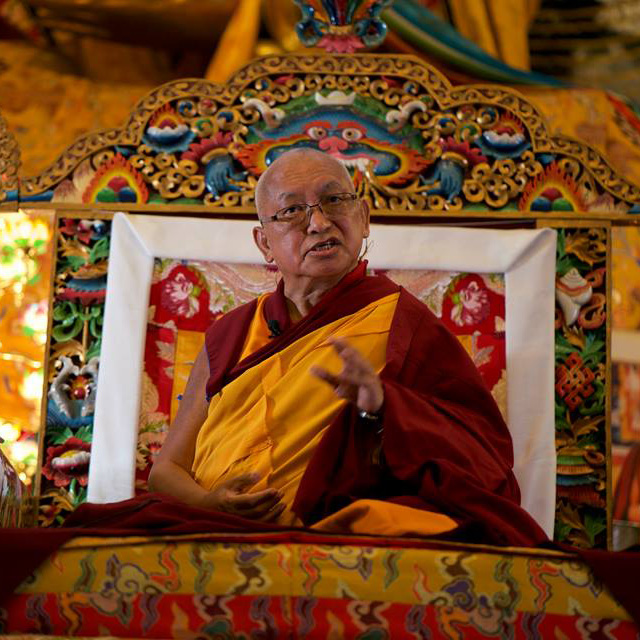
Photo: Bill Kane, Kopan Monastery, Nepal, 2016
I thought to read the motivation that His Holiness taught one time in Dharamsala, when He gave the eight Mahayana precepts outside the temple. It was a very effective motivation, so I got the tape and wrote it down. After listening to that, now I’ve forgotten it, but at that time, after the motivation, my mind very much thought of others; it had changed. Of course, it was not an actual realization, but a blessing. Then I didn’t put any more effort into it, but still I am thinking to do that motivation.
The Real I Taking the Precepts is Not There
Oneself and all sentient beings have been suffering in samsara from beginningless rebirths because of a wrong concept. While there is no self inside this body, while this body is not the self, nor is the mind the self… Or it can be done by way of elaborating with the five aggregates, the aggregate of form and so on: the aggregate of form is not the I; the aggregate of feeling is not the self; the aggregate of cognition,[1] dushe kyi pungpo, is not the I, it is not the self; duche kyi pungpo, the compounding aggregate, [is not the I]. “Compounding” is the translation of the word duche. From the fifty-one mental factors you take out the two of feeling and cognition, so there are forty-nine left and these mental factors are called “compounding aggregates” because they compound the result. We must make it clear, that duche is compounding phenomena. The other duche is causative phenomena, but this one is compounding phenomena as it is compounding or producing its result. We need to make the translation more precise.
Then consider the aggregate of consciousness is not the I. None of them individually is the self and all of them together are not the self. The aggregates individually are not the I; nor on the aggregates can you find the I, the self. From the tips of the hair down to the toes there is nowhere that you can find the I, the self. That is the same; you can’t find both. What you can’t find is the two things.
(duration: 13 minutes)
Transcript of Video 2: “The Real I”
(You can read the transcript of the video below. Alternatively, you can read the same transcript alongside the video by clicking here to download it or view it in a separate window.)
What we believe now is “I am taking the eight Mahayana precepts in this hall in North Carolina.” There is a real I taking the eight Mahayana precepts while sitting on this cushion on this floor. That real I you can’t find. “Real I” means that which is not merely labeled by the mind; that means it is existing from its own side. When we say a “real” something, when most common people in the world in everyday life say “real,” that means the gagcha, the object to be refuted – existence from its own side. We use the common word “real” for the object to be refuted. What ordinary people use is the word “real,” but it is talking about the gagcha, the object to be refuted. The object to be refuted is what has appeared to the hallucinated mind, and it is what is believed and what is held to be one hundred percent true by ignorance.
That real I which you are believing, for instance, myself giving the eight Mahayana precepts and you believe you are taking the Precepts – I cannot say everyone is thinking this – but, it’s not there. In reality, it is not there. There is no such real I that is giving the eight Mahayana precepts and no real I that is taking them. You can’t find that. You cannot find it from the tip of the hair down to the tip of your toes. Nowhere can you find that. Not only can you not find that one, but you can’t find even the merely imputed I that exists. Even the I that exists, the merely imputed one, even that you can’t find. You can find it in the United States, now. You can find it in this hall, but you can’t find it on these aggregates. If you look for it, you can’t find it, even the merely labeled one.
So, there is a question: when you look for it and can’t find it, then is that realizing emptiness? From my point of view, you need to check that definition: if you look for it and can’t find it, then you are seeing emptiness. You need to check more about that topic. Because the I is three: the merely labeled I, the mere I, and the real I (the I not merely labeled by the mind, but existing from its own side).[2] Then the just I is not “merely labeled” or “truly existent.” I saw that in a text, these three. When you look for it, you can’t find it. Which I? That needs to be checked. Because when you look for both the merely labeled I and the not merely labeled I, both the truly existent I and the merely labeled I, you can’t find them. If, for instance, you look for the merely labeled I and can’t find it, and then you also look for it on these aggregates and can’t find it, then that becomes falling into nihilism.
In the lamrim, it explains that if you look for the vase, just the vase, not the truly existent vase, you leave out the object to be refuted. You don’t touch the object to be refuted. In the four-part analysis, which analyzes the four vital points, the first point is understanding the object to be refuted. Why does that come first? It doesn’t make sense that when you look for the merely-labeled general I, you can’t find it. If you look for the vase, just the general vase, you don’t touch the truly existent real vase. If you cannot find it anywhere, then nothing becomes clear; the vase is not clear at the end. Then there is the danger of falling down into the nihilism that destroys dependent arising. I have checked in a few different places that mention the mistaken way of analyzing by missing the object to be refuted. So it becomes unclear what the vase is and you cannot point it out. So you cannot come to the conclusion that the vase exists, the conventional truth, which is the truth for the obscured mind, kundzob denpa, or truth for the all-obscured mind. The existence of that vase, the dependent arising, is destroyed by that way of analyzing. It cannot come back to dependent arising. It does not support it, it doesn’t help it, so you are lost. This is just a drop, to express some idea. That kind of analysis doesn’t become meditation on emptiness. It is not meditation on emptiness. Meditation on emptiness should harm ignorance, however, this does not harm ignorance. Ignorance is still left there. If it is meditation on emptiness, it should harm that. “When you look for the object and can’t find it, that is seeing emptiness,” I think that needs to be made very specific.
This I is taking the eight Mahayana precepts . The real I taking the eight Mahayana precepts is not there. You cannot find it in this body, nor on these aggregates. It is just totally empty, just totally empty. That one is totally non-existent from its own side. From where it is appearing to the hallucinated mind, it is totally non-existent right there.
[End of Video 2: “The Real I”]
Normally, I say this is my mudra of “appearing from there” [Rinpoche demonstrates the gesture]. This is the mudra expressing the gagcha, the object to be refuted, appearing from there, from its own side. Then, when seeing emptiness, it is totally non-existent right there, from where it is appearing while it is totally empty, totally non-existent, not only now, not only from last night, not only from birth, but it never happened from beginningless time. It has been empty and non-existent from the beginning. It never came into existence. It has been empty and non-existent from the beginning. While it is like this, then you have a hallucination that it is existing from its own side. That which is merely imputed appears back to you as not merely labeled by the mind. Just this second it is merely imputed, but in the next second it appears to the hallucinated mind as not being merely labeled by the mind. It is a mental fabrication. Then, one lets one’s mind hold on to it, thinking this is one hundred percent totally existent or true. It is in that moment that we create the root of samsara: ignorance.
We are following ignorance. We are under the control of ignorance. Ignorance has been our guru. We listen to everything ignorance says. We totally trust in ignorance. It has been like this from beginningless rebirths. Because of that, then other negative emotions and concepts such as attachment and anger arise. Then many secondary branches of anger and attachment happen. There are many different types; eighty-four thousand teachings were given because there are eighty-four thousand delusions.
Due to Ignorance We Have Experienced the Suffering of the Lower Realms Numberless Times
This then motivates karma. According to the Prasangika school, the karma plants a karmic seed on the mere I. But without the continuum of mind, how does it leave an imprint? That imprint produces rebirth. This ignorance, the self-grasping of the person and the self-grasping of the aggregates, has created suffering in samsara from beginningless rebirths. We have been suffering in samsara up to now.
We have experienced rebirth numberless times in the hell realms: the eight cold hells, eight hot hells, and sixteen neighboring hells. We have had numberless times there from beginningless rebirths. Then we have had numberless rebirths in the hungry ghost realm, where one experiences the heaviest suffering of hunger and thirst for hundreds and thousands and tens of thousands of years. It is such heavy suffering. In essence, we could not find even one drop of water for hundreds of thousands of years. In this suffering, we could not find even the wetness of water on the ground or even one spoonful of food for hundreds of thousands of years. We have been born there numberless times from beginningless rebirths and suffered. It is the same for the animal realm. The first main mistake, which causes rebirth in the animal realm, is being extremely foolish and ignorant. Then, there is the unbelievably heavy suffering of being eaten by one another. Wherever you are, wherever the animal is, its enemies are also there. It’s like that in the ocean or in the forest; the enemy is nearby due to karma. Anytime they can get eaten.
I was recently telling someone that some time ago while I was flying in an airplane, I had the thought, when you look at the ocean it looks so peaceful, like there is nothing wrong. Outside it appears to be so calm and peaceful. However, once you think inside the water, you go inside the water, and watch the animals, what suffering. There is immeasurable suffering – animals the size of mountains eating an unbelievable number of small ones. Whatever they get next to their mouth they eat. Then, there are many small ones eating big ones by living on their body and eating them. In the animal realm you are constantly escaping in fear of being eaten at anytime. At the same time that you experience fear and want to escape, you also need to look for food. At the same time you are eating some animal alive; you are afraid of being eaten by another animal. It’s just aaaamaaaazing. It is an unbelievable state of fear.
Look at the birds. When birds land on a plant looking for food they are always looking this way and that way. You have to understand why. At the same time they are looking this way and that, in all ten directions. There is always fear.
However, since I am talking about this, we are not, at the moment, in this situation of living in constant fear of being eaten. There are many people in the world who eat that which is alive, but we do not do that because of having met the Buddha-Dharma and generated compassion. It is just amazing that we are not born as one of those animals. Wow. This is an unbelievable opportunity. We have the comfort and freedom to practice Dharma today, for example, by taking the eight Mahayana precepts . This time of retreat on the lamrim: doing meditation, then tantric practice, the quickest path to enlightenment, Lama Chöpa or Guru Puja, all sits on the foundation of the lamrim. Lamrim means to purify obstacles and collect extensive merits. Lamrim is a condition for this. It is just amazing. What is the English word? We are not aware enough of our life situation. All of this suffering and fear we do not have that we are continuously not aware of. Then, there is so much comfort, unbelievable comfort. It’s so unbelievable that we can’t imagine what comfort we have. We are kind of spoiled and so unable to practice Dharma. We are totally spoiled. There is an English word that I have forgotten. [We take it for granted.]
We have been born as those animals living in the ocean. We have been like that numberless times. We have been all of those animals, big like mountains, whales. We have been born numberless times like that. Then we have been small ones numberless times. We have been born as jellyfish numberless times and then been eaten by other animals numberless times. Even those animals that are with human beings experience unbelievable suffering. They experience heat and cold, are tortured, carry heavy loads, pull carriages. Can you imagine? In India, I saw an animal carrying a heavy load and breathing heavily because of this. Even animals living with human beings are tortured. As long as they function, are of use, it’s okay, but when they are no longer of use, they are killed – like horses and cows. As long as they have a function like giving milk, they are used. [Horses] are used for riding, then when they get old and no longer function, they are killed for their meat. Horsemeat is not eaten here, but in Mongolia and other countries, they eat horsemeat and drink horse milk. Can you imagine?
They cannot express anything. They have no freedom and cannot express their feelings. They cannot express how much they suffer. As long as they can walk, they are used. We have been born like that numberless times, not only in the water and in the forest, but on the earth. Wherever you are, the enemy is there. There are those living in the ground, like the moles that makes tunnels and then snakes eat them. Sometimes they come out and make a lot of noise and the snake goes back. Wherever they are, the enemy comes. Imagine the difference between us human beings and them? We don’t have that problem for even one day. So, if we don’t practice Dharma and use this incredible life with so much comfort while we have it, it is just wasted. There is no greater loss than this. In Engaging in the Bodhisattva Deeds, Master Shantideva says:
If, even when I have the good fortune of virtuous conduct,
I do not create virtue,
Then what shall I do when all confused
By the suffering of the unfortunate rebirths? [4.18]
If I do not create virtues
But readily amass negativities,
Then for hundreds of millions of eons
I shall not even hear the term “good migration.” [4.19]
“When we have the fortune to collect and enjoy virtue, if we do not collect merits, then when we are born in the lower realms, totally ignorant and experiencing the suffering of lower realms, at that time what can we do?” Nothing. You can do nothing. While we have this incredible opportunity, then we don’t practice Dharma, don’t do the practice of purification, don’t collect merits, and don’t attain the paths. Then when we are reborn in the lower realms, due to the karma we have collected from beginningless rebirths to be born in the lower realms and which we haven’t finished purifying and which we haven’t finished experiencing, what can we do? You can do nothing. You have to suffer until that karma finishes, for eons and eons and eons.
Due to Ignorance We Have Experienced the Suffering of the Higher Realms Numberless Times
Human beings experience eight types of sufferings: suffering of rebirth (as explained in the five outlines of the Lamrim Chenmo), old age, sickness, death, suffering of meeting undesirable objects, suffering of parting from desirable objects… There is so much worry and fear that you can’t find the object of desire. Even when you look for it, you can’t find it. Even if you find it, you don’t get satisfaction. As Mick Jagger of the Rolling Stones expressed with his guitar, it is exactly like that. He expressed his experience, his life. He is someone who became very famous in the world and achieved a reputation, wealth, friends, but still didn’t get satisfaction. He expressed that. There are all of these sufferings. Then, there is the suffering of the contaminated aggregates. The conclusion is like that.
The suras’ and asuras’ mental suffering of the five signs that they are nearing death is much heavier than the hell beings’ physical sufferings. I think sometimes the beggar on the street who begs everyday for some food does not have much worry: just to get some food and live on that. There is not much worry about becoming better than others, richer than others, having a company, like wealthy people and business people. They have all this wealth and are millionaires or zillionaires, but they have so many worries. They have an unbelievable house. It is just unbelievable. I recently saw on TV in the Unites States a program about someone who was very wealthy. They showed the house built near a lake, on the water. They showed everything: the house, its many, many rooms, beds, boats. The good thing was that the person had a sincere heart focused on helping others. They did not know Dharma, but they had a sincere heart and compassion directed toward helping others. Otherwise, there is nothing other than much worry and fear.
You think of business, reputation, somebody else getting richer than you, and yourself becoming weaker. There is worry and fear about losing your reputation or wealth. Even if you have enough money for many, many lifetimes, there is unbelievable worry. Then, there are also relationship problems, not just externally, but so much stress and pressure. Then, there is the worry or fear of losing the relationship. There is much worry and problems. The beggar doesn’t have that much painstaking worry, painstaking!
There was one lama, Gelek Rinpoche, when he was living in Delhi he mentioned, during his teachings, about the poor people who work on the road outside under the hot sun. They are putting bricks, working on the road. They look at the large buildings and can see air-conditioning and fans going around and think, “Oh, those people with so much comfort and pleasure, it is like heaven. How wonderful their life is, no problems, only happiness.” Then, those people who are living in the houses think, “Oh, those people working on the road have no heavy responsibility. How simple, how good, their lives are, with no responsibility, no problems.” Those wealthy people living in the houses are attracted to the life of those poor people outside, because they have so many relationship problems, business problems, so many problems, so much worry and fear. So, the devas’ mental suffering is heavier than the animals’ physical suffering, as Kyabje Trijang Rinpoche explained.
The Four Wrong Concepts of a Self, Samsaric Happiness, a Clean Body, and Permanence
We have gone through these sufferings numberless times. Not only that, but the wrong concepts… The original one is this: while there is no I, holding that there is an I, that wrong concept.
The other one is, as I already talked about yesterday, samsaric pleasures, which are only suffering. We look at them and label them as real happiness and then become attached to them. We have been continuously suffering in samsara since beginningless rebirths like that.
This body is like a garbage can or a septic tank that holds all the waste from the toilets, all of the essence that goes out of us, and is collected in a septic tank. It would be unimaginable to be inside that, but the body is like that, like a septic tank or a garbage can. Nagarjuna said the body is a container of thirty-six dirty things. Food before being eaten is clean, then after it goes inside the body, it comes out dirty. Like Kunu Lama Rinpoche says, “Whether it comes out of the mouth, ears, or holes in the lower part of the body, it is dirty.” It is dirty because inside the body it is dirty, so this shows that the nature of the body is dirty. By looking at it as clean and then being attached to that, due to that, we have continuously taken rebirth and suffered in samsara from beginningless rebirths up to now.
One’s own life, the I, is impermanent, the aggregates are impermanent, possessions are impermanent, and the family is impermanent. They are compounded by causes and conditions. Since they are under the control of causes and conditions, they change. They do not last, but always change. Not only day-by-day, hour-by-hour, minute-by-minute, or even second-by-second, but they change even within a second. Perhaps due to subtle impermanence, they change even within a second and don’t stay the same even within a second. Geshe Lamrimpa, in Tibet, mentioned in his text that everything changes. But, by holding to permanence, that this is going to last long, and then being attached to that, we have been suffering and reborn in samsara numberless times and we have suffered from beginningless rebirths.
Due to the concept of permanence, we have been suffering. We have died and beein reborn in samsara numberless times and suffered from beginningless rebirths. Due to the concept of permanence of impermanent phenomena, not realizing they are in the nature of impermanence, of not meditating and not having realized the nature of impermanence, not being aware of impermanence and leading life with the concept of permanence, it is an unbelievable shock when you see change, when death happens to oneself or one’s family. With decay and change, when this happens and you see it, then there is an unbelievable shock, a nervous breakdown, you become crazy. This happens.
The first time I went to Malaysia, I stayed with one family there. At that time, there was no center there so I stayed with this wealthy family. Many lamas had stayed there. One day the son suddenly died. Then the father threw all the statues they had been given on the floor and they broke. Normally you don’t think of impermanence, only the permanence of yourself, your family, etc. So when suddenly a change happens, you can’t stand it. It becomes an unbelievable shock. But it is part of life; it is the nature of life. The mind thought that the nature of life was permanence. This man thought that the Buddha didn’t look after his family, so he threw all the statues given by His Holiness on the floor. That is just an example.
Every Sentient Being is Most Precious, Kind, and Dear
(duration: minutes)
Transcript of Video 3: “Abbreviated Motivation for Taking the Precepts”
(You can read the transcript of the video below. Alternatively, you can read the same transcript alongside the video by clicking here to download it or view it in a separate window.)
If you follow these wrong concepts, you will have to experience the suffering of samsara without end. However, just being free from the oceans of samsaric sufferings and its causes is not enough. All the sufferings, all obstacles and misfortunes and all undesirable things, come from the self-cherishing thought, cherishing the I. It all comes from the I; so the I is what needs to be let go of. All happiness – the happiness from beginningless rebirths, present happiness, future happiness, liberation, and enlightenment – comes from bodhichitta, from cherishing others, from a good heart cherishing others, the thought to benefit others.
That means all your past numberless happinesses from beginningless rebirths, your present happiness, and your future happiness up to enlightenment, you receive from others, from the numberless hell beings, hungry ghosts, animals, human beings, asuras, and suras, and intermediate state beings. The happiness from beginningless rebirths, you cannot imagine all that you have received from the numberless hell beings. You can’t imagine just that result, without thinking of other happiness, just that. There is so much to feel, to think, so much debt. How kind. To make this short: from the hell beings, hungry ghosts, animals, human beings, suras, and asuras – numberless sentient beings – we have received so much. So they are unbelievably precious, kind, dear ones. On top of that, we received our present happiness from all of them, so they are so precious, kind, dear. Then, all the future life happiness is received from each sentient being, the numberless sentient beings from each realm. Therefore, they are much more kind, precious, and dear. Then, liberation from samsara we receive from the numberless hell beings, hungry ghosts, animals, human beings, asuras, and suras. You can’t imagine that ultimate happiness, so they are unbelievably dear, precious, kind. On top of that, you receive enlightenment from every hell being, hungry ghost, animal, human being, sura, and asura, from every sentient being.
So now, every sentient being in your heart is the dearest, most kind, precious one. They are kinder than Buddha, Dharma, and Sangha, because Buddha, Dharma, and Sangha came from the kindness of sentient beings. You survive by eating the food that came from the field, but to have food, you need the field; so the field becomes precious. Therefore, any service you can offer, even a little service you can offer to anybody, even to an insect drowning in water or to a person, whatever small service you can offer is the happiest thing in life. It is the most enjoyable thing in life, the most meaningful thing in life. Even a small help, even if you can only give a small help, that is the happiest thing in life, the most beneficial and enjoyable. You have the happiest life. By seeing this dearest, most precious, kindest one, you are unbelievably happy if there is anything you can do to help them. Then, not only to cause them the happiness of this life, but more importantly to cause them the happiness of future lives, then more importantly to cause them liberation from samsara. Then the most beneficial is to bring them to enlightenment. To do that one must attain enlightenment, therefore I am going to take the eight Mahayana precepts .