
2. Specific Benefits of the Individual Precepts
These benefits will not only come in future lives. When the karma is powerful, changes can happen even in this life, so don’t think that karma begins only after this life and there is nothing you can experience in this life. (Lama Zopa Rinpoche)
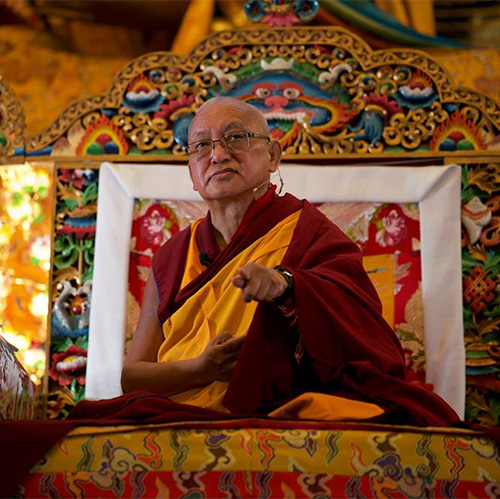
Photo: Bill Kane, Kopan Monastery, Nepal, 2016
Living in these eight precepts means abstaining from eight negative karmas that harm you and other sentient beings, directly or indirectly. You can understand that abstaining from these eight negative karmas naturally becomes a source of happiness. It is a root of happiness for you and for other sentient beings.
Explanations are given of the general benefits of the eight precepts and of the specific benefits of the individual precepts. From those two, today we will concentrate on the specific benefits of the individual vows.
The benefits of avoiding taking the lives of others, that is, killing: This is the basic cause of long life; you will live long and not have sicknesses in all your future lives. No matter how many hospitals you visit and how many treatments you get, if you haven’t created good karma from your side, for example, by living in the morality of abstaining from killing or harming others, you cannot have a long life no matter how many hospitals and health organizations and medicines exist. No matter how many hospitals, doctors, and medicines there are in the world, having a long life is based on first having good karma. It is all based on morality. There has to be good karma from the side of the person. Without this, no matter what is set up externally, nothing can help give someone a long life. External factors can help only on the basis of the person having good karma, such as that from practicing the morality of abstaining from killing.
Many diseases are based on this negative karma of killing, including even the inability to digest food. Many people have problems with their digestion throughout their whole life. This sickness is not the only one caused by the negative karma of killing; it is one of many. This is mentioned in the Tenth Bhumi Sutra.
Another benefit of abstaining from killing is that you become glorious, or magnificent, now and in the future. These good results are not related only to future lives; when the karma is powerful, it can also affect this life. You become glorious, or radiant, similar to the way we see His Holiness the Dalai Lama or we saw His Holiness Ling Rinpoche.
The benefits of avoiding taking what has not been given, or stealing. In all lifetimes, you will have perfect enjoyments and will receive them effortlessly. You will receive things just by wishing for them. Also, no one will interfere with your enjoyments by confiscating or stealing them.
These benefits will not only come in future lives. When the karma is powerful, changes can happen even in this life, so don’t think that karma begins only after this life and there is nothing you can experience in this life. For example, at the beginning you might be able to make very few or very poor quality offerings, but as you continue the practice of making offerings to holy objects or of making charity to other sentient beings, you are gradually able to make more extensive and better quality offerings and more extensive charity. As a result of your good karma, you can have perfect enjoyments, so your offerings to the merit field and your charity to others can become better and better and more and more extensive. Because you created the cause through your previous small offerings and small acts of charity, sooner or later in this life, you can make better and more extensive offerings.
Kadampa Geshe Potowa, I think it was, explained this in relation to the offering of incense. At the beginning, he offered incense using a plant that grows on high mountains; it looks like hair and has a very nice scent. Because he offered this incense to holy objects, later he gained many advantages and was able to make better and more extensive offerings of incense. This is an example of how karma works, of how your life can become better even in the immediate future.
The benefits of living in the morality of abstaining from the sexual act. The eight precepts of the Lesser Vehicle path refer to abstaining from any sexual misconduct, but here in the eight Mahayana precepts it is any sexual act. The benefits of living in this vow are that in all lifetimes you will have a beautiful body and a beautiful complexion. I guess this will save a lot of expense on cosmetics and plastic surgery. You won’t need to have a big operation on your face to straighten this bit and stretch that bit back and forth. I heard that it’s very expensive! Keeping this precept will also incidentally save you a lot of money. The only problem is perhaps that it will cause other people to lose their jobs. There won’t be any need for shops full of cosmetics, for all those billions of different cosmetics in different colors. Anyway, I’m joking.
Another benefit is that you will have perfect sense organs. When we know the benefits, we can automatically understand that if someone has some physical disability, it is a result of not having practiced this or that morality. When you hear about the shortcomings of the complete ten non-virtuous actions, you naturally understand the good results that you will achieve through living in the morality of the ten virtues. By hearing about the positive results, the benefits, of living in the precepts, you come to know the causes of various problems such as being born with an imperfect or ugly body, with missing limbs or imperfect senses.
Physical disabilities cannot be explained simply by an imperfect egg or sperm, as scientists tend to do. That is just a condition for the problem, not its main cause. There might be an imperfect egg, with some cells missing or something, but you need to explain why the imperfect egg happens. The answer is incomplete. Even though the cause is traced back to a defective egg or sperm, this is not the final answer because it is talking only about the physical condition. We are still left with the question, “But what causes the defective egg?” Here, by understanding the benefits of abstaining from the sexual act, you come to know its opposite, the result of sexual misconduct or the sexual act that becomes negative karma.
The benefits of abstaining from telling lies. In all lifetimes you will not be cheated by others. In our daily lives, whenever we find that somebody has cheated us, we should immediately remember that we are experiencing the result of having told lies in the past. Rather than just becoming upset and angry and making ourselves unhappy, and rather than putting all the blame on someone else, we should think, “This is the result of my past negative karma of telling lies.”
In this way, our delusions – the three poisonous minds of ignorance, anger, and attachment – and our negative karmas become only inspirations; they remind us that from now on we should be careful in our practice of morality, that we should practice the morality of abstaining from telling lies. When we encounter problems in our life, remembering the cause that we created in the past only encourages us; it gives us the strong determination to abandon creating the cause of the problems. We resolve, “From now on I will not create the cause of this problem. Instead I will create its opposite, the cause of happiness.”
Another benefit of abstaining from lying is that everyone values our speech, everyone believes what we say. In our daily lives, when we say something and other people don’t listen to or don’t believe us, when our speech is powerless, we should realize that this is the result of our past negative karma of telling lies. This sometimes happens in our daily lives. The other way around is that someone who normally doesn’t listen to others, somehow has to accept a particular person’s request, even though it is a difficult one. This is because that particular person has power in his speech. He comes in, asks for something, and somehow the other person naturally has to accept. There is a reason for this; it comes from the past good karma that person created by living in the morality of abstaining from telling lies.
The benefits of abstaining from drinking alcohol. In all lifetimes you will have a great memory. This can be to do with past lives, but I also think you can tell that much of it is the result of this life. The memory of a person who lives in pure vows is very clear. Take Geshe Sopa Rinpoche as an example. There are eight prayers, including The King of Prayers, Praise to Maitreya Buddha, and a prayer to be born in Maitreya’s pure land, that are normally recited for others. Geshe-la said that he had not recited those eight prayers since leaving Tibet, which was about forty years ago, [but still he remembered them]. In Tibet, those prayers are recited every day when all the monks do puja in an assembly. When I was in Madison for the commentary on great insight, it happened a few times that a Tibetan or Western person passed away and Geshe Sopa Rinpoche was asked to pray for them. I respected very much the way that Geshe-la took care of each request very precisely. I thought it was fantastic. He paid very special attention when he was requested to pray for someone who had died. He called the monks who were around and had everyone pray together in his room. This is fantastic, because there is a lot of benefit for the people who have passed away. Because those praying, principally Geshe-la himself but also the other geshes, were all living in pure vows, their prayers had a lot of power.
One of the people Geshe-la did prayers for was a Tibetan man who used to take tourists to the very high mountains in Nepal. I think he died when his airplane crashed. He was a very good man with a big family; it seems that everyone loved him very much because he was so kindhearted. I think that his daughter has some association with the Hyatt Hotel in Chicago. After he finished reciting the eight prayers, Geshe-la said, “I haven’t recited these prayers since I left Tibet, but I can remember all of them!” I mean, forty years is a long time.
The point I am trying to make is that it seems that a good memory is the result [of abandoning alcohol] not only in past lives but in this life. The way you live your life has an immediate effect on your mind. There can be a positive result even in this life, if you live in morality in the earlier part of your life. Other benefits of living in the morality of abstaining from alcohol, of abandoning alcohol, are that all your senses become clear and that you have perfect wisdom.
Many people become like vegetables later in life; they are not dead but they are unable to function. It could be the result of past karma, but I think much of it has to do with the karma of this life, with how they lived earlier on in this life. If you study how these people lived, if you analyze their attitudes and their behavior, you might be able to see how this particular problem happened. Otherwise, there is no way to explain it without knowing karma. There is no way to explain it.
The benefits of avoiding sitting on high or expensive thrones and beds. This means sitting on such a throne or bed without a Dharma reason, without the thought to benefit others or to show respect for the teachings. Sitting on high or expensive thrones and beds with a motivation of attachment clinging to this life, out of pride and so forth, becomes negative karma. Here, “high” means higher than a cubit.
By living in this vow, you will always be praised and respected by others. In this way, you will be able to benefit others. When others praise and respect you, you can bring them into Dharma, into the path to enlightenment. Also, especially if you are a bodhisattva or an ordained person, praising and respecting you helps others create good karma. Another benefit is that you will have many enjoyments, such as comfortable bedding and animals to ride when you travel. The text says specifically that you receive many things to ride on, which means animals, but I think you can include other vehicles such as cars and airplanes.
The benefits of avoiding eating at the wrong time. In all lifetimes you will have perfect crops and you will receive food and drink without any effort. Difficulty in obtaining the means of living comes from not having practiced the morality of abstaining from eating at the wrong time in the past and from eating with attachment. [When one takes the eight Mahayana precepts for a single day, the vow is to eat one meal only, in one sitting, and to finish it before midday.]
The benefits of avoiding perfumes and wearing garlands and ornaments. In all lifetimes your body will have a scented smell; not a scented smell from a shop, but one that comes naturally from the body. I remember in Solu Khumbu when I was very young, there was a small incarnate lama with a naturally scented smell. It made a strong impression on my mind. You also notice this smell when you meet some lamas. It is not like the smell of perfume; it is a holy kind of smell.
Different scents, such as manufactured perfumes, have different effects on the mind. Some perfumes make you feel serene and peaceful; others have the opposite effect, causing you to generate attachment.
Other benefits are that your body will have a good color, a beautiful shape, and many special signs similar to those of the bodies of holy beings.
The benefits of living in the vow of avoiding singing, dancing, and playing music. In all lifetimes you will have subdued conduct, with a very subdued mind and body. The sound of Dharma will also come continuously from you. We can meet people like this in our daily life; when they talk, the Dharma always comes out in their conversation. However, this could also refer to reciting prayers and mantras.