Chapter 4. Lojong Advice from the Great Masters
| เว็บไซต์: | FPMT Online Learning Center |
| รายวิชา: | Transforming Kaka into Gold |
| Book: | Chapter 4. Lojong Advice from the Great Masters |
| Printed by: | บุคคลทั่วไป |
| Date: | วันพฤหัสบดี, 27 สิงหาคม 2026, 2:22PM |
4. Lojong Advice from the Great Masters
Whenever you experience an adverse or bad condition, see it as a virtuous friend. This is because just like a virtuous friend explains karma—that from negative karma comes the result suffering and that from good karma comes the result happiness—so too do bad conditions or problems explain to you that you created negative karma in the past. By seeing that, it energizes you to abandon negative karma and to create good karma, the cause of happiness and success. (Lama Zopa Rinpoche)
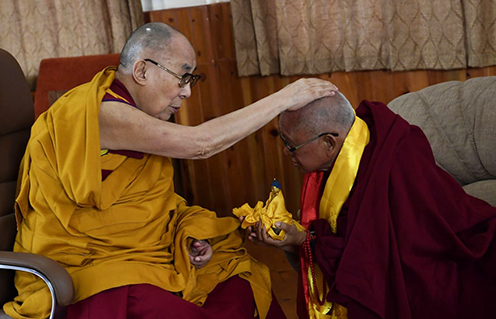
Lama Zopa Rinpoche with His Holiness the Dalai Lama, Dharamsala, India, 2020
POINTS FOR REFLECTION
As you read this chapter of Lama Zopa Rinpoche’s teachings and watch the video excerpts keep the following points in mind and reflect on them:
- What is the advantage of someone criticizing you?
- What is the problem with having wealth?
- How can you make your wealth beneficial?
- How is a bad condition like a virtuous friend?
- What is Choje Gotsangpa’s advice?
- What is Shakya Shri’s advice?
Once you have finished reading this chapter, do the related meditations and mindfulness practices.
Colophon for the Points for Reflection
The points for reflection were compiled by Ven. Joan Nicell, FPMT Education Services, August 2017.
Kharag Gomchung’s Lojong Advice
[Kharag Gomchung[1] said:]
If somebody praises you, it develops your attachment.
If somebody criticizes you, it shows you your mistakes.
The advantage when somebody criticizes you is that it shows you your mistakes, so it [helps you] destroy your mistakes. In other words, when you come to recognize your mistakes because other people brought your mistakes [to your attention], or because they complained to you, you start to see your mistakes and because of that, the advantage of that is, you can eliminate them. Like that, generally speaking, your life can become better and, of course, in Dharma, you can develop your mind to enlightenment.
Also if you become wealthy and rich, it can develop your pride and attachment very much. I’ve seen that extremely rich billionaires and millionaires often have so much attachment [to their money] that it is difficult for them to make charity. On the other hand, when there is fundraising for a project that needs a lot of financial help, it is normally the people who are poor, who don’t have much wealth, that make more charity, that do more of the giving. Those who are billionaires or zillionaires have so much attachment that even when they give, they tend to give less. That’s what I’ve heard and seen happen.
If you are wealthy, don’t be happy.
If you are poor, be happy.
That is one way of doing thought transformation so that pride and attachment don’t arise if you are wealthy. But another way is that if you become wealthy, you can make it worthwhile by making charity. And if you are a Buddhist, by that I mean you go for refuge to the Buddha, Dharma, and Sangha, you can collect unbelievable merit, or good luck, by building temples, statues, and stupas, [by printing] scriptures, by making offerings, and so forth. You can also make charity to sentient beings, to those who are homeless, those who lack food, and those who are sick. There are so many suffering sentient beings, even just human beings, in the world, so, if you are wealthy, you can make charity to numberless beings. In this way you can use your wealth to make your life beneficial for sentient beings.
On the other hand, if you aren’t wealthy, you don’t have to worry about protecting your wealth, you don’t have to do all the activities needed to protect your wealth, and you don’t have to create negative karma to do that, so you have much peace.
This is one example, but it shows that you can make both having and not having wealth beneficial for sentient beings. That’s one way to think.
Bad conditions are your virtuous friend.
Whenever you experience an adverse or bad condition, see it as a virtuous friend. This is because just like a virtuous friend explains karma—that from negative karma comes the result suffering and that from good karma comes the result happiness—so too do bad conditions or problems explain to you that you created negative karma in the past. By seeing that, it energizes you to abandon negative karma and to create good karma, the cause of happiness and success.
In addition, you can use your problems not only to understand that they came from your own negative karma, but to help you to do the particular lojong, as I said before, that uses obstacles, especially those to Dharma practice, in the path to enlightenment. By doing that, something you usually dislike becomes something that you like and need. So in this particular lojong you use problems to achieve your own enlightenment and to help other sentient beings achieve enlightenment. In this way, a problem, or a bad condition, becomes like a virtuous friend who explains karma to you, but it also makes you practice the special lojong.
Obstacles persuade you to engage in virtue.
In this way, experiencing obstacles becomes positive. Because of the obstacles you have, as I mentioned before, you do the special lojong that utilizes them in the path to enlightenment, for sentient beings to achieve enlightenment. Since you utilize them for that, they persuade you to virtue.
Suffering is a broom that sweeps negative karma away.
Like you use a broom to clean the dust and garbage from your room or house, your suffering—your sickness, such as cancer or diabetes, or whatever problem you have, such as relationship problems or depression—becomes positive because it has the benefit of cleaning away your suffering. Because experiencing suffering purifies your past negative karma, the cause of suffering, your depression, sickness, and so forth are good. So because suffering cleans away your past negative karma:
Don’t look at suffering as a mistake.
Kharag Gomchung, a Kadampa geshe, advised that your experiencing suffering now, any problem, depression, or cancer, or a relationship problem, makes past negative karma, the cause of that suffering, finish and so there won’t be any suffering, but only happiness, in the future. Just like there is only one sun in this universe but, due to its shining, all the animals, even insects, and all the human beings can enjoy themselves, you will have much happiness from life to life and then you will go to enlightenment. Therefore, rejoice in the suffering that you have, whether it is cancer, a headache, a toothache, depression, or a relationship problem, by seeing the benefits of experiencing what is happening to you. Then, there is great happiness.
[1] Kharag Gomchung Wangchug Lodro (Tib. kha rag sgom chung dbang phyug blo gros). Some of the following citations were found in his texts Seventy Exhortations (Tib. ang yig bdun cu ma) and Seventy-Two Exhortations (Tib. ang yig bdun cu rtsa gnyis pa).
Colophon
These teachings were given by Lama Zopa Rinpoche at Root Institute, Bodhgaya, February 5th, 2017. Transcribed from the audio recording by Ven. Ailsa Cameron, June 2017. Lightly edited by Ven. Joan Nicell, FPMT Education Services, August 2017.
Choje Gotsangpa’s Lojong Advice
Video 4: Experience Your Problem on Behalf of All Sentient Beings
(duration: 5 minutes)
(You can read the transcript of the video below. Alternatively, you can read the same transcript alongside the video by clicking here to download it or view it in a separate window.)
When you read the life story of Choje Gotsangpa,[1] a Kagyu lama and yogi, you see that he purposely chose to bear hardships to practice Dharma, due to which he almost died a few times. For example, several times he was attacked by lice in his meditation box and made charity of his body to the lice. But there are many other stories about him that I can’t remember. He didn’t like to start monasteries, centers, or anything of that kind for groups; instead he rejected them because they are objects of attachment. Looking at them in this way, he renounced them and lived alone and, even though he could have become rich, he purposely choose to bear hardships to practice Dharma. So comparing how he practiced Dharma to how I practice Dharma, I can’t say everybody here is like me, but my Dharma practice is just a joke. It’s just between my lips.
When you have a problem, such as depression, it’s very important to remember what I said. Otherwise when you are depressed you never think of bodhichitta, you never practice bodhichitta, and you think only of going to see an outside psychologist or doctor, like common worldly people do. So at that time, when you are depressed, you must remember what Choje Gotsangpa said:
By my experiencing this sickness, may all sentient beings, the numberless hell beings, numberless hungry ghosts, numberless animals, numberless human beings, numberless asura beings, and numberless sura beings, be free from all sicknesses and spirit harm. May they be free from all the negative karmas and all the defilements from where they came. By my experiencing this, may they all achieve the dharmakaya, enlightenment.
Remember this, whatever problem you have, so that you use your problem, depression or whatever it is, by experiencing it on behalf of all sentient beings. You experience it for the numberless hell beings, hungry ghosts, animals, human beings, asuras, and suras, wow, wow, wow, for every sentient being. Like that, while you are experiencing it, you make it most beneficial and most worthwhile for the numberless sentient beings. You understand? If you are intelligent, do like that. Do it whether you are intelligent or not! Sorry, I’m joking! That is Choje Gotsangpa’s advice.
(End of Video 4: Experience Your Problem on Behalf of All Sentient Beings)
[1] See the website The Treasury of Lives for a biography of Gotsangpa Gonpo Dorje (1189—1258), a disciple of Tsangpa Gyare Yeshe Dorje.
Colophon
These teachings were given by Lama Zopa Rinpoche at Root Institute, Bodhgaya, February 5th, 2017. Transcribed from the audio recording by Ven. Ailsa Cameron, June 2017. Lightly edited by Ven. Joan Nicell, FPMT Education Services, August 2017.
Panchen Shakya Shri’s Lojong Advice
Panchen Shakya Shri[1] mentioned:
KYI NA DE WA TSHOG SU NGO
When I am happy, I dedicate my happiness to collect merits:
PHÄN DE NAM KHA GANG WA SHOG
“May space be filled with benefit and happiness.”
DUG NA KÜN GYI DUG NGÄL KUR
When I am suffering, I carry the suffering of all myself:
DUG NGÄL GYA TSHO KEM PAR SHOG
“May the oceans of suffering dry up.”[2]
Panchen Shakya a great yogi, said, “When you are happy, dedicate your happiness to other sentient beings to collect merit.” You understand? Then, “May happiness and peace, like the sky,” means limitless like the sky, “be received.” The merit becomes like the sky, meaning it becomes limitless. “May each sentient being receive peace and happiness like the limitless sky.” You understand? When you are happy, do like that.
When you are happy, if you dedicate your happiness to every single sentient being, you collect more than skies of good luck, or merit, numberless times. Even if it is dedicated for one sentient being, you collect more merit than the sky. So now if you dedicate it for numberless sentient beings, you collect merit more than the sky numberless times. Then every sentient being receives peace and happiness filling the whole sky, like the limitless sky. That is the prayer; it is unbelievable.
Then, “When you are suffering, carry the suffering of all sentient beings: May the oceans of suffering dry up.” That means that when you suffer from depression or anything else, you carry all sentient beings’ suffering on yourself, or you take it on yourself, and you experience it for them. That actually means that their suffering absorbs into your self-cherishing thought, from where all your suffering and all the obstacles to your Dharma practice come, and destroys it. And when you destroy that, you also see that the real I, which ignorance believes in, which is not there, is totally false, that it is empty as it is empty. Through that, the root of your samsara, the ignorance holding it as truly existent is eliminated. You can think like that.
“When you suffer, carry all sentient beings’ suffering on you. May their oceans of suffering dry up.” That means may the oceans of suffering of each sentient being dry up, meaning may they become nonexistent, which means may they become enlightened.
[1] See the website The Treasury of Lives, for a biography of Shakya Shri (Śākya Śrī) (1853--1919).
[2] This verse is by Great Pandit Shakya Shri as quoted in The Mind Training Carrying Happiness and Suffering into the Path (Tib. Skyid sdug lam khyer gyi blo sbyong, Damngak Dzö, Volume 4, pp. 101-103, folios 4a7 to 5a3).
Colophon
These teachings were given by Lama Zopa Rinpoche at Root Institute, Bodhgaya, February 5th, 2017. Transcribed from the audio recording by Ven. Ailsa Cameron, June 2017. Lightly edited by Ven. Joan Nicell, FPMT Education Services, August 2017.
The Meditations
 When you have finished reading this chapter and watching the videos, do the following meditations by reflecting on the quotes drawn from Lama Zopa Rinpoche’s teachings. During the meditation session, you can re-read the related section of the chapter to refresh your memory. Try to make the meditations as personal and meaningful as possible.
To qualify for the Certificate of Achievement, each meditation session should last a minimum of half an hour. Start the session with a short bodhichitta motivation and, if you like, do some preliminary prayers. End the session with some dedication prayers. Spend at least 20 minutes of the session doing the actual meditation.
View or download:
To qualify for the Certificate of Achievement, keep track of the meditations you do using the Personal Log. Then, when you finish the entire module, tick them off in the Checklist for the Certificate of Achievement.
Meditation 7: Rejoice in Suffering
Kharag Gomchung, a Kadampa geshe, advised that your experiencing suffering now, any problem, depression, or cancer, or a relationship problem, makes past negative karma, the cause of that suffering, finish and so there won’t be any suffering, but only happiness, in the future. Just like there is only one sun in this universe but, due to its shining, all the animals, even insects, and all the human beings can enjoy themselves, you will have much happiness from life to life and then you will go to enlightenment. Therefore, rejoice in the suffering that you have, whether it is cancer, a headache, a toothache, depression, or a relationship problem, by seeing the benefits of experiencing what is happening to you. Then, there is great happiness. (Lama Zopa Rinpoche)
Think of the various kinds of suffering you are experiencing and rejoice in them by seeing the benefits of experiencing what is happening to you.
(To qualify for the Certificate of Achievement do this meditation at least one time.)
Meditation 8: Dedicate Your Happiness to Every Sentient Being
When you are happy, if you dedicate your happiness to every single sentient being, you collect more than skies of good luck, or merit, numberless times. Even if it is dedicated for one sentient being, you collect more merit than the sky. So now if you dedicate it for numberless sentient beings, you collect merit more than the sky numberless times. Then every sentient being receives peace and happiness filling the whole sky, like the limitless sky. That is the prayer; it is unbelievable. (Lama Zopa Rinpoche)
Think of the various kinds of happiness you are experiencing and dedicate it to every single sentient being.
(To qualify for the Certificate of Achievement do this meditation at least one time.)
Colophon for the Meditations
The meditations were compiled by Ven. Joan Nicell, FPMT Education Services, August 2017, for Living in the Path.
The Mindfulness Practices
 Dedicate an entire day to one mindfulness practice. As you go about your normal activities, try to bring that mindfulness practice to mind as often as possible by reflecting on the words of Lama Zopa Rinpoche.
To help you remember to do the mindfulness practices, print the Mindfulness Cards, cut them into the form of cards, and put them in places where you will see them easily and often throughout the day.
To qualify for the Certificate of Achievement, keep track of the mindfulness practices you do using the Personal Log. Then, when you finish the entire module, tick them off in the Checklist for the Certificate of Achievement.
Mindfulness Practice 6: Experience Problems on Behalf of All Sentient Beings
You must remember what Choje Gotsangpa said:
By my experiencing this sickness, may all sentient beings, the numberless hell beings, numberless hungry ghosts, numberless animals, numberless human beings, numberless sura beings, and numberless asura beings, be free from all sicknesses and spirit harm conditions. May they be free from all the negative karmas and all the defilements from where they came. By my experiencing this, may they all achieve the dharmakaya, enlightenment.
Remember this, whatever problem you have, so that you use your problem, depression or whatever it is, by experiencing it on behalf of all sentient beings. You experience it for the numberless hell beings, hungry ghosts, animals, human beings, suras, and asuras, wow, wow, wow, for every sentient being. Like that, while you are experiencing it, you make it most beneficial and most worthwhile for the numberless sentient beings. You understand? If you are intelligent, do like that. (Lama Zopa Rinpoche)
Practice mindfulness throughout the day that whenever you encounter any problems, even small ones, you are experiencing them on behalf of all sentient beings.