Chapter 3. Lojong is to Like Suffering
| サイト: | FPMT Online Learning Center |
| コース: | Transforming Kaka into Gold |
| ブック: | Chapter 3. Lojong is to Like Suffering |
| 印刷者: | Visitante |
| 日付: | 2026年 08月 27日(木曜日) 15:17 |
3. Lojong is to Like Suffering
It is mentioned in the teachings on thought transformation that lojong has to be done by the mind. You change the mind that dislikes the suffering and instead likes the suffering. With that mind you do lojong. You change the mind that dislikes the suffering. Generally, all sentient beings, we and even insects, dislike suffering and like happiness. But here, in lojong, you change the mind that dislikes suffering and make your mind like the suffering. You change your mind from disliking the suffering into liking the suffering. (Lama Zopa Rinpoche)
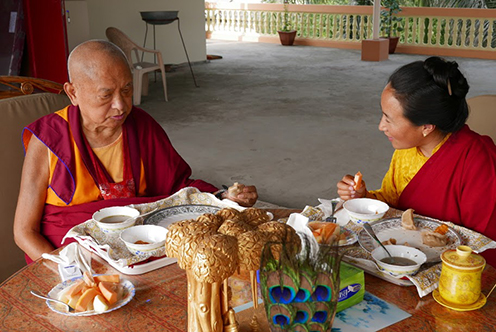
Lama Zopa Rinpoche with Khadrola (Rangjung Neljorma Khadro Namsel Dronme) at Root Institute, 2017 (photo by Ven. Losang Sherab)
POINTS FOR REFLECTION
As you read this chapter of Lama Zopa Rinpoche’s teachings and watch the video excerpts keep the following points in mind and reflect on them:
- What are some examples of what happens when self-cherishing is strong?
- Is the purpose of lojong to stop suffering?
- In what way do you change your mind when practicing lojong?
- What is the procedure for training your mind?
- What are the benefits of suffering and problems?
Once you have finished reading this chapter, do the related meditations and mindfulness practices.
Colophon for the Points for Reflection
The points for reflection were compiled by Ven. Joan Nicell, FPMT Education Services, August 2017.
Change Problems into Something You Need
Video 3: The Selfish Mind Makes Everything into an Enemy
(duration: 16 minutes)
(You can read the transcript of the video below. Alternatively, you can read the same transcript alongside the video by clicking here to download it or view it in a separate window.)
Even though the whole lamrim is lojong, the particular lojong found in the lamrim is so important. If you don’t know it and if you don’t practice it, what happens is:
NANG DZE THAM CHÄ DRA RU SHAR
Everything that appears around you becomes an enemy.
This means that anything that appears to you—whatever you see, whatever you hear, whatever you smell, whatever you taste—turns into an enemy, something that you don’t like. Because you don’t like anything that happens around you, everything becomes an enemy, your enemy. Nangdze thamche dra ru shar in Tibetan means “Everything that appears around you becomes your enemy.”
When your self-cherishing thought is too strong, when you have a very strong selfish mind, even if small birds outside make a chee-chee-chee noise, you get angry. You get angry that they don’t let you be quiet and think, “I want to get rid of these birds.” Then, you chase them away or something. Or even if a dog barks, you get angry at it, thinking, “It doesn’t let me be quiet.” If somebody brings you bread or something else that is cold instead of hot, you get angry at the cook. Or if there’s one flea in your bed while you are sleeping, waaaah! You get angry and move from that hotel to another hotel because one flea bit you. Then you say that the hotel is so bad. You do things like that.
When the mind is so selfish, so strong, everything turns negative. Everything, whatever happens, makes you get angry and complain. Then, it is very difficult for things to fit your desire, what you like. It is so hard to satisfy your mind, so difficult to satisfy your mind. Wooooo!
NANG DZE THAM CHÄ DRA RU SHAR
Everything that appears around you becomes an enemy.
Everything that happens, you get angry. It doesn’t fit your desire, your mind. Everything is something that you don’t like. Then, in a hotel or in a house, you don’t like or want even the decorations. You want to change them immediately. You want them this other way. Everything becomes a very big problem. Your mind becomes so difficult to satisfy.
Therefore, what I’m saying is to do the special thought transformation of making or transforming problems, things you think are harmful, useful to achieve enlightenment. You transform the problem that originally was an obstacle to enlightenment into something useful for your enlightenment for sentient beings. You use the obstacle to cause happiness to all sentient beings and to free them from the suffering of samsara. You use your problems like that. It is like transforming poisonous food, which causes death, into nectar, which makes your body and mind healthy and causes you a long life. By changing your mind, you transform the problem into something that you like. From an unwanted problem, you transform it into what you want and what you need. It becomes something you need. Before you didn’t need it, but now you need it! You make it something you need for your enlightenment.
Therefore, lojong, thought transformation, is not to stop suffering. It is not to stop pain or a sickness, such as cancer or whatever, or a problem. You don’t practice real lojong to stop the problem. If the problem is stopped, such as cancer, a sickness, or pain, you have no opportunity to do lojong. Because the pain is stopped, you don’t have an opportunity to practice lojong. Therefore, to use it for lojong you need the pain or the person’s anger or the person’s abuse or whatever problem it is. You need the problem to utilize it to achieve enlightenment, to cause happiness to numberless sentient beings. But if the problem is stopped, you have no opportunity to do lojong. Okay? So the purpose of lojong is not that. Many people might think it’s to stop the sickness or whatever it is, but it’s not that. That’s not the real reason. Instead, while you have sickness, while you have the problem, you can do lojong.
It is mentioned in the teachings on thought transformation that lojong has to be done by the mind. You change the mind that dislikes the suffering and instead likes the suffering. With that mind you do lojong. You change the mind that dislikes the suffering. Generally, we have dislike for suffering and like happiness. All sentient beings, even insects, are the same. But here, in lojong, you change the mind that dislikes suffering and make your mind like the suffering. You change your mind from disliking the suffering into liking the suffering.
You do that and then from the morning you motivate that when a problem comes, whenever you face a problem, you try to build up your courage, thinking, “I will never let myself be easily disturbed or bothered.” Basically if you are selfish, that’s what happens. As I mentioned before, everything turns into something negative, so it becomes easy for you to be disturbed by what you see, what you hear, and what you smell. In the end, everything disturbs you. So instead from the morning you build up your courage, thinking, “I won’t let myself be so easily disturbed. I won’t be like this.” You encourage yourself to look at the problem as pleasure and not let it bother you. You don’t allow things to bother you so easily. You make yourself strong, not like that.
Then, you abandon the thought that dislikes the discomfort, the suffering, or the problem and establish the thought that likes the suffering, by thinking of the benefits of the suffering. You train your mind beginning with a small discomfort, a small suffering. You try to practice like this with the small ones, and then gradually you can do it even with the great pains and great obstacles. You can utilize them or transform them into pleasure. As your mind gets trained and develops, you can use even great problems to achieve peerless happiness, enlightenment, for sentient beings. You can utilize obstacles to practicing Dharma to achieve enlightenment for sentient beings. You can do that.
So first you train with small sufferings and discomforts. Then, as you get more and more trained, later you can transform even big problems into pleasure. In this way, you energize yourself and stop the thought of dislike. Normally even insects have dislike for suffering and like happiness. But in this particular lojong you change the dislike for suffering into the dislike for comfort and the like for suffering. So rather than as before having no need for the problem, now you change your mind and the problem becomes something you need to achieve enlightenment.
(End of Video 3: The Selfish Mind Makes Everything into an Enemy)
Colophon
These teachings were given by Lama Zopa Rinpoche at Root Institute, Bodhgaya, February 5th, 2017. Transcribed from the audio recording by Ven. Ailsa Cameron, June 2017. Lightly edited by Ven. Joan Nicell, FPMT Education Services, August 2017.
The Benefits of Problems
The benefits of suffering and problems are mentioned in Bodhicharyavatara (v. 6.21):
[ZHÄN YANG DUG NGÄL YÖN TÄN NI
Moreover, suffering has good qualities:
KYO WÄ DREG PA SEL WAR JE
Through being depressed by it, pride is eliminated,]
KHOR WA PA LA NYING JE KYE
You generate compassion for those in samsara,
DIG LA DZOM ZHING GE LA GA
Your negative karma is destroyed, and you delight in virtue.
When you have a problem, for example, when you have cancer or any other disease, it destroys your pride. Also when you see other beings suffering in samsara, who are the same as you in having cancer, AIDS, or whatever problems you have, you feel compassion for them.
For example, there was a student at Chenrezig Institute who had AIDS. When he was at Chenrezig Institute, he did the practice of the Medicine Buddha and took the eight Mahayana precepts. He disciplined himself and his AIDS got better. When he was more healthy, he went into the town to help other people with AIDS. He was busy trying to help others but because he didn’t get much time to discipline himself, his health would get worse. So again he would come back to Chenrezig Institute where he was able to discipline himself by taking the eight Mahayana precepts and doing the Medicine Buddha practice, so again his health got better. Then again he went to the city to help other AIDS people. Like that, because he got AIDS, he felt compassion the more he thought of other people who had AIDS. That’s why I’m telling this story, as proof of this. But also this story shows that if you discipline yourself by practicing Medicine Buddha and taking the eight Mahayana precepts, you get better, whereas when you don’t discipline yourself, when you become loose, your AIDS gets worse and again you have to build up your discipline.
When you recognize that your sickness or your relationship problems, all the problems that go on and on, come from your past negative karma, from not controlling your attachment, you become careful to not create negative karma. Because of the problems, you abandon creating negative karma, such as sexual misconduct and so forth, you get energy to control your attachment, and then your mind is happy to collect virtue.
In short, by seeing the problems you have, you are happy to abandon their causes. Then to have happiness, you need to create virtue, so you are happy to collect virtue. Also seeing the problems you have helps you develop renunciation to samsara.
Colophon
These teachings were given by Lama Zopa Rinpoche at Root Institute, Bodhgaya, February 5th, 2017. Transcribed from the audio recording by Ven. Ailsa Cameron, June 2017. Lightly edited by Ven. Joan Nicell, FPMT Education Services, August 2017.
The Meditations
 When you have finished reading this chapter and watching the videos, do the following meditations by reflecting on the quotes drawn from Lama Zopa Rinpoche’s teachings. During the meditation session, you can re-read the related section of the chapter to refresh your memory. Try to make the meditations as personal and meaningful as possible.
To qualify for the Certificate of Achievement, each meditation session should last a minimum of half an hour. Start the session with a short bodhichitta motivation and, if you like, do some preliminary prayers. End the session with some dedication prayers. Spend at least 20 minutes of the session doing the actual meditation.
View or download:
To qualify for the Certificate of Achievement, keep track of the meditations you do using the Personal Log. Then, when you finish the entire module, tick them off in the Checklist for the Certificate of Achievement.
Meditation 5: Everything Becomes an Enemy
NANG DZE THAM CHÄ DRA RU SHAR
Everything that appears around you becomes an enemy.
When your self-cherishing thought is too strong, when you have a very strong selfish mind, even if small birds outside make a chee-chee-chee noise, you get angry. You get angry that they don’t let you be quiet and think, “I want to get rid of these birds.” Then, you chase them away or something. Or even if a dog barks, you get angry at it, thinking, “It doesn’t let me be quiet.” If somebody brings you bread or something else that is cold instead of hot, you get angry at the cook. Or if there’s one flea in your bed while you are sleeping, waaaah! You get angry and move from that hotel to another hotel because one flea bit you. Then you say that the hotel is so bad. You do things like that.
When the mind is so selfish, so strong, everything turns negative. Everything, whatever happens, makes you get angry and complain. Then, it is very difficult for things to fit your desire, what you like. It is so hard to satisfy your mind, so difficult to satisfy your mind. (Lama Zopa Rinpoche)
Meditate remembering small unpleasant experiences that made you angry because of selfishness.
(To qualify for the Certificate of Achievement do this meditation at least one time.)
Meditation 6: Learning to Like Suffering
You abandon the thought that dislikes the discomfort, the suffering, or the problem and establish the thought that likes the suffering, by thinking of the benefits of the suffering. You train your mind beginning with a small discomfort, a small suffering. You try to practice like this with the small ones, and then gradually you can do it even with the great pains and great obstacles. You can utilize them or transform them into pleasure. As your mind gets trained and develops, you can use even great problems to achieve peerless happiness, enlightenment, for sentient beings. You can utilize obstacles to practicing Dharma to achieve enlightenment for sentient beings. You can do that. (Lama Zopa Rinpoche)
Meditate on small problems and suffering that you have experienced or are experiencing, think about their benefits, and try to change your mind into liking them.
(To qualify for the Certificate of Achievement do this meditation at least two times.)
Colophon for the Meditations
The meditations were compiled by Ven. Joan Nicell, FPMT Education Services, August 2017, for Living in the Path.
The Mindfulness Practices
 Dedicate an entire day to one mindfulness practice. As you go about your normal activities, try to bring that mindfulness practice to mind as often as possible by reflecting on the words of Lama Zopa Rinpoche.
To help you remember to do the mindfulness practices, print the Mindfulness Cards, cut them into the form of cards, and put them in places where you will see them easily and often throughout the day.
To qualify for the Certificate of Achievement, keep track of the mindfulness practices you do using the Personal Log. Then, when you finish the entire module, tick them off in the Checklist for the Certificate of Achievement.
Mindfulness Practice 4: I Won’t Let Things Bother Me
From the morning you motivate that when a problem comes, whenever you face a problem, you try to build up your courage, thinking, “I will never let myself be easily disturbed or bothered.” Basically if you are selfish, that’s what happens. As I mentioned before, everything turns into something negative, so it becomes easy for you to be disturbed by what you see, what you hear, and what you smell. In the end, everything disturbs you. So instead from the morning you build up your courage, thinking, “I won’t let myself be so easily disturbed. I won’t be like this.” You encourage yourself to look at the problem as pleasure and not let it bother you. You don’t allow things to bother you so easily. You make yourself strong, not like that. (Lama Zopa Rinpoche)
In the morning set your motivation thinking, “I will not let myself be easily disturbed or bothered,” and then practice mindfulness throughout the day looking at problems as pleasure and not letting them easily bother you.
(To qualify for the Certificate of Achievement do this mindfulness practice as much as possible for two full days.)
Mindfulness Practice 5: All My Problems Come from My Negative Karma
When you recognize that your sickness or your relationship problems, all the problems that go on and on, come from your past negative karma, from not controlling your attachment, you become careful to not create negative karma. Because of the problems, you abandon creating negative karma, such as sexual misconduct and so forth, you get energy to control your attachment, and then your mind is happy to collect virtue.
In short, by seeing the problems you have, you are happy to abandon their causes. Then to have happiness, you need to create virtue, so you are happy to collect virtue. Also seeing the problems you have helps you develop renunciation to samsara. (Lama Zopa Rinpoche)
Practice mindfulness throughout the day remembering that any unpleasant experiences that happen come from negative karma you created in the past and so abandon negative karma and collect virtue.