Chapter 1. Lojong Makes Your Mind So Happy
| サイト: | FPMT Online Learning Center |
| コース: | Transforming Kaka into Gold |
| ブック: | Chapter 1. Lojong Makes Your Mind So Happy |
| 印刷者: | Visitante |
| 日付: | 2026年 08月 27日(木曜日) 15:17 |
1. Lojong Makes Your Mind So Happy
When your mind is trained in lojong, the lamrim lojong, whenever you face a problem your mind is so happy. Why is your mind is so happy? It is totally opposite to how people think in the West—your mind is so happy because you are experiencing the suffering of the six-realm sentient beings. Because your mind is already trained in bodhichitta, your mind is so happy when you meet a problem, any problem. If somebody is angry with you or somebody accuses you, your mind is so happy. If somebody talks about your mistakes or a doctor says that you have cancer, your mind is so happy. (Lama Zopa Rinpoche)
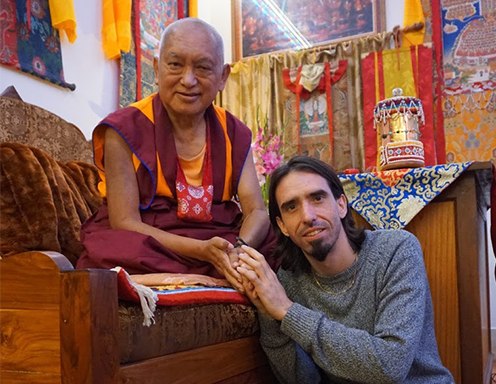
Lama Zopa Rinpoche with Tenzin Osel Rinpoche at Root Institute, 2017 (photo by Ven. Losang Sherab)
POINTS FOR REFLECTION
As you read this chapter of Lama Zopa Rinpoche’s teachings and watch the video excerpts keep the following points in mind and reflect on them:
- What is the best motivation for reading these teachings on lojong?
- What is special about the lojong found in the lamrim?
- What happens when you have too much luxury and comfort?
- What happens when you have too many problems?
- Why does the concept of permanence cheat you?
- Who or what should you blame for all your problems?
- Who or what do most people blame?
- What practice brings real peace and happiness in your heart?
- What are some of the analogies of bodhichitta?
- What happens when your mind is trained in lojong?
Once you have finished reading this chapter, do the related meditations and mindfulness practices.
Colophon for the Points for Reflection
The points for reflection were compiled by Ven. Joan Nicell, FPMT Education Services, August 2017.
The Motivation for Studying Lojong
Study[1] [these teachings] with a proper motivation and with the best motivation, that of bodhichitta, so that studying them becomes the path to achieve buddhahood and, not only that, that it becomes a cause of the happiness of all sentient beings, not only of their temporary happiness but of the peerless happiness of buddhahood, that is, that it becomes a cause for all sentient beings to achieve buddhahood.
If you study the teachings with a bodhichitta motivation, even if you don’t have the realization of bodhichitta and instead have an effortful motivation of bodhichitta, it becomes a cause of the happiness of every sentient being, for example, of every single animal—every single fish and creature living in the water, those that are the size of mountains and the smallest ones whose name I don’t remember, as well all the numberless animals living under the ground, in the bushes, in the grass, in the trees, and flying in the sky—and also the numberless hell beings, hungry ghosts, human beings, asuras, and suras. Bodhichitta is what makes your life the most beneficial for all sentient beings and what makes your life the happiest and the best. Therefore, think:
The purpose of my life is not just to achieve happiness for myself but to free the numberless sentient beings from the oceans of samsaric suffering and bring them to full enlightenment, peerless happiness, the cessation of obscurations and completion of realizations, sanggye,[2] by myself alone. To do that, I myself must first achieve the state of omniscience. Therefore, I’m going to study these teachings on lojong, thought transformation.”[3]
[1] The original word “listen” used in the context of an oral teaching has been changed to “study” in this paragraph.
[2] Tib. sangs rgyas. Lama Zopa Rinpoche translates the meaning of sangs (purify or cleanse) as “the cessation of obscurations,” and the meaning of rgyas (increase or develop) as “the completion of realizations.”
[3] Lama Zopa Rinpoche gave these teachings in the context of giving the oral transmission, or lung, of Namkha Pal’s Mind Training Like the Rays of the Sun, which is a commentary to Kadampa Geshe Chekawa’s Seven Points of Thought Transformation. Therefore, Rinpoche actually said: “Therefore, I’m going to take the lung on the commentary to Seven Points of Thought Transformation.”
Colophon
These teachings were given by Lama Zopa Rinpoche at Root Institute, Bodhgaya, February 5th, 2017. Transcribed from the audio recording by Ven. Ailsa Cameron, June 2017. Lightly edited by Ven. Joan Nicell, FPMT Education Services, August 2017.
The Special Lojong
From the beginning of the lamrim, the root of the path to enlightenment or correctly following the virtuous friend, up to omniscient mind, it is all lojong, or thought transformation. Although the whole lamrim, the graduated path to enlightenment, is lojong, there is a particular lojong found in the lamrim that utilizes obstacles and misfortunes in the path to enlightenment. Like transforming poison into medicine or transforming kaka into gold, by transforming obstacles, they become the utmost need in your life. All the obstacles to practicing Dharma, the misfortunes, and black magic, and when nothing is working and everything is stuck, by practicing the particular lojong from the lamrim you utilize these in the path to enlightenment, in the path to the happiness of all sentient beings, not just their temporary happiness but their ultimate happiness, the enlightenment of all sentient beings.
Then, [these obstacles and misfortunes become] very important and needed because otherwise, when your life is very luxurious and comfortable, Dharma practice doesn’t happen. Or when you have too much trouble or depression, you are again unable to practice. If you have too much luxury and comfort, you don’t remember impermanence-death and so your life is totally distracted and you don’t practice Dharma. And if your life is in depression or some other obstacle, again it becomes difficult to practice Dharma because your mind is overwhelmed by problems. You understand? In that way, the time to practice Dharma becomes almost nothing, hardly anything.
You have to understand why you need lojong, thought transformation. You have to understand the need as otherwise, in the West, life is taken for granted and then it finishes. Then, one day, sooner or later, your opportunity is lost. It is gone.
All the time you see your father die, you mother die, your brothers die, your sisters die, your family and friends die, but you never think of your own death. You never think of your own death. You are going to die any second but you never think that, even though you see death around you all the time. You understand? You never think that and instead you think, “I’m going to live for a long time.” You can’t promise you will never die, but you always believe, “I’m going to live for a long time.” That concept of permanence cheats you totally! It totally cheats your life. “Before I practice Dharma, before I do retreat, I need to do this. I need to do that.” Thinking like that, your practice is delayed, suddenly death comes, and everything is finished. You have no more time left.
Usually it is like that. You never think that you are going to die any time. You don’t think that even though you see other people dying, especially nowadays from cancer. So many people are dying of cancer, however, in America these days [the leading cause of death is] not cancer. What is it? Is it high blood pressure? No, heart attacks.[1] Maybe cancer is the third or second [leading cause of death], I’m not sure.
Anyway you never think you are going to die. You are always going to live, so much more, so much more. You are always going to live. So then you completely cheat and deceive yourself. Even if you meet Dharma, you never practice it. You never practice it. That’s how you deceive yourself. Nobody cheats you. You deceive yourself.
Even if you are very learned, you know all the Kangyur, the more than one hundred volumes of the Buddha’s teachings, [and the Tengyur], the more than two hundred volumes of commentaries on the Buddha’s teachings, those written by Nagarjuna, Asanga, Chandrakirti, all the pandits from Nalanda, and so forth, even if you know all those by heart and can explain them well, it is possible that you never think of the impermanence-death of yourself, of you. Then, you will die soon but you didn’t get to practice Dharma.
When death comes, there is so much fear and worry about separating from your family, from your wealth, and from your body, which you cherished most among the numberless sentient beings. You have to leave all these. Then there is the worry and fear of your negative karma and that you will have to experience the lower realms or even the upper realms. Can you imagine the worry and fear? It’s amazing. You die with great worry and fear, with tears falling. Even when birds, such as peacocks and pheasants, die, tears come to their eyes. I saw that this happens at their death time. They don’t speak a language, like we who can communicate, but the feeling is the same and tears come to their eyes, and then they die.
[1] Lama Zopa Rinpoche is referring to the fact that he has been told that the leading cause of death in the USA is heart disease, not cancer, which is what he used to think.
Colophon
These teachings were given by Lama Zopa Rinpoche at Root Institute, Bodhgaya, February 5th, 2017. Transcribed from the audio recording by Ven. Ailsa Cameron, June 2017. Lightly edited by Ven. Joan Nicell, FPMT Education Services, August 2017.
The Essence of Lojong
Video 1: Blame Your Self-Cherishing
(duration: 8 minutes)
(You can read the transcript of the video below. Alternatively, you can read the same transcript alongside the video by clicking here to download it or view it in a separate window.)
Kadampa Geshe Chekawa mentions in the root verses of Seven Points of Thought Transformation:
LE LÄN THAM CHÄ CHIG LA DA
Put all the blame on one.
KÜN LA KA DRIN CHHE WAR GOM
Meditate on everyone as kind.
When any problem arises, immediately, without the delay of even a second, blame the one. Who is “the one”? It is your own mind. From where hell and enlightenment, samsara and nirvana, and everyday happiness and problems come is your mind. All that you experience comes from your mind, your own mind, your self-cherishing thought. So “Put all the blame on one” means put all the blame for anything you dislike, for any problem, for any undesirable thing, on your self-cherishing thought.
LE LÄN THAM CHÄ CHIG LA DA
Put all the blame on one.
Other than the people who practice the Mahayana teachings, those who look at the selfish mind as the enemy and look at other sentient beings as most kind because they are from where all their past, present, future happiness come, the majority of people in the normal world, those who haven’t met the Mahayana teachings and those who even though they know the Mahayana teachings intellectually don’t practice them, when any problem or undesirable thing arises, they immediately blame it on others, those from whom they receive all their past, present, and future happiness, including enlightenment, and from whom all the realizations come. They point to and blame outside enemies for all their problems.
[Like them,] you cherish your self-cherishing thought, from where suffering and all the obstacles come—the real enemy and mara.[1] You consider this one to be the most important. You cherish it the most. You cherish your real enemy the most. And you consider others, those from whom you receive all happiness, those from whom Buddha, Dharma, and Sangha come, those who have been your mother, to be your enemy, from where all the problems come, from outside, from out there. It is totally opposite! The recognition is totally opposite. Except for those who practice bodhichitta and lojong, this is the mistake of the world in general, including those who understand these intellectually but don’t practice them. They do the same thing as people who don’t know the Dharma, who have never met Dharma, and who don’t know the Mahayana teachings, that is, when a problem comes, they blame others. They think that their problems come from outside. But from where the problem came is the selfish mind. You have to understand that mistake.
In short, the practice is that when obstacles come, when any undesirable thing arises at any time, to put all the blame, without the delay of even a second, on the one—your own self-cherishing thought.
Then:
KÜN LA KA DRIN CHHE WAR GOM
Meditate on everyone as kind.
In reality you should meditate only on the kindness of others. Think that all your happiness, past, present, and future, came from sentient beings and then meditate on their kindness. That’s the practice. That is the practice. You understand? Only when you practice this is there real peace and happiness in your heart, and not only satisfaction but also fulfillment. This happens only if you are practicing this. Otherwise, although there are many people who recite a lot of mantras, circumambulate [holy objects], read Dharma texts, and do many things externally, the people who do real Dharma practice, the real practice of the Mahayana teachings, are very rare. That the mind really becomes Dharma and practices the Mahayana teachings by putting all the blame on one and meditating on everyone as kind is very rare. That mind is so rare.
(End of Video 1: Blame Your Self-Cherishing)
[1] “Mara” is a Sanskrit word that can be translated into English as “demon.”
Colophon
These teachings were given by Lama Zopa Rinpoche at Root Institute, Bodhgaya, February 5th, 2017. Transcribed from the audio recording by Ven. Ailsa Cameron, June 2017. Lightly edited by Ven. Joan Nicell, FPMT Education Services, August 2017.
Lojong Brings Happiness
There was a monk from Nalanda Monastery in France who had studied from learned geshes, such as Geshe Kelsang, Geshe Jampa Gyatso, and Geshe Jampa Tegchok. He started the Masters Program in Lama Tzong Khapa Institute in Italy after discussing it with Lama Yeshe. He studied much philosophy for a long time, such as Madhyamaka, Abhisamayalamkara, and even Drang Nge Legshe Nyingpo, Heart of the Good Explanations of Interpretative and Definitive Meanings, written by Lama Tsongkhapa. But after studying all those texts, he told me, “Tibetan Buddhism doesn’t bring me happiness.” He said that, even though he had studied so much. He didn’t understand [these teachings] because he didn’t practice their meaning. He didn’t practice their essence—lojong. He didn’t practice that example, the root [of lojong]: “Put all the blame on one. Meditate on others as kind.” The benefits of cherishing others and the shortcomings of cherishing I didn’t get done. Changing the mind from a selfish mind into benefiting and cherishing others didn’t get done. Because of that, happiness didn’t come. Real peace and happiness in the heart, as well as satisfaction and fulfillment, didn’t come. So then he said, “I studied Tibetan Buddhism, but Tibetan Buddhism didn’t bring me happiness.” Waaaah! That happened. You understand? He didn’t realize it was due to thinking [that studying philosophy is] only about intellectual understanding. He didn’t recognize that and didn’t practice [lojong]. You have to know that.
As Shantideva says, “A person who carries a whole load of medicine but never eats it will never recover from their sickness.”[1] You have to understand that, otherwise, there is the danger that you learn so much intellectually, but don’t practice it, like carrying medicine or like storing it in your house, like in a museum, and not eating it even though you have a sickness. You understand? Although you have all the understanding of Buddhism intellectually but, like feeding a computer with so many things, you just feed your brain with it but don’t practice it.
There is a precious teaching from the sutra Dongpo Kopai Do,[2] [cited by Namkha Pal in his Mind Training Like the Rays of the Sun], in which the Buddha begins by saying rig kyi bu,[3] which I translate as “son of the race.” It means someone who will become a buddha and work for sentient beings, that is, someone of the Mahayana race. The word “son” doesn’t have anything to do with the sex; it means someone who has bodhichitta, who will become enlightened, and who will work for sentient beings, like the Buddha.
Dongpo Kopai Do says:
Son of the race, bodhichitta is like the seed of all the Buddha’s qualities.
Bodhichitta is like the seed of all the Buddha’s dharmas, all the dharmas, or all the Buddha’s qualities.
Bodhichitta is like a field for increasing the white Dharma of all transmigratory beings.
Bodhichitta is like a field in which to develop our crop of virtue.
Bodhichitta is like the earth on which all the world depends.
All the world—all enjoyments and all beings—depend on, or come from, bodhichitta, so bodhichitta is like the earth.
Bodhichitta is like Son of Namtho, cutting off all poverty.
Son of Namtho[4] is a guardian of wealth who relieves sentient beings’ poverty by giving them wealth. Bodhichitta, like Son of Namtho, cuts off all the poverty of sentient beings.
Bodhichitta is like a father, protecting completely all bodhisattvas.
Bodhichitta is like the king of wish-granting jewels, bringing all success.
Bodhichitta is like a wish-fulfilling vase, making all wishes succeed.
Bodhichitta is like a short spear, defeating the enemy that is delusion.
Bodhichitta is like armor, ceasing the remembering of all unrighteous things.
Bodhichitta is like sword, cutting the heads of all delusions.
Bodhichitta is like an axe, cutting the tree of delusion.
Bodhichitta is like a weapon, protecting from all harm.
Bodhichitta is like a hook, making one stay above the water of samsara.
Bodhichitta is like chilpa[5], a hook, which makes you abide above the water of samsara and not sink. When something makes you sink in the water of samsara, bodhichitta is like a hook that makes you stay above it.
Bodhichitta is like a wind mandala, making the root of obscuration and covering blow away.
Bodhichitta is like the abbreviated content,[6] containing all the bodhisattvas’ prayers and conduct.
Bodhichitta is like a stupa since the world of suras, human beings, and asuras make offerings to it.
Son of the race, like that, bodhichitta has all those qualities and other limitless particular qualities.
As mentioned above, bodhichitta is the particular door to enter the Mahayana path to achieve buddhahood (the total cessation of obscurations and completion of realizations). When bodhichitta is generated in one’s continuum, it burns the obscurations of all the negative karma collected from beginningless rebirths. Bodhichitta guards one from all sufferings and fears. Bodhichitta unceasingly[7] gives one all results, temporary and ultimate.[8]
Like the essence of the butter that comes from churning the oceans of Buddha’s teachings, by seeing the benefits of bodhichitta, which is like the real seed that is the particular cause of achieving enlightenment, from the depths of your heart be happy.
Generally, after having received a perfect human rebirth, one has the opportunity to practice the holy Dharma, especially the [two] bodhichittas of the Mahayana path. What I have found is well found. To generate a strong wish is very important.
When your mind is trained in lojong, the lamrim lojong, whenever you face a problem your mind is so happy. Why is your mind is so happy? It is totally opposite to how people think in the West—your mind is so happy because you are experiencing the suffering of the six-realm sentient beings. Because your mind is trained in bodhichitta, your mind is so happy when you meet a problem, any problem. If somebody is angry with you or somebody accuses you, your mind is happy. If somebody talks about your mistakes or a doctor says that you have cancer, your mind is happy.
In short, when your mind is trained in lojong, you don’t think, “Oh, poor me, I have cancer, ooooh.” Instead, whenever you face a problem, your mind is so happy. Why? Because you think that you have received the problems of all sentient beings upon yourself as a result of praying for that to happen. It is like when, during summer time, Geshe Lama Konchog fell down the steps very heavily in front of the Tara statue at Kopan and,[9] because he thought that he had received my life obstacles on himself, he was so happy. His mind was very happy.
[1] The editor was unable to find this quotation in Engaging in the Deeds of a Bodhisattva, but perhaps it is comes from Compendium of Trainings. The King of Meditative Stabilization Sutra says something similar:
I have explained this very good teaching.
Yet if you, having heard it, do not practice correctly,
Then just like a sick person holding on to a bag of medicine,
Your illness cannot be cured.
[2] Tib. sdong po bkod pa'i mdo. Eng. Array of Stalks Sutra.
[3] Tib. rigs kyi bu.
[4] Tib. rnam thos kyi bu. Skt. Vaishravana. Also known as rnam thos sras.
[5] Lama Zopa Rinpoche initially thought that ‘chil pa, translated here as “hook,” might refer to some kind of animal skin or a certain kind of fish, but Geshe Ngawang Rabga, resident teacher at Root Institute, Bodhgaya, suggested to Rinpoche that it means “hook,” so Rinpoche used that translation.
[6] Tib. mdor bstan. This can also be translated as “synthesis” or “summary.”
[7] Tib. mi shes pa.
[8] Tib. mngon mtho dang nges legs. Literally, higher state and definite goodness.
[9] Geshe Lama Konchog was a good friend of Lama Yeshe and a teacher of the monks at Kopan Monastery in Nepal for many years.
Colophon
These teachings were given by Lama Zopa Rinpoche at Root Institute, Bodhgaya, February 5th, 2017. Transcribed from the audio recording by Ven. Ailsa Cameron, June 2017. Lightly edited by Ven. Joan Nicell, FPMT Education Services, August 2017.
The Meditations
 When you have finished reading this chapter and watching the videos, do the following meditations by reflecting on the quotes drawn from Lama Zopa Rinpoche’s teachings. During the meditation session, you can re-read the related section of the chapter to refresh your memory. Try to make the meditations as personal and meaningful as possible.
To qualify for the Certificate of Achievement, each meditation session should last a minimum of half an hour. Start the session with a short bodhichitta motivation and, if you like, do some preliminary prayers. End the session with some dedication prayers. Spend at least 20 minutes of the session doing the actual meditation.
View or download:
To qualify for the Certificate of Achievement, keep track of the meditations you do using the Personal Log. Then, when you finish the entire module, tick them off in the Checklist for the Certificate of Achievement.
Meditation 1: Blame the Self-Cherishing Thought
LE LÄN THAM CHÄ CHIG LA DA
Put all the blame on one.
When any problem arises, immediately, without the delay of even a second, blame the one. Who is “the one”? It is your own mind. From where hell and enlightenment, samsara and nirvana, and everyday happiness and problems come is your mind. All that you experience comes from your mind, your own mind, your self-cherishing thought. So “Put all the blame on one” means put all the blame for anything you dislike, for any problem, for any undesirable thing, on your self-cherishing thought. (Lama Zopa Rinpoche)
Meditate on how your self-cherishing thought is to blame for any problem you have ever experienced, are experiencing, and will experience.
(To qualify for the Certificate of Achievement do this meditation at least one time.)
Meditation 2: Think of Everyone as Kind
KÜN LA KA DRIN CHHE WAR GOM
Meditate on everyone as kind.
In reality you should meditate only on the kindness of others. Think that all your happiness, past, present, and future, came from sentient beings and then meditate on their kindness. That’s the practice. That is the practice. You understand? Only when you practice this is there real peace and happiness in your heart, and not only satisfaction but also fulfillment. (Lama Zopa Rinpoche)
Meditate on how others are kind in that they are the source of all your past, present, and future happiness.
(To qualify for the Certificate of Achievement do this meditation at least one time.)
Colophon for the Meditations
The meditations were compiled by Ven. Joan Nicell, FPMT Education Services, August 2017, for Living in the Path.
The Mindfulness Practices
 Dedicate an entire day to one mindfulness practice. As you go about your normal activities, try to bring that mindfulness practice to mind as often as possible by reflecting on the words of Lama Zopa Rinpoche.
To help you remember to do the mindfulness practices, print the Mindfulness Cards, cut them into the form of cards, and put them in places where you will see them easily and often throughout the day.
To qualify for the Certificate of Achievement, keep track of the mindfulness practices you do using the Personal Log. Then, when you finish the entire module, tick them off in the Checklist for the Certificate of Achievement.
Mindfulness Practice 1: Put All the Blame on One
LE LÄN THAM CHÄ CHIG LA DA
Put all the blame on one.
Practice mindfulness throughout the day of putting the blame for any difficulty, problem, or suffering that occurs on your own self-cherishing thought.
(To qualify for the Certificate of Achievement do this mindfulness practice as much as possible for two full days.)
Mindfulness Practice 2: Realizing Every Thing is Like a Mirage
Mindfulness Practice 2: Meditate on Everyone as Kind
KÜN LA KA DRIN CHHE WAR GOM
Meditate on everyone as kind.
Practice mindfulness throughout the day of all the kindness you receive from others.
(To qualify for the Certificate of Achievement do this mindfulness practice as much as possible for two full days.)
Colophon for the Mindfulness Practices
The mindfulness practices were compiled by Ven. Joan Nicell, FPMT Education Services, August 2017, for Living in the Path.
The Service Practice
Preparing for Your Death
 Write down in your diary book [that tonglen is the best meditation to do when you are dying] so that you will remember that. In Singapore, I told people to write down in a book what they want to do and what they want to meditate on when they are dying. Besides your will, write down the meditations that you are going to do and how you are going to think when you die. You must write it down. In Singapore I told the students there to write this down now to prepare their minds. It is very important![1]
If you are a Dharma practitioner, you have to prepare like that so you have no worry or fear about being born in the lower realms and all those other things, such as separating from your family and friends, your girlfriend or boyfriend, from your possessions, and even from the body that you have cherished most among the sentient beings. Even leaving this body, you will have no worry. Your mind will very happily leave it and your consciousness will transfer from this body to a pure land and so forth. (Lama Zopa Rinpoche, in chapter 5 of this course)
Begin preparations for your death by writing down in a diary, notebook, or computer file what you want to meditate on and what you want to do when you are dying. Make sure that you will be able to find the diary, notebook, or computer file easily, when it comes time to make use of it.
(To qualify for the Certificate of Achievement write down what you want to meditate on and what you want to do when you are dying.)