Chapters 1-6 of Lama Zopa Rinpoche's Teachings
| Sitio: | FPMT Online Learning Center |
| Curso: | Bodhichitta Mindfulness |
| Libro: | Chapters 1-6 of Lama Zopa Rinpoche's Teachings |
| Impreso por: | Invitado |
| Fecha: | domingo, 11 de octubre de 2026, 20:16 |
1. Bodhichitta Brings Happiness
By practicing the good heart, even for yourself, in day-to-day, moment-to-moment life, there is happiness even for yourself – a comfortable life, a life without fear, depression, guilt. All of these things – the package of sufferings – don’t happen. You don’t engage, because of the good heart, in all those things. It brings happiness to you, happiness now, happiness like the sun shining in this world, and happiness in future lives for yourself. Also, it brings peace in the world, towards other sentient beings, for anybody who is around you. (Lama Zopa Rinpoche)
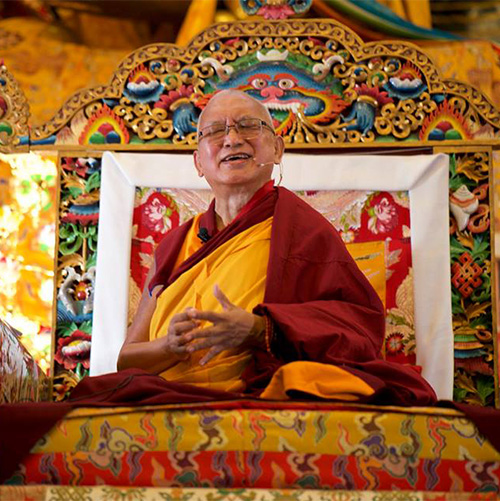
Photo: Bill Kane, Kopan Monastery, Nepal, 2016
(duration: 13 minutes)
Transcript of Video 1: “Bodhichitta Brings Happiness”
(You can read the transcript of the video below. Alternatively, you can read the same transcript alongside the video by clicking here to download it or view it in a separate window.)
As it is mentioned in the sutra teachings by the Buddha, it is explained some of these mindfulness practices. Of course, normally, if you can do, that is incredible, but especially when you are doing retreat, whether you are doing personal retreat or group retreat, this practice is extremely worthwhile to keep the mind in bodhichitta. Of course, there is also renunciation and right view; you can relate it to many things. You can do activities with the different parts of the lam-rim, but especially with bodhichitta; you can do every activity with bodhichitta. That is the most wise life, the most meaningful, the most beneficial life.
As His Holiness the Dalai Lama often says, “If one follows the delusions, it harms oneself and it harms others.” Here, “others” means numberless sentient beings. One thing is that if you follow the self-cherishing thought, for example, it does not allow you to gain the realization of bodhichitta, the good heart. It doesn’t allow you to generate the good heart, because you are totally seeking happiness only for yourself, only working for yourself. Whatever you do is only for yourself. When you are unable to generate bodhichitta, then you are unable to complete the merits of wisdom and virtue, the Mahayana path. You are unable to enter the Mahayana path and are also unable to achieve the exalted Mahayana path, the arya path. Because of this, then you don’t have all those incredible realizations, the wisdom directly realizing emptiness, nor all those many qualities that enable you to offer extensive benefit to sentient beings. It is so unbelievable that you won’t have that. You aren’t able to do extensive benefit for sentient beings; you can’t offer deep benefits. You cannot complete the path and achieve full enlightenment. You cannot cease the defilements, and so you can’t complete the path, so you can’t do perfect work for sentient beings and bring them to enlightenment. Even from that side, since sentient beings have to suffer for a long time, that is how sentient beings are harmed. That is one way that by following the delusions it harms oneself and harms all sentient beings. There is direct harm and indirect harm. If you think from life to life, this is why it harms numberless sentient beings; if you think in terms of life to life.
But if one practices Dharma, if one follows bodhichitta, the good heart, then it results in the total opposite – happiness for yourself and happiness for all sentient beings, for others. The happiness is like that. As I mentioned before, the happiness of this life just comes. Without even clinging to that, it just comes, if you have the good heart. Without even thinking about it, it just comes, not to mention the happiness of future lives, liberation from samsara, and full enlightenment. As well, all those four different levels of happiness, you are able to cause to numberless sentient beings. They receive that from you as well. By practicing the good heart, even for yourself, in day-to-day, moment-to-moment life, there is happiness even for yourself – a comfortable life, a life without fear, depression, guilt. All of these things – the package of sufferings – don’t happen. You don’t engage, because of the good heart, in all those things. It brings happiness to you, happiness now, happiness like the sun shining in this world, and happiness in future lives for yourself. Also, it brings peace in the world, towards other sentient beings, for anybody who is around you. It brings peace to others, then to the whole world, to others, to numberless sentient beings. All this comes from Dharma, from the good heart. Then, when death comes there is nothing to feel sad about. There is only reason to rejoice, to feel great happiness. When death comes, you can die with great happiness and joy, because there is nothing to regret, no reason to feel depressed, sadness.
Thus, the person who is seeking liberation, who is seeking the state of omniscience, needs to attend to many methods for collecting merits and purifying defilements. Then the means to that, the Omniscient One, who is extremely skillful, who has great compassion for us sentient beings, explained that even our daily life conduct, eating, walking, sitting, sleeping, doing our job, all the things that we normally do, not only studying Dharma and doing meditation, all these things, living in morality, also many other virtuous activities that you do, even these small activities that you normally do, by the way, the Omniscient One who is extremely most skillful and has great compassion for us explained that even these activities that we normally do become a method to collect unfathomable virtue, a means of collecting skies of merits. They become not only beneficial to oneself, but beneficial towards all sentient beings. The Buddha explained this to us, whose level of mind is lower. For those with lower mind – in particular, for those who do not have a bodhichitta realization – this is how everything you do becomes dedicated for the happiness of other sentient beings, how it becomes the cause of happiness for all sentient beings. This is something, immediately, to practice. Of course, there is lam-rim meditation, but even at other times, during the break times, do all your activities, as much as possible, with bodhichitta and the thought to benefit other sentient beings, to make your actions beneficial for all sentient beings.
[End of Video 1: “Bodhichitta Brings Happiness”]
2. Bodhichitta Mindfulness in Daily Activities
There are quite a lot of things that come from the Sutra of Clouds of Sublime Rare Ones (Do De Könchog Trin). The “sublime rare ones” are the Buddha, Dharma, and Sangha. Some [bodhichitta mindfulness practices] are not mentioned there, so I added them. (Lama Zopa Rinpoche)
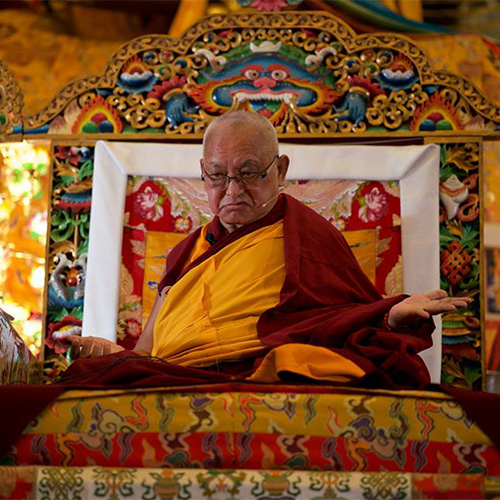
Photo: Bill Kane, Kopan Monastery, Nepal, 2016
There are quite a lot of things that come from the Sutra of Clouds of Sublime Rare Ones (Do De Könchog Trin[1]). The “sublime rare ones” are the Buddha, Dharma, and Sangha. Some [bodhichitta mindfulness practices] are not mentioned there, so I added them.
The sutra explains that in the morning when one wakes up, the very first thing to do when one wakes up from sleep is to think, “May all sentient beings achieve the dharmakaya.” The minute you wake up, you should think that. Maybe the eyes are still closed, the mind woke up but the eyes are still closed – I’m joking – remember that.
Then when you get dressed, think, “May all sentient beings wear the dress of shyness and shame.” By one’s own reasoning, there is shyness, ngö tsa, shy. The other is shame. Do you have another word?
Student: Consideration.
Rinpoche: Consideration. That is right. Shy and shame, I’m not sure. The reason [to cultivate shyness] is because then you, generally, are protected from negative actions. The reason is because, without shyness, you have to suffer and cannot achieve realizations if you engage in negative actions. For example, you took the bodhisattva vow. You made the vow in front of Buddha, Dharma, Sangha, and sentient beings, so if one breaks it, one becomes shameless, careless of other sentient beings. So, because of others, you practice.
Then again, from the sutra, when you get dressed, “May sentient beings wear the dress of shyness and shame.”
When you put on a belt, think, “May sentient beings’ minds be bound by the three higher trainings.” These are the higher trainings of morality, concentration, and special insight. Because that is what is said in sutra, when you release a belt, think, “May sentient beings be freed from the bondage of karma and delusions.”
When you lay down to go to bed, “May sentient beings achieve the dharmakaya.” Then the same thing when you see a stupa. When you see a stupa or other holy object, think, “May all sentient beings achieve the dharmakaya.” When you see a holy object such as a Buddha statue, “May all sentient beings achieve enlightenment quickly.” You can dedicate like that.
When you stand up, think, “May all sentient beings rise up from the oceans of samsaric sufferings.” When you get up from bed in the morning, you can also think that. Every time you get up, you can think the same thing. This is what to think with mindfulness.
It says in the Dö De Könchog Trin, this sutra explained by Buddha, that when you offer incense, think, “May all sentient beings’ stains of being wicked in nature be eliminated. May they have the scented smell of morality.” Dedicate like this for sentient beings. “May they live in pure morality,” something like that.
When you clean, in the sutra it is mentioned to think, “May all sentient beings not engage in bad conduct. May they have perfect, beautiful, wonderful conduct.” That is what the Könchog Trin mentions that Buddha says to think when you clean, when you wipe off the dust or clean the floor. Here, in the Dö De Könchog Trin everything is related to bodhichitta; everything is dedicated to sentient beings. So, when you wipe the floor, you are cleaning sentient beings’ disturbing thought obscurations.
It is also said in the Könchhog Trin that when you eat food, then you dedicate that all sentient beings not have delusions. There are six root delusions and twenty secondary delusions, you dedicate for sentient beings to not have the root delusions and secondary delusions. That is what it says, just that.
When you enter a temple, every time you enter inside, you should think that you are bringing all sentient beings into the city of liberation. That can also mean to enlightenment, great liberation. Think that you are bringing them there. Here everything is related to sentient beings. You are bringing them inside the city of the sorrowless state. You can also pray, “May they enter the city of liberation.”
Then, when you go out, think that you are bringing sentient beings out of the prison of samsara; you are liberating them. Visualize that and also pray for that.
When you open the door of a house, think that you are opening the door of transcendental wisdom gone beyond the world, beyond samsara. That is the mindfulness to practice.
When you close a door, think, “I am closing the door of samsara for sentient beings.” Think that and pray, “May this happen.”
Every time you sit down, think that you are bringing sentient beings to the heart of enlightenment. Generate that thought every time you sit down.
Every time you do washing, when you clean your teeth, when washing your body, when washing pots, anytime when washing, think, “I am washing all the stains of delusions of sentient beings.” Every time think that. That is what to think when you do washing, as explained in the Do De Könchog Trin. You are washing away all the obscurations of all sentient beings. When you clean a room with a vacuum or broom, think that [the vacuum or broom] is the antidote to the obscurations. It is the path of wisdom, the whole path from guru devotion up to enlightenment. Also, similarly, think that your toothbrush is the complete path to enlightenment and that with it you are cleaning the obscurations of sentient beings. It is the same when washing clothes, and also in the kitchen when washing pots. Think that the water is the path to enlightenment and you are cleaning sentient beings’ minds.
Then, if you are making a fire with wood, think that all sentient beings’ delusions are burned away by the fire of transcendental wisdom. Like this, whatever you are doing always dedicate it to sentient beings.
The Könchog Trin says that when you lie down, put your right hip on the bed and generate bodhichitta to bring all sentient beings into the sorrowless state. The sorrowless state is liberation; the great sorrowless state is enlightenment, which is what the buddhas achieve.
When you are making food in the kitchen, whatever you are cutting [chopping] – vegetables, meat, onions, whatever – practice the mindfulness that you are cutting all sentient beings’ ignorance and delusions with the knife or sword of the wisdom realizing emptiness. You are cutting sentient beings’ ignorance and delusions. You can also think, when you are cutting food, that the food is sentient beings’ delusions and the knife is wisdom, the path. Or the food is sentient beings’ self-cherishing thought and the sword is bodhichitta. Or you are cutting the root of samsara, self-grasping, by the wisdom realizing emptiness.
Before going to bed, what Lama Tsongkhapa did is that he would recite the Thirty-five Buddhas’ names thirty-five times with prostrations. The normal advice in the lam-rim is to examine the day from the morning time. You go through every action you did. However many actions became virtue, then you rejoice in those. And however many actions became non-virtue, you generate regret and purify them before falling asleep. Lama Tsongkhapa did the Thirty-five Buddhas’ prayer and recited the names thirty-five times with prostrations. That makes one very happy that one is a monk who is completely pure and so then one can go to sleep very happily. That is mentioned by Kachen Yeshe Gyältsen in his lamrim teachings.
The best one, even if one cannot do a long version of a self-initiation, is to do a middle or short one, or even the long one. If you have done retreat, that is the best one to do before going to bed. Or do Vajrasattva with the four opponent powers and then go to sleep with a very happy mind. That is how to make life meaningful, the happiest. It is like that.
Download a booklet with condensed versions of these bodhichitta mindfulness practices.
3. Sleeping with Bodhichitta
Physically lie down like a snow lion lying down and, with the mind, hold the light, have a virtuous thought, and remember the meditation. One must rely on these three: the light, the virtuous thought, and the remembrance of the meditation. Hold onto that until you fall asleep. (Lama Zopa Rinpoche)
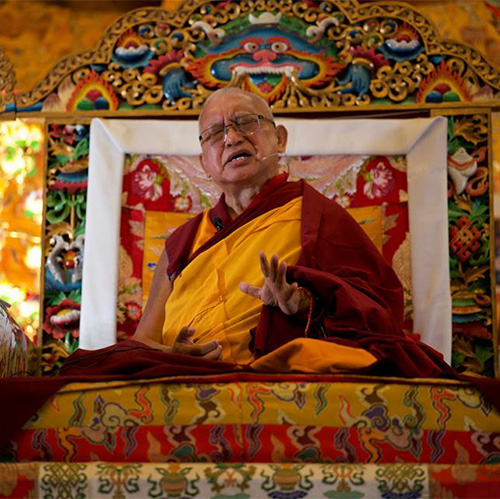
Photo: Bill Kane, Kopan Monastery, Nepal, 2016
(duration: 14 minutes)
Transcript of Video 2: “Sleeping With Bodhichitta”
(You can read the transcript of the video below. Alternatively, you can read the same transcript alongside the video by clicking here to download it or view it in a separate window.)
The lamrim teachings mention the sleeping yoga that Lama Tsongkhapa explained. It is mentioned in the sutras that when you go to bed, you go out and wash your feet and then you come back inside, put your left leg on [top of] your right leg and sleep like a snow lion. That is what is mentioned in the sutras. Sleep like that, in the position of a snow lion lying down. Then hold well the light, the illumination. Your mind should hold that well. Why is that? So that you don’t get a very heavy thick sleep and so it is easy to get up in the early morning. So you are not controlled by thick heavy sleep and you can get up early to practice Dharma. Physically lie down like a snow lion lying down and, with the mind, hold the light, have a virtuous thought, and remember the meditation. One must rely on these three: the light, the virtuous thought, and the remembrance of the meditation. Hold onto that until you fall asleep.
Other than that, when you are about to go to sleep, you must have a very strong thought, strong courage, a strong thought that you will get up without delaying in the morning. His Holiness goes to bed from eight or nine o’clock then gets up at three o’clock in the morning to practice. The attendant gets up at three o’clock to offer tea and do service. So, 3 or 4 or 5 o’clock, to not be late and to have the courage to get up and to not have a very heavy sleep. Of course, in the West completely heavy sleep is the best. Complete total sleep, then, “Last night I had a fantastic sleep, an unbelievable time.” This is another way of looking at it!
As it is mentioned in lamrim, you should have that thought, that courage, to not delay the time of getting up. Then, like an animal with fear… It uses the example of animals like deer who, when they sleep at night, sleep very lightly in the forest or jungle. They have light sleep with their ears up, so when other animals attack it is very easy to wake up and run. Their sleep is very light with their ears up. They sleep like that, so it is easy to run when the enemy comes. They sleep with fear like that. Here, it is with the fear that you might miss the opportunity to practice Dharma, so to not be late for that. Lie down remembering that when the Buddha was passing away into the sorrowless state, showing that holy deed, he was in the position of a snow lion lying down. Then, he showed the holy deed of passing into the sorrowless state. Like that, lie down. If you do that, you remember Buddha when you go to bed. The benefits, by the way, are that even when you are asleep you do not forget the Buddha, you remember the Buddha. And during sleep your mind doesn’t get separated from virtue, so you are taking the essence day and night. The third benefit is that you don’t sleep very heavily like a pig’s sleep. The fourth is that in your dreams you won’t create very heavy negative karma. You won’t dream those things. Those dreams won’t happen, the source of nightmares, because you sleep in the Buddha position. It helps to protect you. Then, even during sleep you are able to practice virtue, even during sleep. That also helps when you die. When you die, you are also able to die in this position of the snow lion lying down and to remember the Buddha. That position even helps to not get reborn in the lower realms.
This is in general. Then, according to the lower tantra, you see yourself as the mandala deity. The guru and the deity are the same. In the presence of the guru, then you sleep with creativity. In non-creativity, then you absorb into the seed syllable, the deity’s mantra. For example, [in the case of] Chenrezig, the HRIH gradually dissolves, then there is no object, and you meditate on emptiness. Then you rise up. When you sleep in non-creativity, then the next morning remember non-creativity and rise as the deity.
In highest yoga tantric practice, meditate on the dharmakaya and fall asleep. Then arise from that, from the dharmakaya. All the dakinis play music and persuade you to rise, and say these words that I mentioned. Absorb whatever syllable and then [meditate on the] dharmakaya.
[End of Video 2: “Sleeping With Bodhichitta”]
When you go to sleep, it is also mentioned to think, “May all sentient beings achieve the dharmakaya.” That is also mentioned. When you wake up, remember that, and when you go to sleep it is the same. Then, if you are practicing highest yoga tantra, meditate on the dharmakaya, with the mind abiding on ultimate reality, like space. Or see yourself as the deity in the mandala, [remember] the guru with devotion, and go to sleep like that with the generation stage. But, in general, do tong-len meditation or meditate on emptiness, and with that go to sleep; or else generate compassion.
There is a mantra to recite when going to sleep:
OM SIDDHI SIDDHI BUDDHA BUDDHA BODHAYA BODHAYA BALA BALA TISHTHA TISHTHA HRIH KAMPA KAMPA BARA GACHA GACHA BHAGAVATI MA BI LAM BA A LE SVAHA[1]
Say that seven times and then blow on the right palm. Then put the palm under the right cheek in the snow lion position, and without interruption of another superstitious thought, go to sleep. If the mind meditates on emptiness, if you do that, then you are able to recognize the clear light of sleep. Then you are able to quickly realize the meaning of the Prajnaparamita – emptiness. Due to the Buddha’s kindness, there are various means that help for the quick realization of emptiness.
[1] Mantra revised by Ven. Joan Nicell based on the Tibetan text Chos spyod rin chen phreng ba, August 2016.
4. Bathing with Bodhichitta
When you are washing, before washing generate the motivation: “I am going to free the numberless sentient beings from whom I have received all my past, present, and future happiness and bring them to enlightenment by myself. Therefore, I am going to offer a bath to the guru and the Three Rare Sublime Ones.” (Lama Zopa Rinpoche)
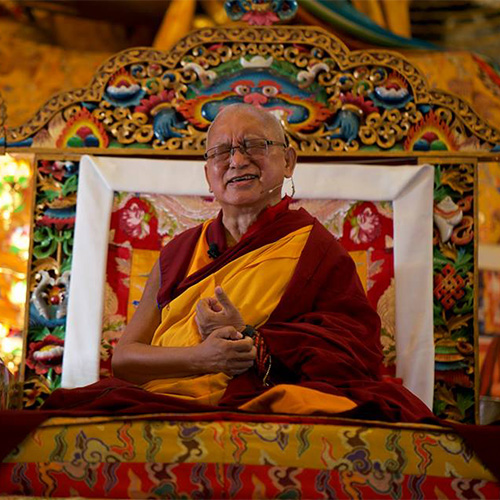
Photo: Bill Kane, Kopan Monastery, Nepal, 2016
When you are washing, before washing generate the motivation: “I am going to free the numberless sentient beings from whom I have received all my past, present, and future happiness and bring them to enlightenment by myself. Therefore, I am going to offer a bath to the guru and the Rare Sublime Ones.”
If you have received an initiation, either a higher or lower tantra initiation, purify in emptiness and visualize yourself as the deity. But the most important thing is not the deity; it is to focus on the guru from whom you received that deity’s initiation or your root guru. Mainly focus on him; then you collect the most extensive merit. When washing, offer a bath to the guru. Initiating deities, or goddesses, initiate you with the vase water. You can think that, then generate great bliss. That is not so much mentioned in the lower tantra, but it is okay to do. While washing, meditate on that: yourself, the guru, experiencing that – infinite bliss. It is fantastic! You don’t have to wash with a depressed mind, with a self-pitying mind.
If you want to do it the short way, when washing recite or chant this:
Offering a Bath to the Gurus
KYAB SUM KÜN DÜ LA MA DOR JE CHHANG
Guru Vajradhara, embodiment of all three refuges,
GANG LA GANG DÜL SHE NYEN TSHÜL ZUNG NÄ
Takes the form of the virtuous friends to subdue beings in whatever way is needed,
CHHOG DANG THÜN MONG NGÖ DRUB TSÖL DZÄ PÄI
And grants the supreme and common realizations:
DRIN CHÄN LA MA NAM LA KU THRÜ SÖL
To the kind gurus, I offer this bath.
OM SARVA TATHAGATA ABHISHEKATA SAMAYA SHRIYE ah hum
“Yourself, Guru Vajradhara, encompassing all the three objects of refuge,” Buddha, Dharma, and Sangha, “taking the form of the virtuous friend,” having various aspects for whomever they subdue, manifesting in the form of the virtuous friend, “for whomever is to be subdued.” Relate this meditation to your virtuous friend. Here, I am not saying that I am a buddha. I am not saying that, but this is the meditation. Then, “Who grants the common and sublime realizations.” It is very important to focus on yourself as the guru. Do the same thing when you do the Lama Tsongkhapa Guru Yoga. Of course, there is the name “Lama Tsongkhapa,” but if you don’t understand it, you might think it is only Lama Tsongkhapa, the Tibetan Lama Tsongkhapa. In India, anyone who is Tibetan, who speaks Tibetan, is called “lama.” Like the police, if people speak Tibetan and are from Tibet or are Sherpa, even the Indian police call them “lama.” In Nepal, there are many Sherpa leaders in the government who are called “lama.” When we are talking about Lama Tsongkhapa, we are not talking about that. Also, “Guru Shakyamuni Buddha” means that he and your root guru are oneness. This is the meditation: oneness – your root guru and Guru Shakyamuni Buddha; oneness – your guru and Lama Tsongkhapa; oneness – your guru and Tara.
There is one lama whose incarnation lives in France, from whom His Holiness Song Rinpoche received initiation. In his past life, he called all the deities “guru.” That is extremely good for reminding the mind.
You chant that. The short way is just to chant “KYAB SUM KÜN DU LA MA DOR JE CHANG…” while washing; it reminds you of that meditation. Then, if you want to elaborate, do it like the offering bath. [See FPMT Retreat Prayer Book: Lama Chöpa Jorcho]. There are gradual prayers; you can follow the short, middle, or elaborate offering bath.
If you want, you can bless the water by chanting OM MANI PADME HUM or [the mantras of] the five powerful deities of purification (See Supplementary Material: Five Powerful Mantras). Chant each of their mantras a few times and blow on the water, whereby it becomes powerful to purify negative karma, such that if touched it purifies negative karma.
Then after the offering bath, comes perfume. For those who, not sangha, but those who use perfume or scented smell after a bath, lay people, then it is very good to see yourself as the guru, the embodiment of the Buddha, Dharma, and Sangha, and make offerings to yourself, so you collect so much merit.
Anointing the Holy Bodies
TONG SUM KÜN TU DRI NGÄ DANG WA YI
Like polishing gold already pure and refined,
DRI CHHOG NAM KYI THUB WANG NAM KYI KU
So do I apply the best of perfumes,
SER JANG TSO MA JI DOR JÄ PA TAR
Fragrantly filling the billion universes,
Ö CHHAG BAR WA DE DAG JUG PAR GYI
To the dazzling holy bodies of the Munis.
Then when you dress, offer dress to yourself, the guru-deity, reciting the prayer:
Offering Divine Dress
Hold up a fine cloth with both hands in the sparsha mudra.
SAB JAM YANG PA LHA YI GÖ
By offering soft, smooth, and fine divine dress
MI CHHE DOR JEI KU NYE LA
With indestructible faith in
MI CHHE DÄ PÄ DAG BÜL NA
You who have attained the indestructible vajra holy body,
DAG KYANG DOR JEI KU THOB SHOG
May I too achieve the vajra holy body.
“Thin, light, divine dress to the indestructible vajra holy body, I offer with devotion.” At that time, although the Tibetan prayer says “May I also,” you include all sentient beings: “May myself and all sentient beings achieve the vajra holy body.” It is fantastic.
Lay people, when putting on ornaments, those who wear ornaments normally, recite this prayer while offering ornaments to the guru, the merit field:
Offering Ornaments
Hold up a mala with both hands in the sparsha mudra.
GYÄL WA TSHÄN PEI RANG ZHIN GYÄN DÄN CHHIR
Because the victorious ones are adorned by the natural ornaments of the signs and exemplifications,
GYÄN ZHÄN DAG GI GYÄN PAR MI TSHÄL YANG
They do not need any other kind of ornament.
RIN CHHEN GYÄN CHHOG PHÜL WÄ DRO WA KÜN
But by offering these supreme jewel ornaments,
TSHÄN PE GYÄN PÄI KU LÜ THOB PAR SHOG
May all transmigratory beings achieve the holy body adorned with all the signs and exemplifications.
Chant that and make offerings to yourself, the guru-deity, so you collect unimaginable merits. “May I achieve the holy body adorned with the signs and exemplifications.”
5. Eating with Bodhichitta
The bodhisattva way of performing the eating yoga is that you yourself are the servant serving all sentient beings who are your lord or master. They are the precious ones from whom you receive all past, present, and future happiness, so you are a servant to them. A bodhisattva eats food to serve them; that is the bodhisattva eating yoga. (Lama Zopa Rinpoche)
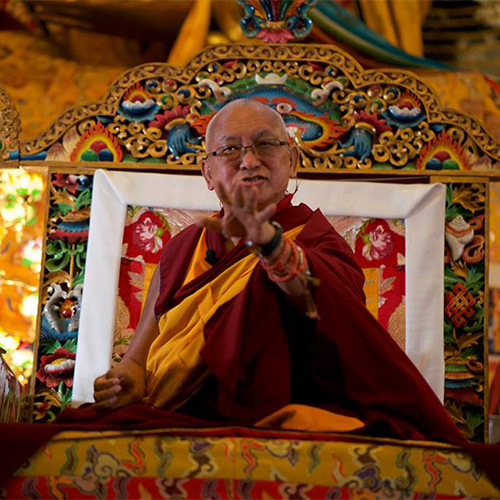
Photo: Bill Kane, Kopan Monastery, Nepal, 2016
The daily activities that you are doing, the point is to make them most beneficial for sentient beings, a cause for enlightenment, a cause for oneself to attain omniscience so that one can liberate sentient beings from the oceans of samsaric sufferings and bring them to enlightenment. Make the activities that you normally do in daily life, anyway – for survival and so forth – make them most beneficial. Make them not only become Dharma, but the purest Dharma, the cause of enlightenment to achieve the cessation of all mistakes of mind and complete all the qualities, the highest success.
It is explained in the teachings that, by practicing eating yoga, you transform your eating into eating yoga. That is one thing; that is the most important thing. Then, you are making offerings to Buddha, Dharma, and Sangha. Then, you are making charity to all sentient beings, including those living in your body. The many tiny creatures, sentient beings, that are living in your body, to bring them to enlightenment, how can you do that? By revealing Dharma when they become a human being. How do you do that? While they are in your body, by making food charity to them. That is why Buddha explained the eating yoga, so that your eating and drinking becomes the yoga of eating and drinking. If you don’t do that, what happens is that your eating becomes ordinary eating, just for pleasure and survival, and is done with attachment. It just becomes the cause of samsara, just another cause of samsara – to be reborn again in samsara and experience all the sufferings again. And not only that, in particular, to be reborn in the lower realms. If eating is done with attachment seeking the happiness of this life, then you get reborn in the lower realms.
There is one quotation in Pabongkha’s Calling the Guru From Afar. In every moment, in every second, it is in your hands – whatever action you are doing – as to whether it becomes the cause of enlightenment or the cause of hell, the cause of the lower realms or the cause of enlightenment, the cause of liberation from samsara or the cause of samsara. It is similar, even for this life, whether it becomes the cause of a problem now or the cause of peace, inner peace, now. If you eat with a healthy mind, free from attachment grasping to the pleasure of this life, then it becomes inner peace. Otherwise, it becomes a problem. Even today in this life, because there is no peace in your heart, but disturbances, unhappiness, no satisfaction, dissatisfaction, so it just becomes the cause of problems. Totally, it is in your hands. Liberation from samsara is totally in your hands. When eating, walking, sleeping, doing your job, whether you want it to become the cause of liberation or the cause of samsara, it is in your hands. It depends on your mind; it depends on how you think. It depends on your motivation, so everything is totally in your hands. There are three things: the cause of samsara, the cause of the lower realms, then one more – you are running out of merits. You received this food, this enjoyment, as a result of past good karma, some merits collected in the past. You are living on that result, so what you are doing is just finishing that. You are just only using that, finishing your merit; that is it.
If there is no continual merit, if you don’t make this action Dharma, then there is no continual making of merit. It is like living on the money you collected with hard work in the past, but it finishes fast if you are not collecting any more money by working. Like that, you are living on the merit collected in the past by practicing Dharma, but it is finishing. When it finishes, then you experience the result of past negative karma. That is why many wealthy people… They became wealthy early in life and, at that time, have no idea that this came from good karma, no idea at all. They think that they will be rich in this life forever. Because they don’t understand Dharma, they don’t use their money, their wealth, to collect merits, so everything is done with attachment clinging to this life. Therefore, everything becomes negative karma. There is nothing that becomes virtue, collecting merits. Then after some time, they run out of merit. Then nothing is working; everything is stopped. Then, they can’t even pay the rent for the house. Even the things that you don’t normally have to worry about like paying rent for the house, even basic things, become an unbelievable worry. Then, they cannot take care of their family. I have seen many like that. While they were wealthy they didn’t meet Dharma, there is no Dharma. Even if they heard Dharma, but they did not practice it. They did not use their wealth to collect extensive benefit by making charity to sentient beings and offerings to Buddha, Dharma, and Sangha. You didn’t do that, so when you run out of merit, aaaah, at the same time you have to keep your image, a rich house, rich this and that, because you are in a rich society. You joined many of these people, so you have to keep the image. Maybe as a Western person maybe not much; it may be more in the East, Indians. Then, they suffer so much. They don’t have [money] but they have to keep up the image, then there are lots of debts, masses of problems, on and on like this. That is what happens.
There are three things, three problems, that happen if this one action of eating doesn’t become Dharma – the danger that happens. There is one thing to know: Everything is in your hands; it depends on your mind. These are very powerful words. I don’t remember them exactly, but think that. It kind of gives the idea.
Hinayana, Mahayana, and Vajrayana Ways of Eating
There is the eating yoga of Hinayana: eating food unstained by the three poisonous minds of anger, attachment, and ignorance, but just to survive in order to practice the Dharma. There is a prayer that monks commonly recite according to the Theravadin tradition, the Hinayana.
Seeing this food as medicine,
We eat it without attachment or hatred,
Not to become fat, not out of pride,
Not to look strong, only to sustain the body.
Eating is not for beauty of the body, elegance, to become soft, flexible, all this. It is just to survive in order to practice Dharma:
The bodhisattva way of performing the eating yoga is that you yourself are the servant serving all sentient beings who are your lord or master. They are the precious ones from whom you receive all past, present, and future happiness, so you are a servant to them. A bodhisattva eats food to serve them; that is the bodhisattva eating yoga. There is a prayer to achieve enlightenment for sentient beings, and then for the sentient beings living in your body, you make charity to them and then they achieve enlightenment. That is the bodhisattva way of doing eating yoga.
Through gathering together the organisms in my body with material things at the present,
In the future may I gather them with the Dharma.
In order to achieve the state of a complete buddha for the welfare of sentient beings,
I will consume this food and drink.
The tantric way of doing eating yoga is that you use what you are eating as a tsog offering or burning offering practice. Then, your eating becomes that practice: a tsog offering or a burning offering practice. For tsog offering, normally what you do is to visualize the guru-buddha-deity in front. But mainly, here, based on having received a tantric initiation, you yourself are the guru-deity. The three become one, [you, the guru, and the deity]. Then you eat the food as a tsog offering. You make an offering of “tsog.” Tsog is “collection,” offering a “collection,” enjoying the party of dakas and dakinis gathering. Most people have taken a highest yoga tantra initiation, so you see it as transcendental bliss and voidness. Of course, that is very secret. It is highest yoga tantra – very, very secret. Even to mention the name… In the strictest way, you cannot mention even the label. The real tsog is that.
Yourself as the guru-deity. At your heart, there is a syllable HUM, or visualize the deity – the Tara body mandala or the Vajrayogini body mandala, or the Heruka body mandala – at your heart, then making offering to that. You don’t just become the deity, but the guru; that is the most important one. Then you transform [the food and drink] into nectar, exactly the same as tsog. Then, generate great bliss. When you do that, then you collect the highest merit. You are offering it to the guru, so you collect the highest merit.
Eating Food Offerings Made by Others
The karmas collected with even small respect, some small praise, or you offer some small help to your parents of this life, then your karma is unbelievably powerful, so you start to experience happiness in this life. It is the same if you do some small harm or hurt [to your parents]; because the negative karma is very heavy, you start to experience the result in this life. Of the three types of karma, this is one you create in this life and start to experience the result of in this life. Then, there is karma you create in this life and experience billions or zillions of lives later.
Then, more powerful than your parents are monks and nuns living in the thirty-six vows. Then fully-ordained monks and fully ordained nuns are even more powerful. Then, more powerful than them are the arhats. Then, of numberless arhats and one bodhisattva, the one bodhisattva is more powerful than numberless arhats. It is said that if you look at one bodhisattva with a calm mind, then the merits are far more greater than if you make charity of your eyeball to the three realms’ – desire realm, form realm, and formless realm – sentient beings. Looking with a calm mind at a bodhisattva is more merit than making charity of your eyeball to them, because his bodhichitta is so powerful. If you look at one bodhisattva like this, glaring, then the negative karma is more heavy than taking out the eyeballs of all the sentient beings of the three realms. Then, of numberless bodhisattvas and one buddha, one buddha is more powerful. Then, of numberless buddhas and the guru, the guru is the most powerful. So the highest merit you collect is that with the guru. Then, there is unbelievable, unbelievable, unbelievable purification. It is the most powerful.
For those who are not living in pure vows, then eating offerings made by other sentient beings with devotion become like poison. If you do the tantric yoga of eating, with yourself as the guru-deity and bless the food and then eat it in this way, it doesn’t become poison; it becomes the means of collecting extensive merits and purification. Then, the other one is tsog offering, and then the other is like when you do a fire offering, with many different substances, seeds and so forth. Here, it is similar. You eat like a burning offering practice, and there is also unbelievable purification and you collect extensive merits.
6. Tonglen Mindfulness
That is unbelievable. You are destroying the enemy of bodhichitta, and this allows you to have the realization of bodhichitta in your heart. It has unbelievable power. When you take on all the anger of the numberless hell beings, hungry ghosts, animals, human beings, asuras, and suras – all their anger – can you imagine it? Then you take all its suffering results. Do the same with attachment; then take all its results. All the sufferings that you receive from these beings, you take and give to the selfish mind. That is the main thing. (Lama Zopa Rinpoche)
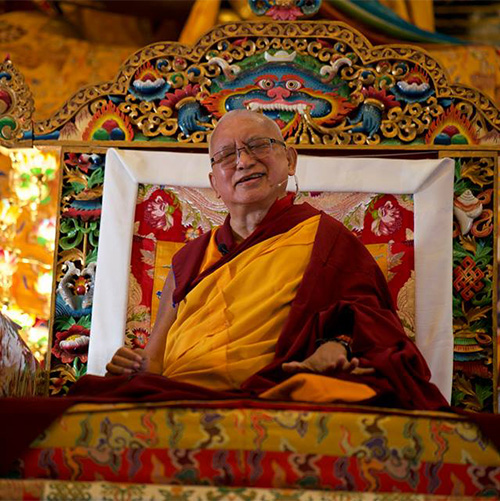
Photo: Bill Kane, Kopan Monastery, Nepal, 2016
General Instructions on Mindfulness
I mentioned to practice mindfulness while walking. I mentioned, before, that the reason why I went through this mindfulness practice is not just to have you listen. It is not just for you to hear what I have to say, but for you to practice now, during this retreat; to get familiar with mindfulness, and also with bodhichitta. Everything has to do with sentient beings. Dedicate everything you do for sentient beings. Everything is dedicated to sentient beings, so practice now, during this time, during this retreat. That becomes the real retreat, and the best mindfulness is bodhichitta…
The idea is to really practice now. Then this becomes a good habit in daily life, you can also do it in normal life; it is unbelievable. Everything, whatever you are doing, is done with refuge and bodhichitta. Everything is dedicated to sentient beings, for numberless sentient beings; not only to your friends, family, or those whom you like, but to numberless sentient beings. That is the case. Can you imagine the motivation? You do everything for sentient beings. Bodhichitta, the mind benefiting sentient beings, is the best retreat. It is what makes the life most meaningful.
Transforming Problems with Tonglen
The most wonderful, happiest life comes only when you are able to practice when somebody criticizes you, puts you down, doesn’t respect you, or talks about your mistakes. That is the best time. At that time, use thought transformation to develop compassion, loving-kindness, bodhichitta, and patience.
You can especially use the tonglen practice; it is most important. Then, even if anger arises, you take all sentient beings’ anger upon yourself and use anger in the path to enlightenment. Use attachment in the path to enlightenment. You take all sentient beings’ anger and attachment from them, then, that totally destroys or eliminates your ego and selfish mind. Then all the results – the sufferings that come from [anger and attachment] – are taken from them and absorb into your heart, into your self-cherishing thought, there. From beginningless rebirths, the selfish mind has caused the heaviest obstacles and hasn’t allowed you to achieve enlightenment. It hasn’t allowed you to achieve liberation from samsara, and it has been an obstacle not only to your future lives’ happiness, but also to your happiness in this life. Your main enemy is not outside; it is in your heart. So completely destroy this selfish mind.
That is unbelievable. You are destroying the enemy of bodhichitta, and this allows you to have the realization of bodhichitta in your heart. It has unbelievable power. When you take on all the anger of the numberless hell beings, hungry ghosts, animals, human beings, asuras, and suras – all their anger – can you imagine it? Then you take all its suffering results. Do the same with attachment; then take all its results. All the sufferings that you receive from these beings, you take and give to the selfish mind. That is the main thing.
If it is more helpful for you, if you find it more beneficial, feel that what you take on absorbs to your attachment and your attachment is destroyed. In this way, you can use the three poisonous minds in the path to enlightenment.
Tonglen Mindfulness
Whatever activity you are doing, such as walking or working, always recite the words of a tonglen verse. For example, you can recite Nagarjuna’s words in Jewel Garland:
Whatever suffering sentient beings experience,
May it ripen on me.
Whatever happiness I have,
May it ripen on those sentient beings.
You can also recite the verse from the Guru Puja:
DE NA JE TSÜN LA MA THUG JE CHÄN
And thus, perfect, pure, compassionate Guru,
MA GYUR DRO WÄI DIG DRIB DUG NGÄL KÜN
I seek your blessings that all negative karmas, obscurations, and sufferings of mother transmigratory beings
MA LÜ DA TA DAG LA MIN PA DANG
May without exception ripen upon me right now,
DAG GI DE GE ZHÄN LA TANG WA YI
And that by giving my happiness and virtue to others
DRO KÜN DE DANG DÄN PAR JIN GYI LOB
All transmigratory beings may experience happiness. (LC95)
“Giving my happiness” does not mean only giving them temporary happiness but also includes giving them ultimate happiness, liberation up to enlightenment. You give all that to all sentient beings. By doing this, “May all transmigratory beings have happiness, especially ultimate happiness – liberation and enlightenment.”
Recite one of these verses over and over again at different times throughout the day, like reciting a mantra. Normally, people recite mantras as much as possible while walking, working or doing other activities. Similarly, here, you recite tonglen and other thought transformation prayers as much as possible; you train your mind with the words. When you do that it is most unbelievable. It so good even just to recite the words, wow!
The Power of Bodhichitta
When you receive the causes of suffering, the karma and delusions of the numberless sentient beings from each realm, as well as the results, the immeasurable sufferings for each sentient being, can you imagine the purification? Numberless eons of negative karma get purified. Negative karma from beginningless rebirths gets purified. You can’t imagine it. It is an unbelievable, unbelievable purification. Then, merits, wow, skies of merits are collected. Skies of merits are collected. Because in each realm there are numberless sentient beings and you are taking all the causes of sufferings from them and, on top of that, all their sufferings, the merits collected are limitless skies of merit, numberless merits. When you take the causes of suffering from the numberless hell beings, you collect numberless merits. When you take the causes of suffering from numberless hungry ghosts, you collect numberless merits. Then you take the causes and their results from the animals, and then from the intermediate state beings. Then you give your happiness and all your past, present, and future merits to each of the numberless sentient beings in each realm. Can you imagine, wow, how many numberless merits, the uncountable number of merits, you collect?
You collect all the results of happiness up to enlightenment, every single happiness, wow, for this life and all your future lives, then for liberation and enlightenment, and give them to the numberless hell beings, hungry ghosts, animals, human beings, asuras, and suras. Each time you do that, you collect numberless merits. To give an example, you do a practice to collect virtue and then give that to the numberless hell beings, hungry ghosts, animals, human beings, asuras, and suras. Can you imagine if you did water offerings? Or if you make charity to a beggar, you collect merits and then give these to the numberless sentient beings. You collect numberless merits by giving to numberless hell beings, hungry ghosts, animals, human beings, asuras, suras, and intermediate state beings. That one merit is multiplied seven times, can you imagine?
Now there are so many merits you collected in the past, present, and future and when you give these to each sentient being, you can’t imagine how much happiness – not just the temporary happiness of this life, but the happiness of future lives – you gain with each one. Then when you give your merits to each sentient being, with each one you collect numberless merits for liberation and enlightenment.
You give away your body many numberless times. Then with your wealth, house, and material possessions you make charity to the numberless sentient beings in each realm. You should collect numberless merits with each object, with each material thing, with each gift of money that you give to each sentient being. With each one you collect merit; just doing this practice of giving one time you collect six times numberless merits, excuse me, seven times, because of the numberless intermediate state beings. You collect numberless merits each time you do the practice, but you can do the practice again and again, so can you imagine? Tsssshhhhh. There are numberless merits by doing tonglen practice even once. Who are you giving to? To the numberless sentient beings. Whether you give them your body, house, one material possession, or one dollar, you collect seven times numberless merits; it is so unbelievable, unbelievable.
If you think of all the details it will make you faint or fall down, then you will end up going to a hospital. I’m joking, but if you really think well, the merits… It is just the most amazing practice. And this is the best practice when you are dying. When death comes, you should do that, wow. You have incredible peace when you do that, incredible inner peace, satisfaction and joy. You die with bodhichitta; this is what His Holiness the Dalai Lama calls “self-supporting death.” You don’t need other people to pray or to do something for you. Whether there are other people there or not, you guide yourself.
When someone goes for a check-up in the hospital and the doctor says, “Oh, you have cancer,” I think there are some people whose minds are so happy, because they can experience cancer for other sentient beings. It is because they get to do a very special practice and use their lives in the best way to free themselves from all past negative karma. It is so powerful. It is the quickest way to purify and collect extensive merits. Your life becomes totally special and it is a quick way to achieve enlightenment. The cancer becomes very special dynamite. The cancer becomes your dynamite practice, so powerful, to destroy the delusions and defilements, and a quick way to achieve enlightenment. It is a quick way so that you become able to liberate sentient beings from the oceans of samsaric sufferings and bring them to enlightenment. It is a quick way to benefit numberless sentient beings.
For people who see the advantage and who normally practice like this, who think in their daily lives that sentient beings and their happiness are the most important, who look at the I as being from where all suffering comes and at others as being from where all your happiness comes, their minds are unbelievably happy. They feel joy when the doctor says, “You have cancer.” Their faces, for example, become very joyful, not closed, with all the veins protruding, and feeling very depressed, very down, with their heart sunk down below the earth. For them it is not like this. There are people who see and who practice like that. Even in the West, there are those who are really practicing like that. They feel full satisfaction.
Of course, it is best when the motivation isn’t that of wanting to recover, but recovery happens by the power of bodhichitta. If pain starts somewhere and you do tonglen, the pain stops. Even before you engage in actual tonglen practice, when the mind is just about to start tonglen practice, because bodhichitta is so powerful, the pain stops. Even when you are not actually engaged in tonglen, but close to doing tonglen, the pain goes away. This is the power of bodhichitta.