A Commentary on “The Method to Transform a Suffering Life into Happiness (Including Enlightenment)”
| Website: | FPMT Online Learning Center |
| Kurs: | Transforming a Suffering Life into Happiness |
| Buch: | A Commentary on “The Method to Transform a Suffering Life into Happiness (Including Enlightenment)” |
| Gedruckt von: | Invitado |
| Datum: | Sonntag, 11. Oktober 2026, 20:16 |
A Commentary to "The Method to Transform a Suffering Life into Happiness (Including Enlightenment)"
Introduction
The Method to Transform a Suffering Life into Happiness (Including Enlightenment) begins with Dorje Chang Losang Jinpa’s short lamrim prayer. The first verse of the Eight Verses of Thought Transformation and a verse from Prayer in Seventy Stanzas by Aryasura then show how to live your life for others. This attitude is then elaborated with some verses taken from A Guide to the Bodhisattva’s Way of Life by Shantideva. This practice is followed by Blessing the Speech and several mantras that are beneficial to recite daily, such as the mantra for blessing the mala.
My wish is that all of you do this most important practice for generating a Dharma motivation, and especially a bodhichitta motivation, when you open your eyes in the morning. As soon as you wake up, whether your sleep has been positive or negative, you should begin this practice. If you know it by heart, you can think it. If you don’t know it by heart, you can read it.
This is how to begin your day, every day of your life, if you want to transform your mind into Dharma. It is for anyone who wants to make their life meaningful and useful not only for themselves but also for the numberless sentient beings, including every single animal – those living in water that are the size of mountains and those that can’t be seen with the eyes but only with a microscope, the worms living in the ground, the tiny insects living in the grass that jump when someone walks on it, and those flying in the sky – as well as every human being, asura, and sura. It motivates you to transform your life from now up to enlightenment, especially from now up to death, and especially for your life today to become a cause of enlightenment for sentient beings. It’s a most unbelievable plan.
In short, The Method to Transform a Suffering Life into Happiness (Including Enlightenment) contains the main motivation and goal for your whole life and for all your lives up to enlightenment. It is to be practiced forever.
A Commentary to "The Method to Transform a Suffering Life into Happiness (Including Enlightenment)"
Preliminaries
If you want to and have the time, you can begin with either the nine-round breathing meditation or a simple breathing meditation to calm your mind. First sit in the seven-point posture of Buddha Vairochana. Each one of the seven points has a purpose, helping to support meditation and realization, and is related to the lamrim, in general, and to the Six Yogas of Naropa, in particular.
To do just a simple breathing meditation: breathe in slowly, then as you exhale think that all three poisonous minds, the causes of suffering, leave in the form of black fog or smoke and go beyond this world. When you breathe in, breathe in white light, thinking that you are breathing in all the qualities of Manjushri, Chenrezig, and Vajrapani, the embodiments of all the buddhas’ infinite wisdom, compassion, and power. You receive perfect wisdom, or understanding, from Manjushri; infinite compassion from Chenrezig; and perfect power from Vajrapani. As you slowly inhale, you receive all these qualities. They fill your whole body, and your heart is transformed into them.
A Commentary to "The Method to Transform a Suffering Life into Happiness (Including Enlightenment)"
Actual Practice
The Method to Transform a Suffering Life into Happiness (Including Enlightenment) is the motivation for how to live your life in Dharma, especially in bodhichitta. In the morning, when you open your eyes, you should remember to transform your mind into Dharma; into Dharma means into a cause that brings only happiness. You should understand that this is how to live your life in happiness. (Lama Zopa Rinpoche)
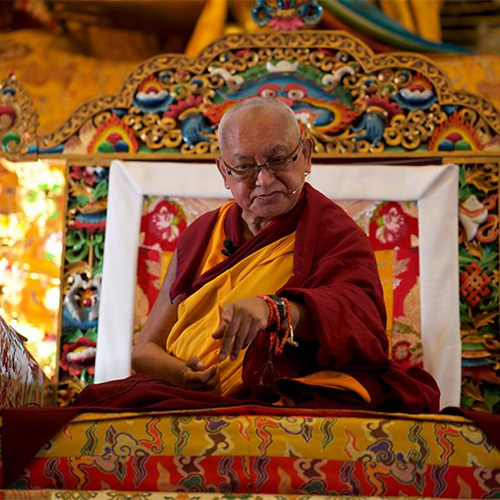
Photo: Bill Kane, Kopan Monastery, 2016
Actual Practice
Transforming the Mind into Dharma and Bodhichitta
The text says:
The Method to Transform a Suffering Life into Happiness (Including Enlightenment)
At the beginning of each day, after you open your eyes, until enlightenment is achieved and until death, especially today, so that all the activities of your body, speech, and mind – hearing, thinking, and meditating, as well as walking, sitting, sleeping, doing your job, and so on – do not become causes of suffering and become causes of happiness, and especially that they become causes to achieve buddhahood (that is, that you transform them into a method for accomplishing benefit and happiness for all sentient beings), here is a method for transforming the mind into Dharma and especially into bodhichitta.
The Method to Transform a Suffering Life into Happiness (Including Enlightenment) is the motivation for how to live your life in Dharma, especially in bodhichitta. In the morning, when you open your eyes, you should remember to transform your mind into Dharma; into Dharma means into a cause that brings only happiness. You should understand that this is how to live your life in happiness. It is not about living your life with self-cherishing, in suffering and depression, thinking, “I’m hopeless.” Instead, from the morning, you make your life the most beneficial and meaningful for sentient beings with the motivation of a good heart, of bodhichitta. This is then the basis for actualizing the lam-rim realizations and the meditations of the tantric path.
The reason that I’m pushing you to do this practice first thing in the morning is that this is what you need to do if you want to be happy and avoid depression, and to make your life most beneficial for sentient beings, which means also for yourself. You should recite this motivation every day to lead your life in the most meaningful way for every sentient being – for every ant, every mosquito, every maggot, every fish, every animal, every human being, every asura, and every sura in the numberless universes – by freeing them from suffering and causing them happiness. This motivation makes your life become a cause of happiness beyond this life, of liberation from the oceans of samsaric suffering, and of the state of omniscient mind.
However, if you do other lam-rim prayers daily, such as the lam-rim prayer found in Lama Chöpa, The Foundation of All Good Qualities combined with Lama Tsongkhapa Guru Yoga, Guru Shakyamuni Buddha Meditation, or Calling the Guru from Afar, you don’t need to do The Method to Transform a Suffering Life into Happiness (Including Enlightenment). Otherwise, in the morning when you open your eyes you should do this practice to transform a kaka life into a happy life, including enlightenment.
It is very important for your daily actions to not become causes of suffering – in particular, causes of the lower realms – and to become causes of the happiness of future lives. If your mind is not paying attention to that, it doesn’t matter if you meditate without moving for hours. If you don’t check your motivation, your meditation becomes another cause of suffering, another cause of the lower realms. If you don’t know the motivation of the lower capable being, which is the first Dharma, the very basic Dharma, and you don’t meditate with that motivation, your whole life’s meditation can become the cause of the lower realms. If you’re meditating so that you can be happy or gain power or attain peace, your meditation becomes another cause of the lower realms. Other people may think, “Oh, he meditates all the time,” but if someone is meditating without knowing even the first Dharma, it just becomes a cause of the lower realms, even though there might be some pleasant feeling of bliss or peace. If you don’t know what Dharma is, your whole life can be wasted. Even though you meditate every day for many hours, it’s meaningless. In reality it’s very sad; if you don’t know what Dharma is, you waste your whole life and also create causes of the lower realms.
Meditating on this practice makes your mind become Dharma. It transforms your mind from your present motivation of worldly concern, or attachment to this life, into a Dharma motivation unstained by that attachment. And it transforms your mind into the motivation of bodhichitta. When you do everything, including eating, walking, sitting, sleeping, and working, with bodhichitta, all your actions become causes of enlightenment. In this way, although it might not be nice to say it like this, your previously kaka life is transformed into gold by transforming your mind into bodhichitta.
Actual Practice
The Lamrim Prayer by Dorje Chang Losang Jinpa
The Title
A Direct Meditation on the Graduated Path, Containing All the Important Meanings
This lamrim prayer composed by the great lama Dorje Chang Losang Jinpa is short, yet it is very, very good as a motivation for life. I received the oral transmission of it from Kyabje Geshe Senge Rinpoche. Geshe-la, a Mongolian and lharampa geshe, was appointed as the abbot of both Sera Me and Sera Je colleges in Lhasa after Mao Zedong died. I didn’t ask him for the oral transmission; Geshe-la from his own side gave it to me and said that it would be good for me to recite it.
When you do this prayer think of your root guru, whether His Holiness the Dalai Lama or someone else, or of the merit field to which you usually pray. When you make requests to the merit field think that the holy beings in the merit field are all one. This is what you have to discover and realize – that they are all one.
Taking Refuge
Essence encompassing all the buddhas,
Originator of all the holy Dharma of scripture and realization,
Principal of all the aryas intending virtue:[1]
In the glorious holy gurus, I take refuge.
If you want to be free from samsara, you need to look for a guru. The continuity of the oceans of samsaric suffering – the suffering of pain, suffering of change, and pervasive, compounding suffering – has no beginning, but if you want to end it, you need to look for a guru. And especially if you want to achieve enlightenment to be able to free the numberless sentient beings from the oceans of samsaric suffering and bring them to the peerless happiness of the state of omniscient mind, you need the root of the path to enlightenment, which is to correctly devote yourself to the virtuous friend. Therefore, you need a guru; you need to do guru yoga practice.
Fifty Verses of Guru Devotion says:
Vajradhara himself said,
“Realization follows after the master.”
By knowing that, please the guru’s holy mind
With everything you do.
Abandon anything that is displeasing.
General and sublime realizations will
Then be granted in just this life.
Realization follows after the master means realization depends on correctly devoting yourself to the vajra master, to the guru. First you check the guru. Then, when you have found a qualified guru, you correctly devote yourself to him, thus causing realizations to come. Sublime realization means enlightenment.
Whether or not you look for a guru and then correctly devote yourself to him depends on your motivation, on what you want to use your life for. You need the root of the path to enlightenment, correct devotion to the virtuous friend, especially if your motivation is the wish to achieve sang gyä, which means total elimination of all obscurations and completion of all realizations, so that you can free the numberless sentient beings from the oceans of samsaric suffering and bring them to enlightenment, the peerless happiness of the state of omniscient mind.
A Summary of the Whole Lamrim
Please, gurus, bless my mind to become Dharma,
Dharma to become the path,
And the path to be without obstacles.
These three lines contain the whole lamrim. The first line contains the graduated path of the lower capable being; the second line, the graduated path of the middle capable being; and the last line, the graduated path of the higher capable being, both the sutra and tantra paths.
The First Panchen Lama’s commentary to Lama Atisha’s Lamp of the Path to Enlightenment mentions four capable beings. The ordinary capable being thinks only of this life, nothing else. They live their life with just the eight worldly dharmas, attachment to this life. In regard to their motivation, they are no different from an animal. Even though they have a human body, millionaires can live their lives in exactly the same way as ants, maggots, fleas, or worms in that they work only for this life, to have happiness and be free of problems right now. No matter how different their lives may look from the outside, their attitude, their motivation, is exactly the same. That is the ordinary capable being, who is not a Dharma practitioner. Even though some of them may look religious, with shaved heads and their way of acting and dressing, in reality they are not spiritual people.
The lower capable being has no attachment to this life, has renounced the eight worldly dharmas. They wish to not be reborn in the lower realms and seek a higher rebirth as a deva or human being, especially a perfect human rebirth. For that, they then take refuge in Buddha, Dharma and Sangha and protect their karma. Of the three special capable beings, they are the lowest capable being.
The middle capable being looks for liberation from the oceans of samsaric suffering. With that aim, they practice the three higher trainings of morality, concentration, and wisdom. This is the graduated path of the middle capable being.
The higher capable being seeks enlightenment. With bodhichitta, they practice the six paramitas and so forth. This is the graduated path of the higher capable being.
The graduated path of the three capable beings is the essence of the whole Buddhadharma, both sutra and tantra. It is the essence of what the Buddha taught, the more than one hundred volumes of the Kangyur, and the essence of what the pandits and yogis, such as Nagarjuna, Asanga, Saraha, Krishnacharya, Tilopa, and Naropa, taught, the more than two hundred volumes of the Tengyur. All these teachings are divided into three levels: the Hinayana teachings, the Paramitayana teachings, which are Mahayana sutra, and the Secret Mantra Vajrayana teachings, which are Mahayana tantra. All those teachings are contained in the lamrim, the graduated path of the three capable beings.
Guru Devotion
Until I achieve buddhahood, please bless me
To be like Youthful Norsang and Bodhisattva Always Crying
In correctly following the virtuous friend with pure thought and action,
Seeing whatever is done as pure,
And accomplishing whatever is said and advised.
This is how to correctly follow the virtuous friend, [the root of the path to full enlightenment].
The Sutra of the Fortunate Eon tells the stories of the Indian bodhisattvas Youthful Norsang and Always Crying. It mentions how Bodhisattva Always Crying sacrificed himself in his incomparable practice of guru devotion, in serving his guru. Even when he had achieved the great path of merit and could see numberless buddhas in nirmanakaya aspect, he continued to look for the guru with whom he had a karmic connection from the past. He finally found his guru, the arya bodhisattva Dharmodgata, who at the time was doing retreat in a temple. While waiting many years for Dharmodgata to finish his retreat, Bodhisattva Always Crying circumambulated and cleaned outside the temple. The day his guru came out of retreat, Bodhisattva Always Crying, wishing to prepare a place to receive teachings from Dharmodgata, thought to sprinkle water on the ground to prevent the dust from rising when people came to hear the teachings. However, maras had dried up all the water in that place, so he took blood from his body and sprinkled it on the ground. Bodhisattva Always Crying is considered to be an incomparable example of devotion to the guru.
Although only these two examples are mentioned in this lamrim prayer, Milarepa and Kadampa Geshe Chayulwa were also incomparable practitioners of correct devotion to the virtuous friend. In his early life Milarepa killed thirty-six people and many animals, but in that same life he practiced Dharma with much hardship, completed the tantric path, and became enlightened. Even though Marpa made Milarepa undergo many hardships, such as building a nine-story tower three times, Milarepa had one-pointed devotion and never gave rise to any anger or heresy toward his guru. By following Marpa’s advice without any mistakes, Milarepa was able to achieve enlightenment in one brief lifetime of this degenerate time. But, of course, Milarepa was not the only one to do this; Lama Tsongkhapa’s indirect disciples, Chokyi Dorje and Gyalwa Ensapa, and many others also did the same.
Kadampa Geshe Chayulwa, no matter what he was doing, whether offering mandalas or writing, the moment his guru Chengawa called him to offer service, he didn’t wait to finish what he was doing but ran immediately to his guru’s room. As a result of his pure mind of devotion and his service, one morning after he had cleaned his guru’s room and was going downstairs with the garbage held in his robe, on reaching the third step he attained the great path of merit, the concentration of continual Dharma, and immediately was able to see numberless buddhas in nirmanakaya aspect. He too is an incomparable example of correctly following the guru
Realization doesn’t happen only by doing meditation; it also happens by offering service. This is because offering service with strong devotion is a most powerful means of Dharma practice for purifying the negative karmas and defilements collected from beginningless rebirths and for collecting the most extensive merits.
By following the examples of Youthful Norsang, Bodhisattva Always Crying, and the others, you will become closer to achieving full enlightenment, even in a brief lifetime of this degenerate time. When a disciple is perfect and the guru is perfect, it is like molding dough with your hands: you can make it into any shape you like.
Seeing whatever is done as pure and accomplishing whatever is said and advised are huge responsibilities and practices. They are what help you quickly develop realizations and quickly achieve enlightenment. Therefore, you have to be very careful and pay much attention to them. Even though you might be teaching Dharma, if you haven’t heard many teachings on guru devotion and don’t know the subject of correctly devoting to the virtuous friend well, you will have many problems that will cause obstacles to your realizations, to transforming your mind into Dharma, into bodhichitta and the rest of the path. Guru devotion is a big subject. It is the most important meditation. If you want to help sentient beings, to free them from the oceans of samsaric suffering and bring them to enlightenment, you need to achieve full enlightenment quickly; for that, this practice is of unbelievable importance.
In my view many Westerners don’t understand how important this practice is. Even though they are good at talking about Dharma, about bodhichitta and many other things, it is often difficult for them to speak about this section of the lamrim teachings. Either they don’t know the subject of guru devotion well and so are not strong in its practice, or else they don’t like this subject. Because they don’t understand it and don’t see the logic in it, they think it’s a fairytale, like a story that a mother makes up when she puts her baby to bed. If this is the case, there will be a lot of blockage to the development of their mind.
For this reason, His Holiness says that beginners should study with a teacher for two or three years and only after that should they decide whether or not to devote themselves to that person as a guru. In other words, you shouldn’t take a teacher as a guru immediately, but first examine them by studying with them, as if you were attending a university or college. Then, if you think you can devote yourself to them as a guru, you can make this decision. His Holiness advises people to be careful so that later on they don’t end up with a big problem in their devotion to their guru, which destroys their enlightenment, their liberation, and the happiness of all their future lives. Also, in every second they create the heaviest negative karma to suffer for many eons in hell, where it is difficult to even hear a human voice. Like this, they also create the cause for it to be difficult to find a guru for eons.
The Graduated Path of the Lower Capable Being
Please bless me to see that this greatly meaningful body with freedoms and richnesses
Is difficult to find and easily perishes,
That action and result are so profound,
And that the sufferings of the evil-gone transmigratory beings are so difficult to bear.
Therefore, please bless me to take refuge from the depths of my heart in the Three Rare Sublime Ones,[2]
Abandon negative karma, and accomplish virtue according to Dharma.
This is the graduated path of the lower capable being.
In the teachings of the Buddha, the difficulty of finding a perfect human rebirth is illustrated by example, by numbers, and by cause. The example is of the unlikelihood of a blind turtle that comes up for air only once every hundred years being able to put its head through a golden ring floating on the surface of the ocean. The example shows that our receiving not just a human body, but a perfect human body with the eight freedoms and ten richnesses is almost impossible.
In regard to number, the Buddha said that in each day, each hour, each minute, the number of sentient beings reborn from the intermediate state into the hell realms is like the number of dust particles of the earth. The number of sentient beings reborn from the intermediate state into the preta realm is like the number of sand grains of the Pacific Ocean. The number of sentient beings reborn from the intermediate state into the animal realm is like the number of blades of grass growing on the mountains and on the ground. The number of sentient beings receiving a higher rebirth as happy transmigratory beings is very few, like the number of dust particles under a fingernail after scratching the earth. The number of sentient beings receiving a perfect human rebirth with the freedoms and richnesses is like the number of grains that can stay on the tip of an upright needle or an upright pane of glass.
In regard to cause, the cause of a perfect human rebirth is very difficult to create because a Dharma motivation is so rare. Basically, since we do everything with attachment to this life, nothing we do becomes Dharma. Not only do we waste our lives, but we create negative karma day and night.
Milarepa said:
By remembering impermanence and death,
You become victorious over laziness.
Remembering death again and again,
Generate the realization of impermanence.
Then from morning to night,
Whatever you do becomes Dharma.
If you remember death, besides listening to, reflecting, and meditating on Dharma, also eating, walking, sitting, and sleeping become Dharma.
By taking refuge in Buddha, Dharma and Sangha, you can purify the negative karmas you have collected from beginningless rebirths and then achieve higher rebirth as a deva or human being, a perfect human rebirth, or rebirth in a pure land. From Buddha, Dharma and Sangha, you can achieve ultimate liberation from samsara and then full enlightenment. By taking refuge in Buddha, Dharma and Sangha, you achieve sang gyä, cessation of the obscurations and completion of all the realizations.
Protecting karma means renouncing negative karma and practicing virtue exactly according to Dharma. If you don't know the difference between worldly dharma and holy Dharma, you will do everything with attachment to this life, such as to receive praise or get power. For example, someone might recite millions and millions of wrathful mantras or do a lot of retreat and think that they have been practicing Dharma for so many years, but actually their actions did not become Dharma because they did them out of attachment to this life. To stop this wrong concept, Dorje Chang Losang Jinpa says abandon negative karma and accomplish virtue according to Dharma. This is illustrated by the story of Geshe Ben Kungyal who cleaned his room and made more offerings than usual to get praise from his benefactor. But when he sat down and realized what he had done was worldly dharma motivated by attachment to this life, he got up and sprinkled ashes on the offerings. Padampa Sangye, who saw with clairvoyance what had happened, said that in Tibet that day Geshe Ben Kungyal had made the best and purest offering to the Buddha, Dharma, and Sangha because he had sprinkled ashes on his attachment.
If you know perfectly the usefulness of and the difficulty of again finding a perfect human rebirth, death and impermanence, the lower realms’ suffering, taking refuge, and karma, your mind becomes pure, with no clinging to this life’s happiness. The motivation of the lower capable being, which is unstained by the eight worldly dharmas, by attachment to this life, is to seek the happiness of future lives. With that motivation everything becomes Dharma. This is the lowest motivation for everything to become Dharma.
The Graduated Path of the Middle Capable Being
In dependence upon that, even if I achieve the mere higher rebirth
of a deva or human,
I will still have to experience suffering endlessly in samsara
Because of not having abandoned, and being under the control of, the disturbing-thought obscurations.
Therefore, please bless me to reflect well upon the way of circling in samsara,
And to continuously follow, day and night,
The path of the three types of precious trainings –
The principal method for becoming free from samsara.
This is the graduated path of the middle capable being.
By depending on the motivation of the lower capable being, you achieve merely higher rebirth as a deva or human. But because you haven’t abandoned the disturbing thoughts and are under their control, you continue to experience suffering endlessly in samsara.
In Lamrim Chenmo, Lama Tsongkhapa defines samsara as “the part of the continuity of aggregates caused by karma and delusion.” The reason for saying “part” is that an arya who has actualized the path of meditation doesn’t have to be reborn in samsara. In this life they still have aggregates caused by karma and delusions, but they have ceased the continuity of aggregates caused by karma and delusions. Since you, on the other hand, haven’t actualized a direct perception of emptiness, you continue to circle in samsara. Unless you practice Dharma, the continuity of your aggregates caused by karma and delusion will not only be beginningless but will also be endless.
The Seventh Dalai Lama mentions, “Wherever you are born – the desire, form, or formless realm – is like being in a burning iron house. In the ten directions, wherever you go, you are always burned by suffering.” As long as you are not free from samsara, as long as you remain in samsara, wherever you go is like being burned in a red-hot iron house. By realizing that samsara is of the nature of suffering, you give up attachment to samsaric perfections. By thinking well about the way you circle in samsara, you continuously practice the three precious higher trainings, the principal method for becoming free from samsara. That is the path of the middle capable being.
The Common Graduated Path of the Great Capable Being
In dependence upon that, even if I achieve mere liberation,
Since there is no sentient being of the six types who has not been my father and mother,
Please bless me to think, “I must fulfill their purpose,”
And turn away from the lower happiness of nirvana.
Then, please bless me to generate precious bodhichitta
By equalizing and exchanging myself with others,
And follow the conduct of the conquerors’ sons, the six paramitas and so forth.
This is the common graduated path of the great capable being.
The mind can change, even though now you are totally selfish, totally cherishing the I, thinking day and night, all the time, “When can I be happy?” In the East, old Tibetan fathers and mothers recite, “OM MANI PADME HUM, OM MANI PADME HUM, OM MANI PADME HUM.” Like that, in the West people recite, “When can I be happy? When I can be happy? When can I be happy?” Instead of living your life with self-cherishing thought, you can live it with compassion; that’s the correct motivation. By thinking of the kindness of sentient beings, you cherish and serve them.
On the basis of loving kindness and compassion, the higher capable being develops the motivation of bodhichitta, the wish to free sentient beings from the oceans of suffering and bring them to full enlightenment. To be able to do that perfectly, without the slightest mistake, you yourself have to achieve the state of omniscient mind. With that motivation, you then practice the six paramitas, the path to enlightenment of the Conquerors’ Sons, the bodhisattvas.
The Graduated Path of the Secret Mantra Vajra Vehicle
Having trained my mind in the common path in that way,
I will not be upset even if I have to experience the sufferings of samsara for a long time.
However, please bless me to look at sentient beings with extraordinary unbearable compassion,
And to enter the quick path of the Vajrayana teachings.
Then, please bless me to protect my vows and samayas more than my life,
And to quickly accomplish the unified Vajradhara state
In one brief lifetime of this degenerate time.
This is the graduated path of the secret mantra vajra vehicle of the greatest capable being.
There is then the tantric path. With even stronger compassion and bodhichitta, you practice tantra, and especially highest yoga tantra, to achieve enlightenment quickly for sentient beings.
[1] Or “arya sangha.” Usually gen-dun (Tib. dge ‘dun) is translated as sangha but Rinpoche translates it literally here as "intending virtue."
[2] Kön-chog-sum (Tib. dkon mchog sum) is usually translated from the Sanskrit tri ratna as “Three Jewels,” i.e., Buddha, Dharma and Sangha, the three objects of Buddhist refuge, but Rinpoche prefers to translate the Tibetan term literally as “Three Rare Sublime Ones” to better convey the rarity and importance of encountering them.
Actual Practice
Requesting the Guru
I added the next two verses; they are not in the original text by Dorje Chang Losang Jinpa.
✦ Then recite the following verses and meditate on the guru entering your heart.
May I not give rise to heresy for even a second
In regard to the actions of the glorious guru.
May I see whatever actions are done as pure.
With this devotion, may I receive the guru’s blessings in my heart.
You must practice looking at the guru’s actions as the actions of all the numberless buddhas. When your guru gives you advice or a teaching, think that all the buddhas are giving you that advice or teaching. Whatever holy action the guru does, think it is the holy action of all the buddhas. With every single action, think, “This is the action of all the buddhas.” That is the way to meditate. That is what you have to learn and realize.
If the guru is speaking to you very sweetly and praising you, think, “All the buddhas are praising me.” That action of saying sweet things to you is the holy action of all the buddhas. Especially if the guru is scolding you, think, “This is the action of all the buddhas.” You then don’t get angry, and you continuously subdue your mind. Otherwise, you may get angry, which is the worst, most destructive thing, creating the heaviest negative karma, destroying your merits, your realizations, your enlightenment.
Magnificent and precious root guru,
Please abide on the lotus seat at my heart,
Guide me with your great kindness,
And grant me the realizations of your holy body, speech, and mind.
To do the detailed meditation and visualization of the guru entering your heart, you need to have received a highest yoga tantra initiation. Otherwise, it cannot be explained to you.
That concludes the lamrim part of this practice. The remaining verses explain how to live your life for other sentient beings. Since you practice the Mahayana teachings, your motivation is that of dedicating your life to others, so as to free them from suffering and enable them to achieve the peerless happiness of enlightenment, as well as every other happiness.
Actual Practice
Seeing Others as Wish-fulfilling
✦ Then recite the following verses on how to live your life for sentient beings.
From Kadampa Geshe Langri Thangpa’s Eight Verses of Thought Transformation
Determined to obtain the greatest possible benefit
From all sentient beings,
Who are more precious than a wish-fulfilling jewel,
I shall hold them most dear at all times.
Every temporary happiness that you have experienced from beginningless rebirths, are experiencing now, and will experience in the future, as well as liberation from samsara and the state of omniscient mind, is received from every hell being, every hungry ghost, every animal, every human being, every asura, every sura, and every intermediate state being. You receive all your past, present, and future happiness from every human being, including your enemies, as well as from every mosquito, every ant, and every other insect. Your happiness comes from your good karma (your virtuous actions), which comes from your positive mind.
Your virtuous actions are one of the two kinds of actions of the buddhas; the other action is possessed by the buddhas’ own minds. So, good karma comes from buddhas, buddhas come from bodhisattvas, bodhisattvas come from bodhichitta, bodhichitta comes from great compassion, and great compassion is generated in dependence upon the kindness of suffering sentient beings. Therefore, all your past, present, and future happiness completely comes from every hell being, hungry ghost, animal, human being, asura, sura, and intermediate state being. Everyone is the most kind, most dear, most precious, and most wish fulfilling for you. Therefore, let go of the I and cherish them. With your body, speech, and mind, serve them.
Of course you get every happiness of this life if you cherish all sentient beings, but even if you cherish and fulfill the wishes of just one sentient being, you get all the happiness and success of this life. Not only that, but by cherishing even one sentient being, you get the happiness of future lives. By cherishing even one sentient being, you also achieve the ultimate happiness of liberation from the oceans of samsaric suffering, as well as the sublime success, the state of omniscient mind. Whether you are able to achieve the state of omniscient mind, whether you are able to free the numberless sentient beings in each realm from the oceans of samsaric suffering and bring them to the peerless happiness of the state of omniscient mind, all depends on being able to cherish one sentient being. On the other hand, if you don’t cherish sentient beings, you don’t get all those results. You can’t benefit numberless sentient beings and you can’t lead them to enlightenment. But if you cherish even one sentient being, then all this happens. Therefore, even one sentient being is most kind, most precious, most dear, and most wish fulfilling for you.
Even Buddha, Dharma, and Sangha come from sentient beings. Because Buddha comes from sentient beings, that means Dharma, which comes from Buddha, also comes from sentient beings. Sangha, of course, comes from Dharma, so Sangha also comes from sentient beings. With regard to qualities, Buddha is supreme, but with regard to kindness, sentient beings, from where the Three Rare Sublime Ones come, are supreme. That is another reason why sentient beings are most precious, most kind, most dear, and most wish fulfilling for you.
Among material objects, gold, diamonds, and sapphires are rare and precious, but even more rare and precious is a wish-granting jewel. Those who have the necessary merit can pray to a wish-granting jewel for any external temporary comfort of this life, such as cars, houses, and swimming pools. But with a wish-granting jewel alone, you can’t purify the negative karma that is the cause of the lower realms and you can’t practice the morality of not harming others, so it can’t bring you a higher rebirth. With a wish-granting jewel, you can’t practice the three higher trainings and so you can’t achieve the ultimate happiness of liberation from samsara. Nor can you practice bodhichitta with it, so you can’t achieve full enlightenment, buddhahood. Even if you own the whole sky filled with wish-granting jewels, they can’t give you enlightenment. But just one sentient being can give you enlightenment, if you generate compassion and bodhichitta for them and actualize the path. Since cherishing one sentient being gives you enlightenment, even one sentient being is priceless. Besides a person, even a tiny insect, such as an ant or mosquito, is priceless. The value of the whole sky filled with wish-granting jewels is nothing compared to the value of one sentient being. The benefit to you is infinite; it is unbelievable. Cherishing even one sentient being opens the door to all your happiness.
Even the person who complains about you, abuses you, cheats you, or blames you is a wish-granting jewel. This person you call “enemy” also gives you higher rebirth, liberation, and full enlightenment. If you cherish and generate compassion for this enemy, you get everything – all happiness – from them. But if you don’t cherish this enemy, if you don’t have compassion for them and instead renounce them, you won’t generate bodhichitta and all the other realizations, so there is no enlightenment for you. Please make sure you understand this.
Since a bodhisattva cherishes the person who is your enemy more than himself, how can you harm them? How can you say bad things to or badly treat this person that the bodhisattva cherishes more than a wish-granting jewel? It’s impossible! It’s like harming that bodhisattva as whatever you do to this person affects the bodhisattva, just as criticizing her son or daughter upsets a mother.
Now, the numberless bodhisattvas and buddhas cherish this person you call “enemy” more than a wish-granting jewel. They live their lives to achieve enlightenment for that person. Therefore, how can you harm them? It’s impossible to harm them. Just as someone giving a little present to her son or daughter makes a mother happy, whatever service you offer to this person makes the numberless bodhisattvas and buddhas happy. Whatever your enemy does, if from your side you can smile sincerely at them from your heart and offer them even a little service, that makes the numberless bodhisattvas and buddhas very happy. It’s the best offering to them.
Therefore, the essence of your life, the essence of your meditation practice, is bodhichitta. This is what makes your life most meaningful. Bodhichitta means the happiest life for you and for the numberless sentient beings. Whether you are happy or unhappy, even when you are sick, depressed, and have problems, cherish and serve sentient beings with your body, speech, and mind all the time. In your daily life, in whatever way you can, serve sentient beings. That is the essential practice. Knowing and thinking of their kindness, do whatever you can for others in your everyday life, even if all you can do is help reduce a small suffering or offer a small comfort. Once you see that sentient beings are the most kind, most precious, most dear, and most wish fulfilling for you, being able to help free them from suffering and bring them happiness becomes the most enjoyable thing in your life. It brings you the most happiness. Really, this is the most wonderful practice in life!
Actual Practice
Becoming Wish-fulfilling for Others
From Aryasura’s Prayer in Seventy Stanzas[1]
May I become like a wish-granting jewel
Fulfilling all the wishes,
And like a wish-granting tree
Fulfilling all the hopes of transmigratory beings.
According to the previous verse, sentient beings are wish-fulfilling for you, now here you become wish-fulfilling for sentient beings. Like a wish-fulfilling jewel you fulfill all the desires of sentient beings, and like a wish-granting tree you fulfill all the hopes of sentient beings.
In the pure lands, there are wish-granting trees, which are very powerful in granting whatever you wish for. Not just for human beings, but for animals and all the rest of the numberless six-realm sentient beings, you become like a wish-granting tree, fulfilling all their wishes for happiness. You fulfill not only their wishes for happiness for today or for this life, but for all the millions and billions of future lives. You also fulfill their wishes for ultimate happiness, liberation from the oceans of samsaric suffering and the peerless happiness of the state of omniscient mind. Fulfilling the numberless sentient beings’ wishes is the essence of how to live your life and how to practice Dharma. When you do this, all your problems in life are gone. It depends on how much your mind is capable of thinking like this.
I will tell you a true story. Normally when I do dedications, I dedicate for any sentient being who relies on me or whose name has been given to me to pray for them, that all their sufferings of body, speech, and mind be pacified, that all their wishes succeed according to Dharma, and that ultimately they achieve enlightenment as quickly as possible. Also, whenever I am staying in a Dharma center, I dedicate my merits for all the staff at the center and all the people who came there in the past, who are coming there in the present, and who will come there in the future. In Australia, a woman took her dog to the veterinarian, and he told her that the dog was going to die soon. He advised her to take it home as he didn’t think it would survive. So she took the dog home, put my picture near where the dog was lying, and prayed for the dog. The dog then got better. Now it is okay. She came to the airport recently when I was in Australia to thank me. Also, the mother of a sick child had a picture of me and gave it to the child. The child kept the picture at her heart and recovered from her sickness. So I realized my dedicating in that way helps others. You can do dedications in the same way. By the power of the mind, dedications definitely help. The Vinaya teachings say that whatever prayer you do, the result will happen just as you prayed. This is my experience after praying like that all the time.
If you don’t have much time, the short way to generate the motivation for the day is to reflect on the above two verses, which give very precious advice about how to live your life for others. With the following verses the bodhichitta motivation becomes more specific.
[1] In the Tibetan text this verse is attributed to Nagarjuna’s Precious Garland; however, it is actually found in Aryasura’s Prayer in Seventy Stanzas. (Pranidhanasaptatinamagatha, smon lam bdun cu pa. See stag brag bsam gtan gling gi phyag bzhes mdo sngags chos spyod, Volume 2, pp. 78–79).
Actual Practice
Refining the Bodhichitta Motivation with Shantideva's Verses
From the Conquerors’ Son Shantideva’s A Guide to the Bodhisattva’s Way of Life[1]
The following translation of verses 11–22 from Chapter 3 and verse 55 from Chapter 10 of Shantideva’s text contains additional clarifying words, in italics, from Lama Zopa Rinpoche, who has also added the comments that appear between the verses.
For the sake of accomplishing the two purposes of all sentient beings,[2]
Without any sense of loss or concern
I give away my body and likewise my enjoyments, such as food and clothing,
And even all my virtues accumulated over the three times. (v. 11)
The two purposes are the works for self, the cessation of all obscurations, and the works for others, the completion of all realizations. You accomplish these two for the sake of all sentient beings.
In order to complete the works for sentient beings, you give them your body, all your belongings and enjoyments, and all your past, present, and future merits. This means that you give them every happiness of this life, the happiness of future lives, liberation from samsara, and enlightenment.
When you recite this verse, it is very good to visualize your body as wish-granting jewels filling the whole sky, giving the numberless hell beings, hungry ghosts, animals, human beings, asuras and suras whatever they want, including enlightenment. In this way, your body becomes a cause for the success of all their wishes for every happiness, up to enlightenment. Then, with all your enjoyments – however many hats and clothes you have, however many shoes you have (winter shoes, spring shoes, autumn shoes, summer shoes, shoes for inside, shoes for outside, and party shoes) and however much money you have in the bank – make offerings to all sentient beings, causing them to receive all happiness up to enlightenment. Also offer them all your past merits collected from beginningless rebirths, as well as all your present and future merits, causing them to receive all present and future happinesses up to enlightenment. By your giving everything you have to all the hell beings, hungry ghosts, animals, human beings, suras, asuras, and intermediate state beings, they all achieve enlightenment. That is the richest practice, the best meditation. Wow! You collect skies of merit so many times when you dedicate your hats and your shoes for all sentient beings. As there are numberless sentient beings of the seven types – hell beings, hungry ghosts, animals, human beings, suras, asuras, and intermediate state beings – you create skies of merits seven times even with your shoes, even with your hats, and even with your gloves. Can you imagine? This is how to create the best cause of success for yourself.
By abandoning attachment and giving everything away, I will attain the state beyond sorrow. Since sentient beings are the supreme field of generosity, I will give everything to them.
By abandoning attachment and giving everything away, I will pass beyond sorrow,
And my mind will achieve the non-abiding sorrowless state, the state of omniscience.
Since I will have to give up everything all at once when I die,
It’s best for me to give it away to sentient beings, because buddhahood is attained in that way. (v. 12)
No matter how much wealth you have and how many people you have around you, sooner or later you will have to die. Even if you are a king or a president, ruling a population of hundreds of millions, sooner or later you will have to die. Even if you own a jewel palace made of diamonds and gold, where not only the bathroom taps are made of gold, but even the toilet is made of gold, sooner or later you will have to die. And when you die, you will have to leave everything behind, even the body that you cherish more than all sentient beings, more than all precious things. No matter how many family members, soldiers, and bodyguards you have, no matter how much wealth and how many palaces, beautiful places, and even countries you own, you will have to leave everything behind. Only your bare consciousness will go to the next life, like when a hair is pulled from butter, no butter comes along with it.
Therefore, since you will have to separate from your body, possessions, and so forth when you die, it is best to give them away now to sentient beings, who are the supreme field of generosity. By making the decision to give away everything you are attached to, you will attain the non-abiding sorrowless state, which means full enlightenment.
Do you understand the benefits? Right now there is a recession in the world, and everybody is being careful not to waste or spend their money, but to keep it for the future. However, you might die tomorrow or even today and then your family will fight over your money. Therefore, my idea is that with devotion you should make offerings to guru, Buddha, Dharma, and Sangha, and that with compassion for sentient beings you should spend your money to help others. If you do this sincerely, you will create the cause to receive. Giving is a safe way to increase both your inner and outer wealth. But worldly people think, “Oh, I better not spend my money,” because they don’t know karma, and then they become more and more poor. This is because miserliness, not being able to use your money even for yourself, is the cause of poverty. Therefore, my idea is that you should make as much charity as you can to sentient beings. Even if you offer a small thing to them with compassion, from that one good karma you will experience the result of receiving wealth for a hundred thousand lifetimes.
I’m telling you this from my own experience. However, worldly people think that they shouldn’t give as that will cause poverty for themselves. In reality, when you help others in a small or big way, you collect so much merit. Many years ago in Bodhgaya when I was doing the hundreds of initiations of Rinjung Gyatsa, I thought that giving to the beggars, to sentient beings, is the best offering to the numberless buddhas and bodhisattvas, because the numberless buddhas and bodhisattvas cherish them the most. No matter how much you cherish yourself, the buddhas and bodhisattvas cherish you a hundred thousand times more. They don’t have self-cherishing thought even for one second. They cherish all sentient beings, not leaving out even one, no matter how small it is, even if it’s microscopic. Therefore, when you make charity and offer something respectfully with your two hands to a beggar, you should think that it also becomes the best offering to numberless buddhas and bodhisattvas.
As I have already given this body, an impure aggregate,
To all beings[3] to use for their pleasure,
Even if they always kill me, criticize me, beat me, and so forth,
I will let them do whatever they like. (v. 13)
Since you have given your body to sentient beings, you allow them to use it for whatever makes them happy. This is totally different from the way worldly people think, which is to cherish themselves and renounce others. To protect yourself from being used by others and to use other sentient beings for your own happiness is normal in the world. But this verse is about using yourself for others’ happiness. Do you understand the difference? It is totally opposite. This is a totally new education in the West, where self-cherishing thought is advertised, and also advised by psychologists, as the main thing to be developed. Instead of putting yourself down, you put your self-cherishing thought up.
It is very important to remember that you have already given your body to others, especially when someone slaps you. For example, each time you’ve said this verse in Lama Chöpa (v. 101), you’ve given your body to them:
I seek your blessings to complete the perfection of generosity
Through the guideline teaching for increasing the mind that gives without attachment,
Namely, transforming my body, wealth, and collection of virtues of the three times
Into the objects desired by each and every sentient being.
Of course, it makes a difference whether you did the meditation or not. If you only recited the prayer, you haven’t given your body away, but if you did the meditation, you have given your body many times to sentient beings. Then, it doesn’t make sense to get upset when someone gets angry at you or scolds you. It would be a very good test if, while you are chanting the verse about giving everything to sentient beings, someone were to come along and slap you!
Kyabje Khunu Lama Rinpoche told the following story to His Holiness the Dalai Lama. At Tashi Lhunpo Monastery in Tibet, a person was sitting in meditation and someone said to him, “What are you doing?” The meditator replied, “I’m practicing patience.” Then the other person said to the person practicing patience, “Eat shit.” The meditator immediately answered back, “You eat shit!” Although he was meditating on patience, this was his immediate answer.
If you remember to do tong-len at these times, thinking of all the benefits you receive from sentient beings, including all your three-time happiness – all the happiness of all your past lives, then on top of that the happiness of this present life and the happiness of your future lives – and also liberation and enlightenment, there is no way to get angry back, no way to start a court case. You only think to respect them and to cause them happiness in return.
In reality it is like this: whatever they do to you, feel great happiness about it because you have given your body to be used by them for whatever makes them most happy. Therefore, when you see that they have found your body useful, it is the most unbelievably happiest thing to have happen in your life. In reality it is like this, but of course if you listen to worldly, mundane people or follow Western culture, it is different. Since they give advice with attachment and anger, it is totally opposite to Dharma, totally opposite to bodhichitta.
In short, you have to understand well the bodhichitta practices, or Mahayana thought transformation practices. Otherwise you won’t know that all your problems arise from self-cherishing thought, and so you will use others for your own happiness.
My root guru, Kyabje Trijang Rinpoche, said that when giving your body away according to the lamrim, you don’t make charity of your blood, bones, and things like that. You imagine your body becomes numberless wish-granting jewels filling the sky, and then you offer them to the numberless hell beings, hungry ghosts, animals, human beings, asuras, suras, and intermediate state beings. They get whatever they want and need, such as Dharma, realizations, and a virtuous friend, and then they all become enlightened. If you are practicing a lower tantra or highest yoga tantra, you can think they all become whatever deity you are practicing. By doing this, you collect more than skies of merit. Even by giving your body as one wish-granting jewel to numberless sentient beings, you collect more than skies of merit. Can you imagine it? The merits are amazing.
Then you also give them your possessions. However many socks you have, however many hats you have, however many ties you have, however much money you have in the bank, you give them to the numberless hell beings, numberless hungry ghosts, numberless animals, numberless human beings, numberless asuras, numberless suras, and numberless intermediate state beings. They get whatever they need and then they all become enlightened. After that, you give them your merits collected from beginningless rebirths, those you are collecting now, and those you will collect in the future, and the results of that merit – the happiness of this life, the happiness of future lives, liberation from samsara, and full enlightenment. You completely offer your three-time merits and all your happiness up to enlightenment to the numberless hell beings, hungry ghosts, animals, human beings, asuras, suras, and intermediate state beings, so they get whatever they want and whatever they need, and they all become enlightened.
If you want to do a meditation, you can do this one. Making a billion dollar profit every day is nothing compared to even thinking to benefit sentient beings, besides actually giving to them. It is said in A Guide to the Bodhisattva’s Way of Life that the merit of just giving rise to the thought to benefit somebody, a human being or insect, even though you don’t actually benefit them, is much greater than offering the universe filled with gold and jewels to the buddhas. That merit is small compared to the merit of just thinking to benefit somebody, so imagine if you actually attempt to help them.
I will allow them to do whatever makes them happy and give up being attached to my body and getting angry at others.
From now on, whether they play games with my body
Or make it an object of laughter by ridiculing and making fun of it to hurt me,
Since I have already given this body of mine to sentient beings,
Why would I resist by protecting it and so forth? (v. 14)
As you have already given your body to others, why do you still protect it from sentient beings?
I will also use it to do any virtuous action
That doesn’t harm and benefits others. (v. 15a)
Do whatever is not harmful but is of benefit to others.
Praying for virtues to become causes that do not go to waste includes: praying for yourself to become a cause of only benefit for others (v. 15b), praying for others’ attitudes to become causes that do not go to waste (v. 16), and praying for others’ actions to become causes that do not go to waste (v. 17).
Whenever any sentient being encounters me,
May it never be meaningless for them and always be meaningful. (v. 15b)
When, no matter what they are doing, other sentient beings focus on you, think of you, or pay attention to you, may it never be meaningless for them. For insects, animals, people, and spirits, may encountering you never be meaningless for them, but only be highly meaningful. Even if only a few sentient beings focus on you, may there be benefit for them.
Whenever someone has an angry or devotional thought arise
Just by looking at me,
May that attitude alone become a cause that always
Accomplishes all the temporary and ultimate purposes of that being. (v. 16)
When others, just by looking at you, have an angry or devotional thought arise toward you, may that thought become a cause of their success, both temporary as well as ultimate (liberation from samsara and full enlightenment). When you generate a good heart in this way, don’t wish them only temporary happiness, but also ultimate happiness.
This wish is very important. You should pray like this every day. Even if somebody is angry with you, pray for it to be meaningful for that person, animal, or whoever, and pray for it to be helpful to them in achieving enlightenment. And when someone is attached or devoted to you, also pray for that attitude to be useful to them in achieving enlightenment. This is the attitude of a bodhisattva.
Whenever others criticize me with their speech,
Harm me with their bodies,
Or likewise insult me behind my back,
May all of them have the fortune to achieve great enlightenment. (v. 17)
Even when others criticize you, harm you with their body, or insult or complain about you behind your back, pray for it to be useful for them, causing them to have the fortune to achieve enlightenment. This is another very important prayer that makes your life most worthwhile and beneficial for sentient beings.
May I be a savior for those who lack a savior,
A guide for all those beings who enter a road,
A boat, a ship, and a bridge
For those who want to cross the water. (v. 18)
No matter how others treat you, what you are going to do for them is to become a savior, a guide, and so forth.
In Madhyamakavatara, Chandrakirti mentions that not only buddhas, but even higher bodhisattvas, those of the eighth, ninth, and tenth levels, can manifest as bridges, roads, and so forth to benefit sentient beings. When we are in trouble and somebody comes along and helps us, I think that that person could be a manifestation of a bodhisattva or buddha in an ordinary form. That this happens is the result of our past good karma.
When you recite this verse and the following verses from Shantideva’s A Guide to the Bodhisattva’s Way of Life, it is very good to visualize offering these things to sentient beings.
May I be an island for those who seek the safe shore of an island,
A light for those who want a light,[4]
Bedding for those who wish for bedding,[5]
And for all beings who desire a servant,
May I become a servant of them all. (v. 19)
Usually you don’t want others to use you as their servant. You think of that as something bad, and instead want others to become your servants. But here the practice is to want to be a servant of others. As your goal is to bring happiness to others, this attitude becomes a cause of enlightenment.
May I be a wish-granting jewel and a wish-fulfilling vase giving rise to whatever is desired, such as food and clothing,
Powerful mantra accomplishing the actions of pacification, increase, and so forth, great medicine curing every sickness,
A wish-fulfilling tree satisfying every need,
And a wish-granting cow for all beings. (v. 20)
If, after you find a wish-fulfilling jewel, you clean it in three ways, put it on top of a banner on a roof on the night of the full moon, and pray, whatever material things you wish for immediately get materialized. This happens mainly due to your merits, but it is also due to the wish-fulfilling jewel itself. Like this, whatever others wish for, may they immediately get it from you.
A wish-fulfilling vase, which is the same as a wealth vase, brings success, wealth, and so forth. By your becoming such a vase, all wishes are immediately fulfilled.
When you recite millions of mantras, you actualize mantra. It is then very easy to achieve success in the four actions of pacification, increase, control, and wrath. For example, you can pacify diseases, life obstacles, and spirit harm, as well as negative karma and defilements; increase life, fortune, wisdom, and wealth; control sentient beings and material needs to benefit others; and so on.
The great medicine is arura, the plant that Medicine Buddha holds. The arura normally used in Tibetan medicine is ordinary arura, but the best arura is the one that, even just by wearing it, prevents you from getting a disease or, if you already have a disease, causes it to go away. In Tashi Lhunpo Monastery in Tibet this type of arura is a relic at the heart of a four-story Maitreya Buddha statue. It is said that sickness is healed by standing near the heart for a little while.
The wish-granting trees in a pure land grant whatever you pray for, fulfilling all your wishes.
The particular enjoyment of the people of the northern continent is a wish-granting cow. This cow not only continuously gives milk, but the different parts of its body are made of jewels, and its tail is a wish-granting tree.
Like the four great elements, the earth and so forth,
And like the sky, may I always be
A means of living in every way
For the innumerable sentient beings. (v. 21)
Likewise, may I be a means of living,
At all times and in all ways, for the realms of
Sentient beings equaling the extent of space,
Until they all attain the sorrowless state. (v. 22)
The earth is used in so many different ways for the happiness of sentient beings, such as fields for the crops that we use for our survival and to plant flowers for our enjoyment. The earth is also used as the base for airports, train stations, roads, vehicles, factories, shops, monasteries, houses, and gardens. Pray that you may be used in many ways, like earth, by sentient beings for their happiness.
Water is also used by sentient beings in so many different ways for their happiness, not only to quench their thirst, but to water crops, to swim in, to travel on by boat and ship, and so on. Pray for yourself to be used, like water, by sentient beings in all kinds of ways for their happiness.
Fire too is used in so many different ways. When it is cold, fire is used for heating, as well as for cooking. Pray for yourself to be used, like fire, by sentient beings in so many different ways for their happiness.
Wind is also used by sentient beings in so many different ways for their happiness, such as in air-conditioning and fans when they feel hot. Pray for yourself to be used, like wind, by sentient beings for their happiness.
The sky is also used in so many different ways for the happiness of sentient beings, such as for traveling. Pray for your life to be used, like the sky, by sentient beings for their happiness.
When you pray to be a means of living and happiness for other sentient beings, you pray to always be this. It is not that you do this just when you are in a good mood, but you don’t do it when you are in a bad mood or depressed, which may be most of the time. It’s not like that; it’s at all times and forever.
In short, because they have renounced themselves and cherish others, bodhisattvas pray to be used, like the four elements and the sky, by sentient beings in so many different ways for their happiness. They pray to be totally used by sentient beings for whatever happiness they want. This is what bodhisattvas pray for and what they actually do, once they have gained the power to do so. Therefore, don’t think that the bodhisattva attitude is something very simple.
His Holiness the Dalai Lama often recites these words of the Conquerors’ Son Shantideva after taking the bodhisattva vows.
As long as space remains,
As long as transmigratory beings remain,
Until then may I too remain
To dispel the suffering of transmigratory beings. (v. 55)
The refuge savior, His Holiness the Dalai Lama, often asks people to recite these holy words of the bodhisattva Shantideva after he gives the bodhisattva vows.
Gampopa, Milarepa’s heart disciple, said: “After waking from sleep and before you get out of bed, think: ‘Today I am going to use my body, speech, and mind in virtue [for sentient beings].’ It is so important to generate this precious thought of bodhichitta, the ultimate good heart. Whatever you do that day is then done with bodhichitta, so everything then becomes virtue and the cause of enlightenment. If your motivation is wrong, everything then becomes negative karma and a cause of the evil-gone realms.
“When you then go to sleep at night, dedicate all your actions of body, speech, and mind for sentient beings. This is extremely important.
“It is said that, without difficulties, this becomes the path to the dharmakaya.
In short, the real practice is living your life for others, every day and every hour, in the most beneficial and meaningful way. Therefore, the first thing to do in the morning is to generate a bodhichitta motivation.