Chapters 1-6 of Lama Zopa Rinpoche's Teachings
2. Bodhichitta Mindfulness in Daily Activities
There are quite a lot of things that come from the Sutra of Clouds of Sublime Rare Ones (Do De Könchog Trin). The “sublime rare ones” are the Buddha, Dharma, and Sangha. Some [bodhichitta mindfulness practices] are not mentioned there, so I added them. (Lama Zopa Rinpoche)
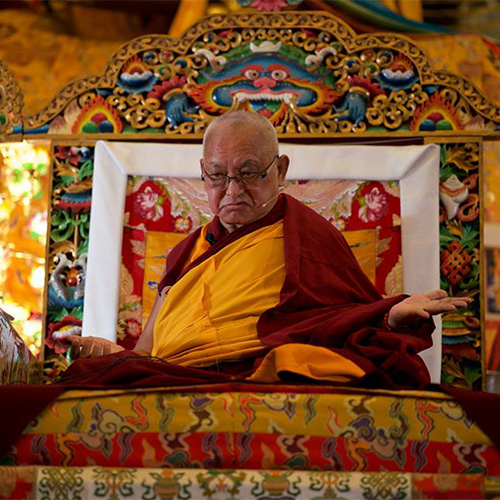
Photo: Bill Kane, Kopan Monastery, Nepal, 2016
There are quite a lot of things that come from the Sutra of Clouds of Sublime Rare Ones (Do De Könchog Trin[1]). The “sublime rare ones” are the Buddha, Dharma, and Sangha. Some [bodhichitta mindfulness practices] are not mentioned there, so I added them.
The sutra explains that in the morning when one wakes up, the very first thing to do when one wakes up from sleep is to think, “May all sentient beings achieve the dharmakaya.” The minute you wake up, you should think that. Maybe the eyes are still closed, the mind woke up but the eyes are still closed – I’m joking – remember that.
Then when you get dressed, think, “May all sentient beings wear the dress of shyness and shame.” By one’s own reasoning, there is shyness, ngö tsa, shy. The other is shame. Do you have another word?
Student: Consideration.
Rinpoche: Consideration. That is right. Shy and shame, I’m not sure. The reason [to cultivate shyness] is because then you, generally, are protected from negative actions. The reason is because, without shyness, you have to suffer and cannot achieve realizations if you engage in negative actions. For example, you took the bodhisattva vow. You made the vow in front of Buddha, Dharma, Sangha, and sentient beings, so if one breaks it, one becomes shameless, careless of other sentient beings. So, because of others, you practice.
Then again, from the sutra, when you get dressed, “May sentient beings wear the dress of shyness and shame.”
When you put on a belt, think, “May sentient beings’ minds be bound by the three higher trainings.” These are the higher trainings of morality, concentration, and special insight. Because that is what is said in sutra, when you release a belt, think, “May sentient beings be freed from the bondage of karma and delusions.”
When you lay down to go to bed, “May sentient beings achieve the dharmakaya.” Then the same thing when you see a stupa. When you see a stupa or other holy object, think, “May all sentient beings achieve the dharmakaya.” When you see a holy object such as a Buddha statue, “May all sentient beings achieve enlightenment quickly.” You can dedicate like that.
When you stand up, think, “May all sentient beings rise up from the oceans of samsaric sufferings.” When you get up from bed in the morning, you can also think that. Every time you get up, you can think the same thing. This is what to think with mindfulness.
It says in the Dö De Könchog Trin, this sutra explained by Buddha, that when you offer incense, think, “May all sentient beings’ stains of being wicked in nature be eliminated. May they have the scented smell of morality.” Dedicate like this for sentient beings. “May they live in pure morality,” something like that.
When you clean, in the sutra it is mentioned to think, “May all sentient beings not engage in bad conduct. May they have perfect, beautiful, wonderful conduct.” That is what the Könchog Trin mentions that Buddha says to think when you clean, when you wipe off the dust or clean the floor. Here, in the Dö De Könchog Trin everything is related to bodhichitta; everything is dedicated to sentient beings. So, when you wipe the floor, you are cleaning sentient beings’ disturbing thought obscurations.
It is also said in the Könchhog Trin that when you eat food, then you dedicate that all sentient beings not have delusions. There are six root delusions and twenty secondary delusions, you dedicate for sentient beings to not have the root delusions and secondary delusions. That is what it says, just that.
When you enter a temple, every time you enter inside, you should think that you are bringing all sentient beings into the city of liberation. That can also mean to enlightenment, great liberation. Think that you are bringing them there. Here everything is related to sentient beings. You are bringing them inside the city of the sorrowless state. You can also pray, “May they enter the city of liberation.”
Then, when you go out, think that you are bringing sentient beings out of the prison of samsara; you are liberating them. Visualize that and also pray for that.
When you open the door of a house, think that you are opening the door of transcendental wisdom gone beyond the world, beyond samsara. That is the mindfulness to practice.
When you close a door, think, “I am closing the door of samsara for sentient beings.” Think that and pray, “May this happen.”
Every time you sit down, think that you are bringing sentient beings to the heart of enlightenment. Generate that thought every time you sit down.
Every time you do washing, when you clean your teeth, when washing your body, when washing pots, anytime when washing, think, “I am washing all the stains of delusions of sentient beings.” Every time think that. That is what to think when you do washing, as explained in the Do De Könchog Trin. You are washing away all the obscurations of all sentient beings. When you clean a room with a vacuum or broom, think that [the vacuum or broom] is the antidote to the obscurations. It is the path of wisdom, the whole path from guru devotion up to enlightenment. Also, similarly, think that your toothbrush is the complete path to enlightenment and that with it you are cleaning the obscurations of sentient beings. It is the same when washing clothes, and also in the kitchen when washing pots. Think that the water is the path to enlightenment and you are cleaning sentient beings’ minds.
Then, if you are making a fire with wood, think that all sentient beings’ delusions are burned away by the fire of transcendental wisdom. Like this, whatever you are doing always dedicate it to sentient beings.
The Könchog Trin says that when you lie down, put your right hip on the bed and generate bodhichitta to bring all sentient beings into the sorrowless state. The sorrowless state is liberation; the great sorrowless state is enlightenment, which is what the buddhas achieve.
When you are making food in the kitchen, whatever you are cutting [chopping] – vegetables, meat, onions, whatever – practice the mindfulness that you are cutting all sentient beings’ ignorance and delusions with the knife or sword of the wisdom realizing emptiness. You are cutting sentient beings’ ignorance and delusions. You can also think, when you are cutting food, that the food is sentient beings’ delusions and the knife is wisdom, the path. Or the food is sentient beings’ self-cherishing thought and the sword is bodhichitta. Or you are cutting the root of samsara, self-grasping, by the wisdom realizing emptiness.
Before going to bed, what Lama Tsongkhapa did is that he would recite the Thirty-five Buddhas’ names thirty-five times with prostrations. The normal advice in the lam-rim is to examine the day from the morning time. You go through every action you did. However many actions became virtue, then you rejoice in those. And however many actions became non-virtue, you generate regret and purify them before falling asleep. Lama Tsongkhapa did the Thirty-five Buddhas’ prayer and recited the names thirty-five times with prostrations. That makes one very happy that one is a monk who is completely pure and so then one can go to sleep very happily. That is mentioned by Kachen Yeshe Gyältsen in his lamrim teachings.
The best one, even if one cannot do a long version of a self-initiation, is to do a middle or short one, or even the long one. If you have done retreat, that is the best one to do before going to bed. Or do Vajrasattva with the four opponent powers and then go to sleep with a very happy mind. That is how to make life meaningful, the happiest. It is like that.
Download a booklet with condensed versions of these bodhichitta mindfulness practices.